

- Resources
Innovative Thinking


A website does not hold one position per country, so whether you rank in Google Malaysia is decided for each searcher rather than once nationally. The question worth asking is whether your pages carry anything that marks them as serving Malaysia. On a .com site with no Malaysian address, no ringgit anywhere and a Singapore office in the footer, usually nothing does.
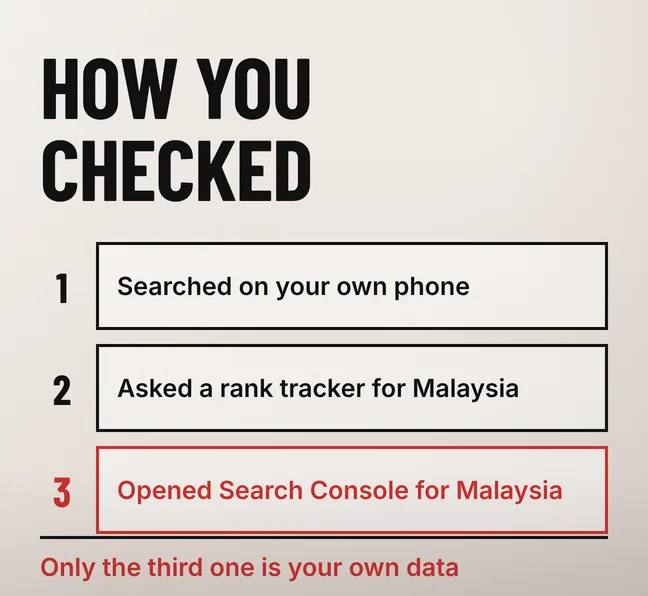
Most owners are also looking at the wrong evidence. A search on your own phone, a screenshot from a Singapore-based developer or a rank tracker pointed at the wrong location can each raise the same alarm with nothing behind it. Settle what is happening before changing a domain or adding tags to the template.
Google Search Console answers this and nothing else does. Its Performance report filters impressions and clicks by country, so set Country to Malaysia and read the queries that already bring Malaysian visitors. That is your own measured data, and it often shows the site surfacing for the brand name and little else.
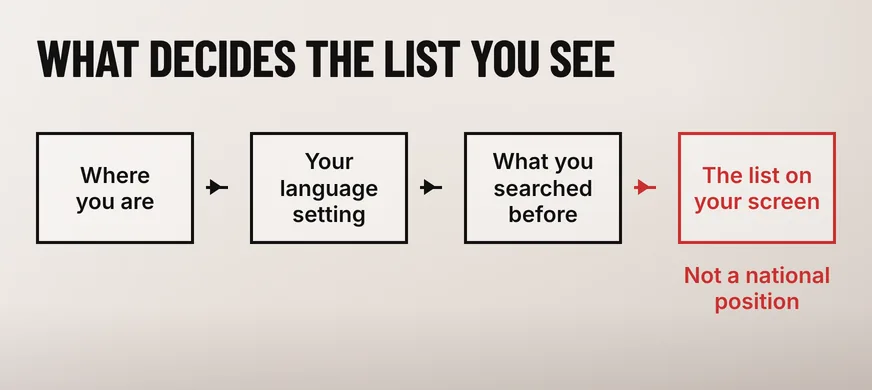
Searching for yourself proves very little, because Google shapes the result list around where the searcher is, their browser language and what they have looked at before. A phone that has searched the company name twenty times this month is the least reliable instrument in the building, and a rank tracker reports on whichever location it was told to use.
Separate two findings that feel identical. A site with Malaysian impressions and no clicks has a relevance or a listing problem; a site with no Malaysian impressions at all has not been judged relevant to those queries in the first place. Only the second one is the country question.
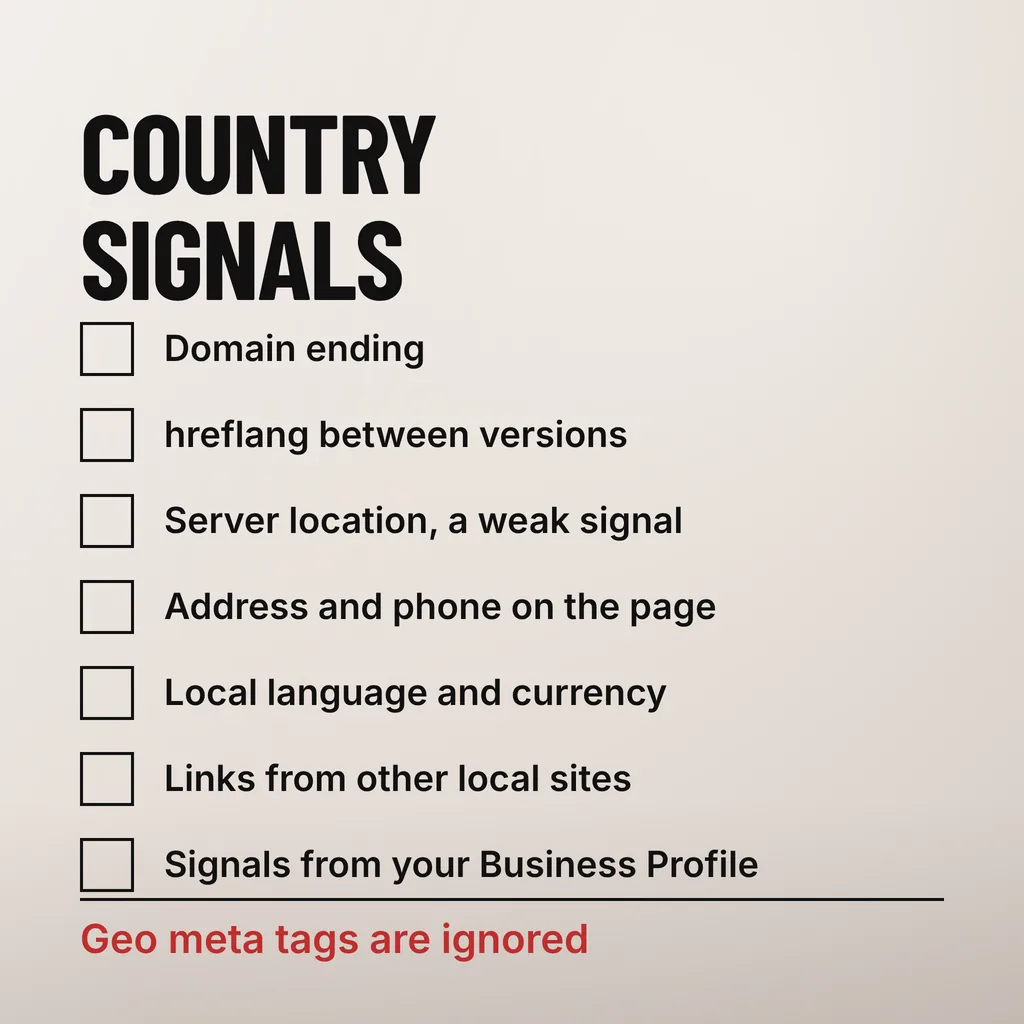
Google names them. Its guidance on managing multi-regional and multilingual sites lists country-code top-level domain names, hreflang statements, server location, and a group it calls other signals: “local addresses and phone numbers on the pages”, “the use of local language and currency”, “links from other local sites” and “signals from your Business Profile”.
Server location matters less than its reputation suggests. Google says it “can be a signal about your site’s intended audience”, then immediately that it “is not a definitive signal”, because many sites “use distributed content delivery networks”. Moving a Malaysian company’s hosting from Singapore to Kuala Lumpur is a latency decision rather than a ranking one.
The rest of that list is page content, and on sites that surfaced in the wrong country it is usually absent or still pointing abroad: a +65 number in the footer, prices in dollars, a contact page with no street address.
Two tags are worth deleting while you are in the template. Google states that it “ignores locational meta tags (like geo.position or distribution) or geotargeting HTML attributes”, so any audit still listing them as a fix is out of date.
A Malaysian domain ending is the clearest country signal available and the most expensive way to get one. Google calls it “clear geotargeting” and says it makes “server location irrelevant”, while also listing it as “expensive (can have limited availability)” and able to “only target a single country”. For a business selling in one market, that last line is a feature.
Google sets out four URL structures with their trade-offs, and the choice matters most to sites serving several countries at once:
| Structure | Example | Google’s advantages | Google’s drawbacks |
|---|---|---|---|
| Country-specific domain | example.my | Clear geotargeting; server location irrelevant | Expensive, with limited availability; more infrastructure; one country only |
| Subdomain | my.example.com | Easy to set up; allows different server locations | Users might not recognise the geotargeting from the URL |
| Subdirectory | example.com/my/ | Easy to set up; low maintenance on one host | Single server location; separation harder |
| URL parameter | example.com?loc=my | — | Not recommended by Google |
Do not reach for the domain first. Changing the address of a working site is a site move, with redirects, rebuilt links and a recovery period, and it is the heaviest item on a list whose cheapest entries are usually untouched. If you already own the .com.my and it merely redirects to the .com, the signal is being spent on nothing.
Only if you have more than one version of the page for it to choose between. The hreflang annotation tells Google which existing variant suits which audience; it does not make a single English page more relevant to Malaysia. A business with one page per topic has nothing for hreflang to do, and adding it changes nothing.
The rules are strict. Google’s reference on localized versions of your pages requires that “each language version must list itself”, warns that “if two pages don’t both point to each other, the tags will be ignored”, and accepts “only language codes listed in ISO 639-1 and region codes listed in ISO 3166-1 Alpha 2”. A region code alone is not valid, and invented codes such as EU or UK have no effect.
Two details catch sites that have built the pages correctly. The reserved x-default value “is used when no other language/region matches the user’s browser setting”, so en-MY and en-SG alone leave every other visitor to an arbitrary pick. A subdomain named en-my is also only a name: Google says such names “are not used” to determine the target audience.
English and Malay on one site is a different question from Malaysia and Singapore. If your site serves two languages rather than two countries, how a Malaysian business website should handle two languages is the decision to make first.
Work from the cheapest signal to the most expensive and measure after each one. The first three items below are page content or a free listing, and between them they cover most of what Google says it reads. The domain comes last because it is the only one that cannot be undone in an afternoon.
Give it weeks. New signals have to be crawled and the queries re-evaluated, so compare the Malaysian country filter in Search Console month over month and ignore what your own phone shows in the meantime.
Barely, on its own. Google says the server location “can be a signal about your site’s intended audience” but qualifies immediately that it “is not a definitive signal”, because content delivery networks serve sites from everywhere. Malaysian and Singaporean hosting are close enough that the latency difference is small for visitors here, so treat it as a hosting decision rather than an SEO one.
Yes, and most pages should. Google builds a result list per searcher rather than one ranking per country, and its documentation describes returning the appropriate version “for the user, according to their browser settings”. A single page with a Malaysian address, ringgit pricing and local links can still be the best answer for a Singaporean searcher. Separate versions are only needed when the content genuinely differs.
Only when something real changes between them. Google accepts a same-language regional split as legitimate, citing “English-language content targeted to the US, GB, and Ireland”, but two near-identical pages compete with each other and double the maintenance. If the difference is a currency symbol, keep one page. If it is pricing, shipping, tax or licensing, build both and connect them with hreflang and a canonical.
A site that surfaces in the wrong country is usually one built without an audience in mind, and the fix is spread across the footer, the contact page, the pricing and the listings rather than sitting in one setting. Our SEO service starts from the Search Console country data rather than a tool’s guess. One thing to do today: filter the Performance report to Malaysia and look at how many queries are anything other than your company name.