
- Resources
Innovative Thinking


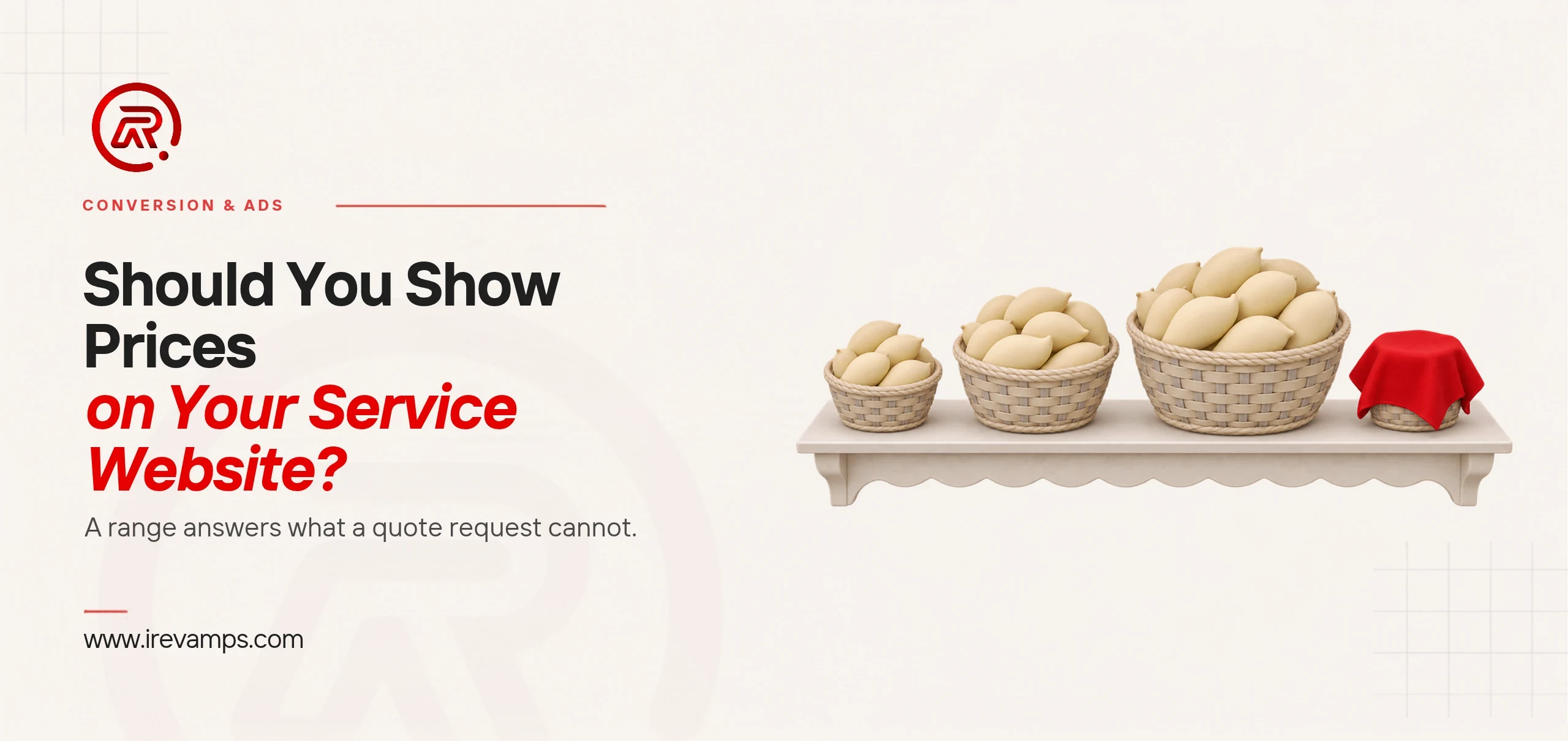
Publish a range tied to its drivers, and keep the package price off the page. For most service businesses the decision to show prices on website pages is a trade of volume for fit: fewer messages arrive, and the ones that do already know roughly what the work costs. The enquiries you lose are mostly the ones that were going to end at the quote anyway.
The exceptions are narrower than most owners expect. Work priced off a site survey, tendered supply and jobs whose cost moves with the ringgit all justify holding back the final figure. Almost none of them justifies holding back a magnitude.
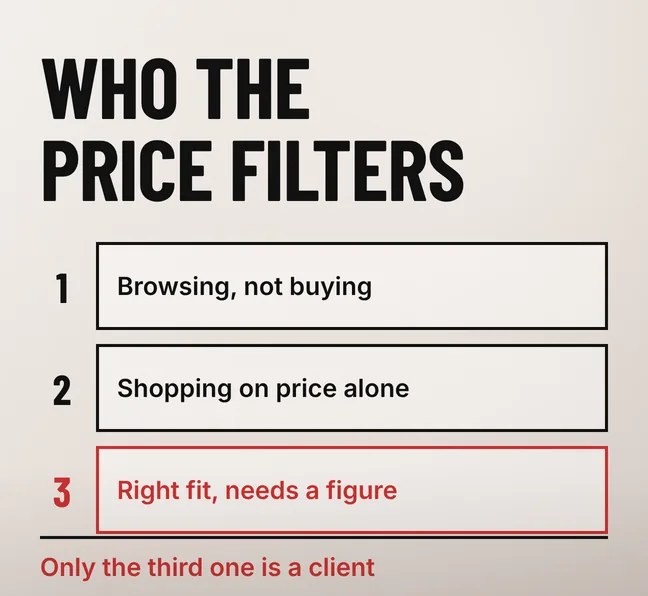
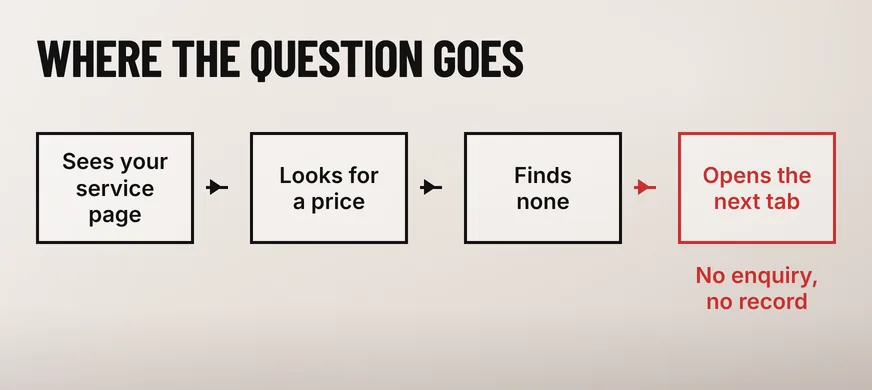
Enquiry volume usually falls and enquiry quality rises, because the people who drop out are the ones who would have dropped out after reading your quote. The cost you can see is the message that never arrives. The cost you cannot see is the buyer comparing three suppliers, finding a figure on two of them, and never mentioning you again.
Nielsen Norman Group watched that second one happen. Its study of business buyers, written up in 2013 as State the Price to Give B2B Sites a Competitive Advantage, reports that “business customers report pricing as the top most needed piece of information online”, and that in testing “we watch participants go to competitors’ sites when websites do not show prices”. It is blunt about how the silence reads, too: “People view companies that hide costs as being evasive and untrustworthy.”
In Malaysia the journey is usually even shorter, because the comparison happens on a phone with three tabs open and WhatsApp as the fallback. A buyer who finds no figure does not always leave; sometimes they send “how much?” and start judging you on reply speed instead, which is a worse conversation than the one your page could have had for you.
If your enquiries have gone quiet rather than got worse, the pricing page is one suspect among several. Why a website with visitors generates no enquiries covers the rest.
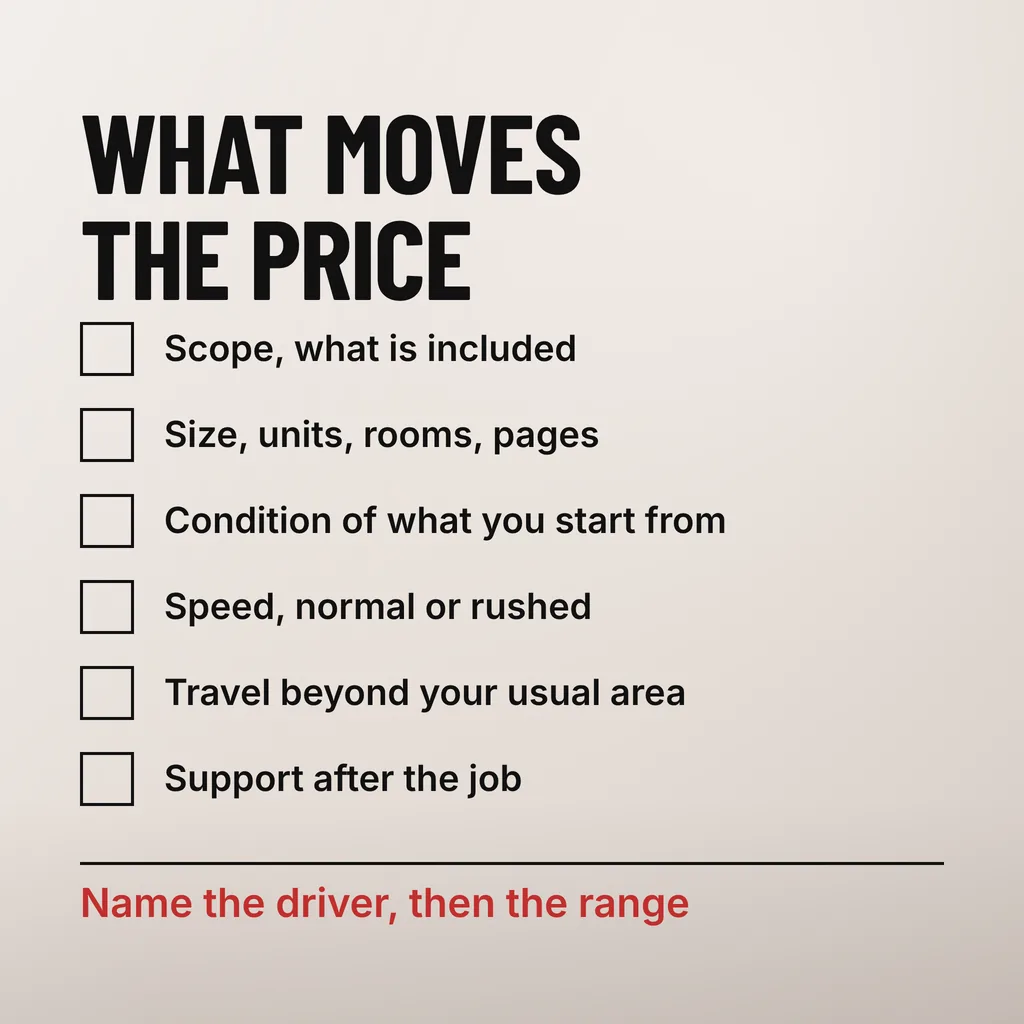
Name the driver, then the span it moves across. A price driver is whatever about the job changes the number — size, condition, speed, how much is custom — and a range attached to a driver lets a buyer work out which end of it they sit at. A package price does the opposite, inviting a comparison against someone else’s differently built package.
Most service work has three or four drivers that do nearly all of the moving. Write them down, put a span against each, and say plainly what sits outside the figure:
| Driver | What it changes | How to put it on the page |
|---|---|---|
| Scope | How much of the job is yours and how much the client keeps | State what is included, and list what is quoted separately |
| Size | Units, rooms, pages, branches, headcount | A rate per unit, with the volume where the rate drops |
| Condition | How much of the existing setup can be kept | Two bands: sound to start with, or needs stripping back |
| Speed | Normal lead time against a compressed one | An openly stated rush premium rather than a surprise |
| Travel | Klang Valley against Johor, Penang or East Malaysia | A radius included, a published rate beyond it |
| After the job | Support, maintenance, warranty length | Priced monthly or annually, separate from the main figure |
Two things keep a range honest. Put the floor where you would genuinely take the work rather than where it looks attractive, because a floor you will not honour turns into an awkward phone call. And revisit it when your own costs move: a range left untouched for two years becomes a quote you lose money on.
Yes, where the scope is genuinely unknown until somebody looks: structural repair, litigation, tendered supply, anything priced from a site survey. Quote-only fails when it is used to avoid the conversation rather than because the number truly cannot be estimated, and that is the more common reason by far.
The test is whether you could answer “roughly how much?” on the phone. If a caller asked and you would give a figure inside thirty seconds, that figure belongs on the page. If you would honestly need to see the premises first, say exactly that on the page, and say what the survey costs and whether it comes off the final bill.
Where the price moves with something outside your control — steel, freight, the ringgit against the dollar — publish the range and date it. A page reading “rates reviewed January 2026” is defensible when you revise it in March. A page with no figure and no explanation is not defending anything.
On its own pricing page, linked from the main menu rather than the footer, with the starting figure repeated on each service page it applies to. Completeness matters more than placement: the figure a visitor reads first should be the figure they end up paying, with tax, deposit and any recurring fee named in the same place.
The damage done by an incomplete price is measured, though not on service sites. Baymard Institute’s cart-abandonment research, on a page updated in October 2026, reports that 40% of abandoning US online shoppers gave “extra costs too high (shipping, tax, fees)” as their reason, with a further 12% citing a total cost that was not visible up front. Those are retail baskets rather than service quotes, and the parallel is ours rather than Baymard’s: what costs you the job is the number changing after the buyer has committed to the process.
So put the conditions where the price is, not in a document sent four days later. Whether service tax is added on top, whether the figure quoted is a deposit or the whole job, what a mid-job change to the scope costs. A price that grows between the page and the invoice spends more trust than never having published one.
Pricing also sits alongside everything else a visitor checks before making contact. What visitors notice before they contact you covers the rest of that list.
Publish the floor and the method. A floor price with a plain description of how you reach the final number gives a buyer enough to place themselves, which is the whole job the pricing page is doing. Four lines usually cover it, and none of them commits you to a figure you cannot hold.
Add a budget band to the enquiry form while you are in there, with four or five options and no free-text box. It lets the enquirer answer the question your page did not, before you pick up the phone.
Some of them, and those are mostly the ones you want filtered out before they reach your inbox. Nielsen Norman Group’s testing found business buyers leaving sites without prices for competitors that had them, so silence loses people too — it just loses them invisibly, with no enquiry to count. Expect fewer messages, and fewer of them going nowhere.
They can find out anyway. A competitor who wants your pricing requests a quote under another name, and the ones who care have usually done it already. What publishing changes is who else sees the figure: buyers comparing suppliers, who otherwise shortlist whoever gave them a number. If yours is the higher price, the page is where you get to explain what the difference buys.
A separate pricing page, with the starting figure repeated on the service pages it applies to. The pricing page earns its own searches and gives you room for the drivers, the exclusions and the terms; the homepage only needs the magnitude and a link to it. Keep that link in the main menu, because somebody hunting for a price looks there first.
A pricing page is a conversion decision rather than a design one: it changes who contacts you more than it changes how the site looks. Our digital marketing and ads service starts from what the enquiries you already receive are worth, because a page that brings fewer and better-qualified enquiries changes what a click is worth paying for. One thing to do this week: write down the three drivers that genuinely move your quotes, and put a span against each of them.