

- Resources
Innovative Thinking



Website revamp approval belongs to one named person who can decide on budget, content and brand without checking upstairs. Everyone else reviews. When a revamp sits untouched for six weeks, the design is rarely the reason: four people commented, none of them was told they owned the decision, and the agency is waiting to find out which comment to follow.
The shape of it is familiar in a Malaysian SME. Feedback arrives in a WhatsApp group from the owner, the sales manager and a cousin who studied design, two of the comments contradict each other, and the one person who could settle it is travelling until Thursday. Three decisions taken before any design work starts prevent most of it.
Final sign-off should rest with one person who can commit the budget, release the content and overrule a department without asking anyone else. In most Malaysian SMEs that is the owner or the managing director. In a larger company it is the marketing or digital lead, given that authority in writing before the project starts.
The UK Government Digital Service sets the same requirement for its own service teams in a single line. Its guidance on what each role does in a service team states that “your service owner must have the decision-making authority to deliver on all aspects of a project”, and hands that same person the job of making sure “the necessary project and approval processes are followed”.
Authority is specific, and a job title is not evidence of it. Your approver has to be able to sign off copy that quotes a price range, retire a page the sales team is fond of, and release photographs that nobody wants to reshoot. Someone who has to ask a director about any of those is a reviewer with a senior title.
Most of what the approver will be asked to decide should already be settled before the design starts. That is what the website revamp brief is for, and decisions made there cost an email rather than a round of rework.
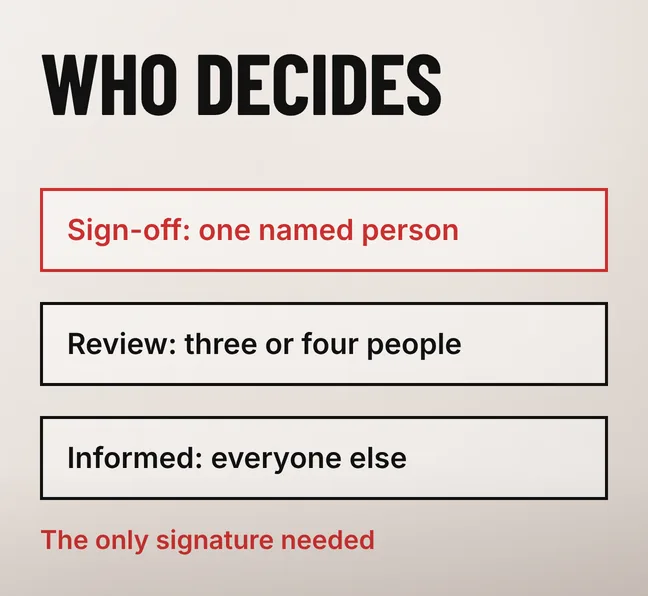
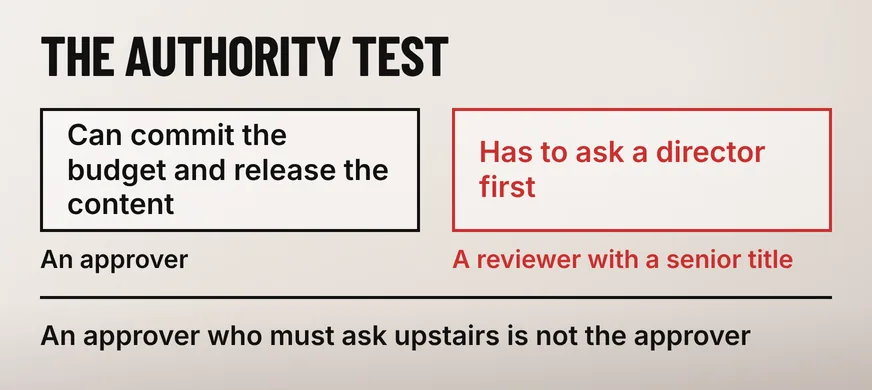
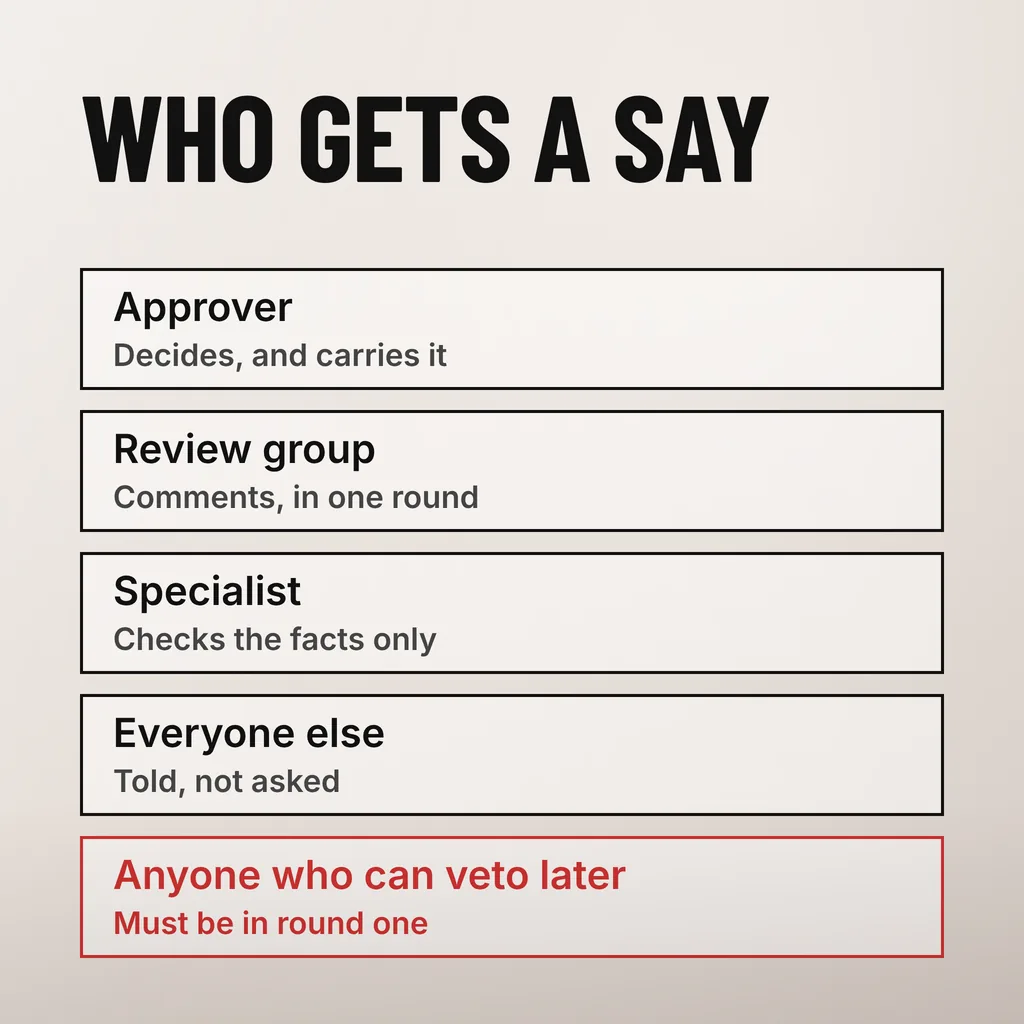
An approver decides that the work can proceed and carries the consequences of it. A reviewer’s comments are read, weighed, and sometimes declined with a reason given. Mixing the two produces a revamp where eight people believe they hold a veto, and the project moves only on the days all eight happen to agree.
Nielsen Norman Group draws the same line between a working session and an approval gate. Its guide to running design critiques, published in 2016, describes a critique as a gathering with “the sole purpose of improving a particular piece of work”, while a design review is the meeting held “in order to gain approval and move forward”. It also tells the facilitator to “purposefully choose the people who will participate in the critique” and sums the register up as “conversation rather than command”.
Choosing the reviewers on purpose is the part most companies skip, and an open invitation is how a design round collects nine opinions. Keep the group to three or four people who each hold something the approver does not: whoever writes the words, whoever answers the enquiries, whoever knows what the system can do. A seat given to a department to keep the peace costs a round.
Three rounds covers most small-business revamps: one on structure and content, one on design, one technical check before launch. Each round gets a single deadline, one collected list of comments and a written close. Open-ended feedback is what turns a six-week revamp into a five-month one, and no number of reminders fixes it.
| Round | What it decides | Who is in it | What closes it |
|---|---|---|---|
| 1. Structure and content | The page list, what each page has to say, what gets retired | Approver and whoever owns the words | An agreed page list and final copy for the main pages |
| 2. Design | The look of the key templates, not every page individually | Approver and the review group | The approver signs off the templates in writing |
| 3. Technical check | Forms, tracking, redirects and speed on a mid-range phone | Approver and the developer | A confirmed launch date |
Three rounds is a practitioner convention rather than a standard, and it matches where decisions actually change: the page list, the look, and what breaks on launch. Put a calendar date on each one. Five working days per round is a sensible starting point for a small team, and that review time is part of how long a website revamp takes rather than dead time between the agency’s tasks.
Collect every comment in one place and have the approver settle the conflicts before anything reaches the designer. One channel, one list, one decision. Nobody should hand a developer two instructions that cannot both be followed and leave them guessing which director to believe.
A WhatsApp group is the wrong channel for this, and it is the usual choice because it is already open. Comments arrive without the page they refer to, they scroll away, and the thread keeps no record of what was decided. A shared document listing one row per page, or the comment tool the agency already provides, gives every note a location and a status.
The approver then marks each item accepted, declined or deferred, and a declined item needs a one-line reason. Without it the comment returns in the next round wearing different words, which is how a design round repeats itself and nobody can say why.
An overrule after sign-off is a change request with a cost and a revised launch date, not a free revision. Work that was approved and built has already been paid for in time, and unpicking it is new work. Say that out loud when it happens, because a revamp where approvals can be reopened silently has no approvals at all.
The preventive fix is to put anyone senior enough to overrule the approver into round one, where their objection is cheap. If the overrule is about brand, pricing or a claim the business cannot keep, the person who signed it off did not hold the authority the project needed, and the thing to repair is the authority rather than the design.
We have not measured how often this happens across projects, so treat the ordering as judgement rather than data. The cost pattern is plain enough: an objection raised at the page-list stage changes a sentence, and the same objection raised after the templates are built changes a fortnight.
Name a deputy with the same authority before the project starts, and agree in writing what happens when neither of them replies by a round’s deadline. Long leave, travel and the weeks around Hari Raya and Chinese New Year are all predictable, so they belong in the schedule rather than in an apology three weeks later.
Those four cost one conversation at the start of the project. Without them a revamp can reach three quarters finished and stop there, with a folder of unresolved comments and nobody willing to say yes.
Usually not. A management team reviews well and decides badly, because nobody in the room carries the consequence on their own. Give one member the sign-off, invite the others into the design round as reviewers, and let the approver settle the disagreements. A revamp approved by consensus tends to end up as the version nobody objects to, which is rarely the version that brings in enquiries.
Whoever can confirm the facts and accept the claims. Marketing usually drafts, and the owner has to approve anything about prices, capacity, certifications or delivery times, because those are commitments the business then has to keep. In a small company both roles sit with one person, which is faster and carries one risk: copy going live without a second reader.
Yes, and an email is enough. Close each round with a short note saying what was approved, what was declined and what is deferred. Without it, a disagreement in month three turns into a question of whose memory is better, and the agency has no defence against redoing work it was told to stop.
We ask for one approver and one deputy by name before design work starts, and close each round in writing so nobody has to reconstruct a decision from a chat thread later. Our website revamp service treats that review structure as part of the project rather than something the client is left to invent. One thing to do this week: write down who signs off your next website change, and send it to the two people most likely to disagree.