


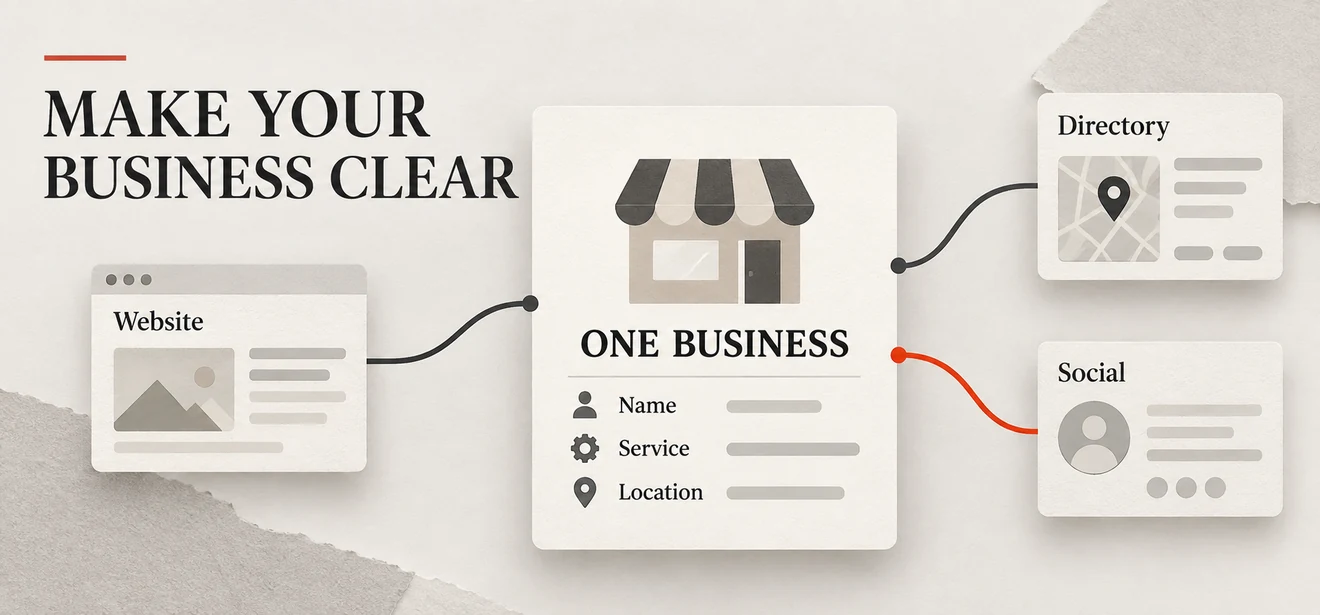
Type your company name into ChatGPT and ask what the business does. The answer arrives in the same confident tone whether it is right, half right, or about a different company altogether. That gap is what entity SEO for small business is about: not ranking for a phrase, but making sure anything reading about you can work out who you are, what you sell and where you do it.
The work is less technical than it sounds. Google describes its own Organization markup as a way to disambiguate your organization in search results — disambiguate, not promote. An assistant that cannot tell you apart from a similarly named business does not guess carefully. It guesses fluently, and a fluent wrong answer is harder to spot than a blank one.
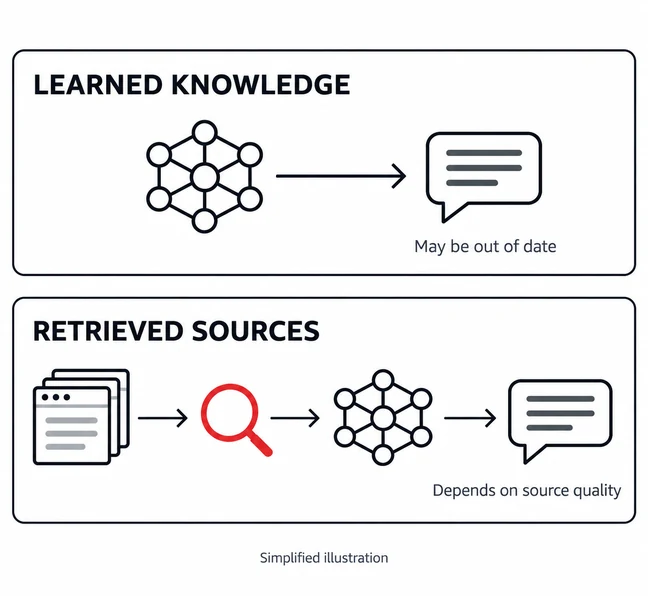
There are two different machines behind that answer, and they fail differently.
The first is the model itself. OpenAI runs a crawler called GPTBot, which it says is “used to make our generative AI foundation models more useful and safe”. Anything absorbed that way is memory: no source, no date, and no way for you to correct it. If your business was never written about much, there is little to remember, and the gap gets filled with something plausible about a company with a similar name.
The second is retrieval. A separate crawler, OAI-SearchBot, is “used to surface websites in search results in ChatGPT’s search features”, and a third agent, ChatGPT-User, fetches a page when something you asked for requires it. When the assistant retrieves rather than recalls, it reads whatever it finds about you today: your own pages, a directory entry, a social profile nobody has touched since 2019.
You cannot edit the model’s memory. You can decide what a retrieval finds, and whether those sources agree with each other. That is the job.
An entity is the business itself, as distinct from the words people use for it. “Ah Seng Aircond”, “Ah Seng Air Conditioning Sdn Bhd”, the Facebook page and the domain are all strings, and they should all resolve to one thing. When they do not, a machine has to choose, on the balance of what it found.
The schema.org vocabulary has a property for exactly this. Its definition of sameAs is “URL of a reference Web page that unambiguously indicates the item’s identity. E.g. the URL of the item’s Wikipedia page, Wikidata entry, or official website.” In plain terms: you point at the other places that are also you, so nothing has to infer it.
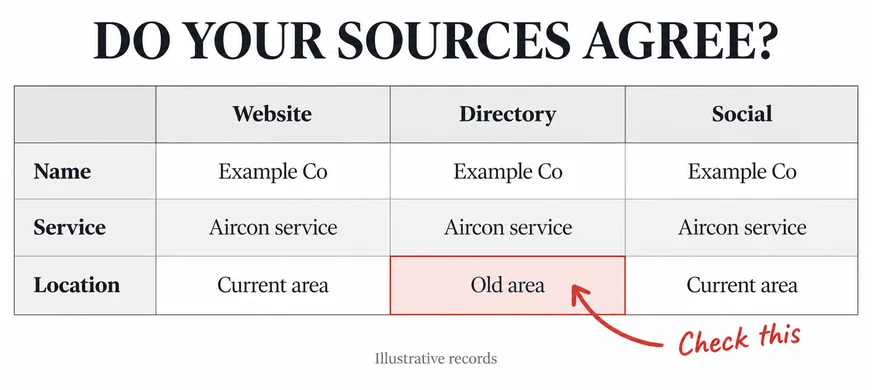
Identity goes wrong in three ways, and each needs a different fix. Unknown: too little about you anywhere to say anything. Confused: your details merged with a business that shares part of your name. Stale: a confident answer about the business you were four years ago. Most sites we are shown are stale or confused rather than unknown.
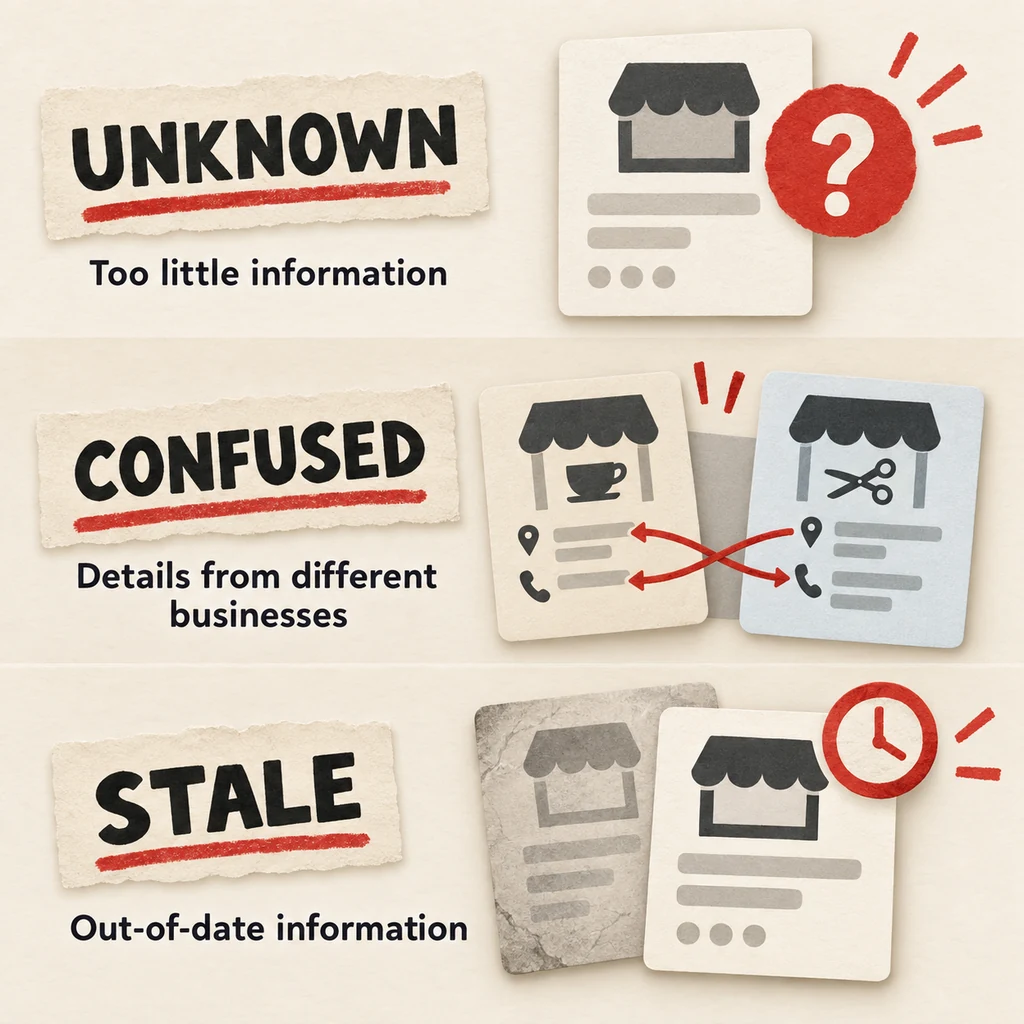
That middle one overlaps with ordinary page writing. If your service pages already answer the questions customers actually ask, most of it is done: the answer is already sitting in prose.
These are the contradictions we find most often.
None of this needs a new website, and it pays off twice: our piece on the trust signals visitors check in the first ten seconds makes the point that a name, address and phone number written identically everywhere is itself a credibility cue. Customers and crawlers read the same footer.
Organization markup is a block of machine-readable facts about the business, published once for the whole site rather than per page. Almost every WordPress SEO plugin emits it already, usually half filled in.
Google is unusually relaxed about the detail. Its guidance states that there are no required properties and suggests concentrating on the name, an indication of real-world presence such as an address or telephone number, and of online presence such as a URL or logo. Add sameAs entries for the profiles that are genuinely yours and you have stated what a machine would otherwise have to deduce.
What it does not do is worth saying plainly, because it is often sold as more. Markup is a statement, not evidence: it does not make a claim true, and will not produce a knowledge panel on request. Nor is it a key to AI search — OpenAI documents what its crawlers are for without presenting structured data as an input to ChatGPT’s answers. Write the facts in readable sentences as well as in markup.
The real value is quieter. Filling it in properly forces somebody to decide, once, what the canonical name and address are. That decision is the deliverable; the markup is where you write it down.
Ten minutes, and it tells you which of the three failures you actually have.
sameAs entries for the profiles you control. A wrong block is worse than an empty one.Run the first step again in a month rather than the same afternoon. Retrieval reflects changes reasonably quickly; a model’s memory does not.
For most small businesses, no. The bulk of it is deciding on one canonical set of facts and making every page and profile match — an afternoon of attention rather than a retainer. What is worth paying for is the audit that finds the contradictions.
Not on its own, and nobody can promise one. A panel appears when Google is confident enough about an entity to assert facts about it, and that confidence comes from independent sources corroborating each other. Markup removes ambiguity; it does not supply the corroboration.
This is the best moment to do it, because there are no contradictions to unpick yet. Settle the name, the address and the service wording now, before a directory listing, an invoice template and a social profile each record them in a different form.
Nearly every case we see is a tidying job rather than a rebuild: one name chosen, a handful of profiles corrected, service pages renamed into words people use, and the organisation block filled in once and properly. Our SEO work starts by asking an assistant about the business and writing down exactly how the answer is wrong, because that says which contradiction to fix first. If the answer you got was about somebody else, that is the useful place to begin.