
- Resources
Innovative Thinking


Prepare the website content before revamp work begins, and start with the part nobody outside the business can supply: what each service includes and excludes, the price or the drivers behind it, the lead times you can honour, your registered name and registration number, original photographs, proof that the work was done, and the answers you already type into WhatsApp every week. A designer can draw a page around placeholder text. Nobody can approve one.
Most of it already exists, scattered across quotations, a job sheet, a phone gallery and a folder of certificates. Start the day the project is agreed, because the collecting is what runs late and the writing is the short part at the end of it.
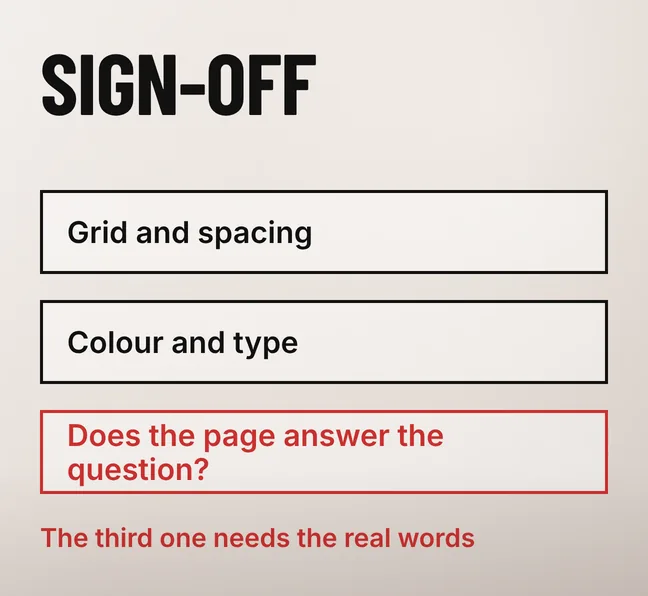
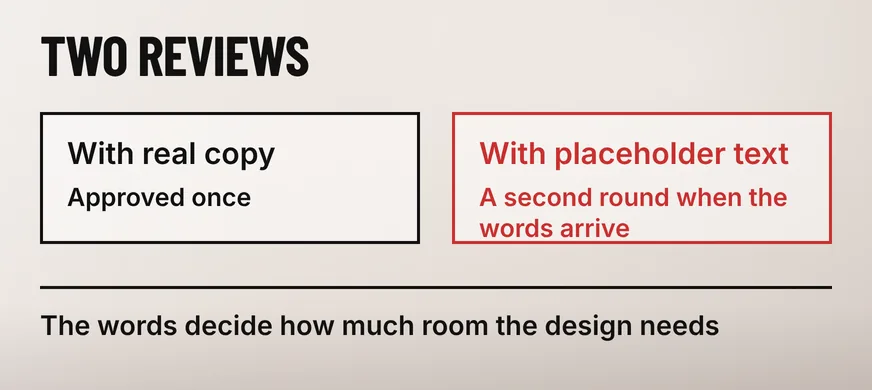
Because a layout can be drawn from placeholder text but cannot be approved from it. Until the real headline, the real service list and the real prices exist, every decision about length, order and hierarchy is provisional, and the same page gets redrawn when the words arrive and turn out to be twice as long.
A design review with Lorem ipsum in it tests the wrong thing. Everyone judges the shape of the page, nobody judges whether it answers the question a buyer arrives with, and the version approved is the one that fits the dummy text. Two weeks later the real copy lands, the three-column feature row has five features to carry, and the page comes back.
We have not measured how often content is what delays a revamp, so read that as reasoning rather than a figure. The dependency runs one way: the copy decides how much room the design needs, which is why deciding what to keep from the old site belongs before the first layout.
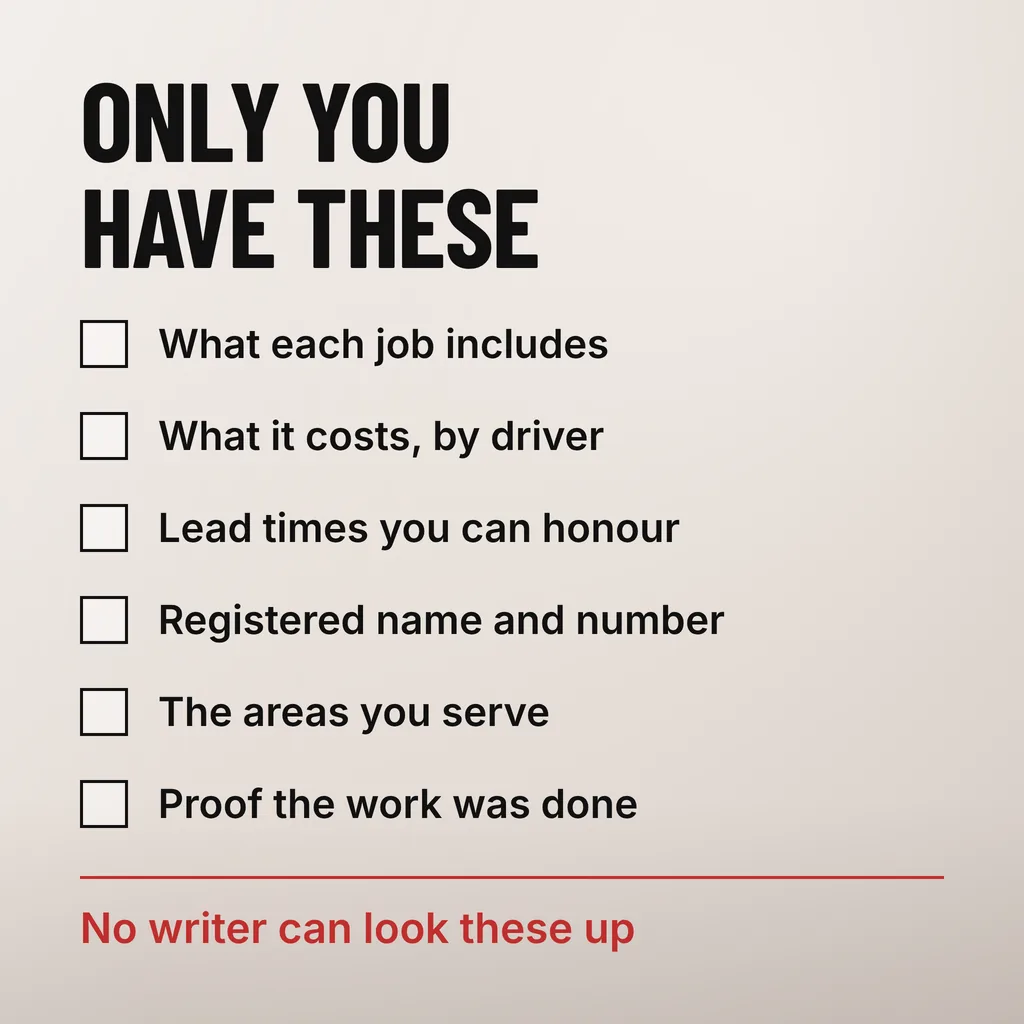
The parts no writer can look up. What a job includes and excludes, your real lead times, the minimum order you will accept, the areas you actually serve, your registered name and registration number, and the proof that the work was done. A copywriter can shape all of it and invent none of it.
| What to prepare | What it decides on the page | Where it already exists |
|---|---|---|
| Each service, item by item, including exclusions | Whether the page answers “is that included?” without an enquiry | Your quotations and invoices |
| The price, or the two or three drivers that move it | Whether a buyer gets a magnitude or another contact form | Your last twenty quotes |
| Lead times, and the capacity behind them | The honest answer to “how soon can you start?” | Your job sheet or booking calendar |
| Registered name, number and address | The footer, and compliance with the Companies Act | Your SSM documents |
| The districts or states you actually serve | Whether a location page describes real coverage | Your delivery and site-visit records |
| Proof: finished work, certificates, memberships, reviews | Whether a stranger believes the rest of the page | Your own files, and clients who said yes |
One of those rows is not a matter of preference. Section 30(2)(b) of the Companies Act 2016 requires a registered company to display its name and registration number, and the Companies Commission of Malaysia issued notices on 1 November 2023 covering company websites and social media pages. The Malaysian Institute of Chartered Secretaries and Administrators, relaying that notice, puts the penalty at RM50,000 or three years’ imprisonment, or both.
The price row is the one owners resist most, and it needs no published package. Read your last twenty quotations, find the two or three things that actually moved the number — size, material, distance, deadline — and write a range against each. The buyer gets a magnitude; you have quoted no package price.
Less than most owners fear, and far more specific. Jakob Nielsen measured for Nielsen Norman Group in 2008 that “users will read about 20% of the text on the average page”, so the work is to put the answer in the first two lines of every page rather than to reach a word count.
That study, How Little Do Users Read?, puts the ceiling lower: readers “have time to read at most 28% of the words during an average visit”, and get through half a page’s information only when it runs to “111 words or less”. It is 2008 desktop data we have not re-measured on Malaysian mobile traffic, so treat it as an order of magnitude.
So each page needs three things prepared, not an essay: one sentence answering the question the page is for, three to six specifics that prove it, and one next step. A page whose answer nobody can write in one sentence usually has no job.
Original photographs of your premises, your team and your finished work, straight from the camera or the phone gallery rather than forwarded through WhatsApp, plus your logo as a vector file and your certificates as PDFs. The form matters as much as the subject, because a compressed copy cannot be made large again.
From the questions you already answer. The enquiries sitting in your WhatsApp and your inbox from the last three months are the most accurate record of what buyers want to know about your business, and the replies you typed are already in your own voice and already correct.
Scroll back and count which questions repeat. Ten questions asked five times each are the FAQ, and the answers are mostly written already. Paste them in as they were sent and trim the greeting.
That first-hand material is what Google’s own guidance asks for. Its documentation on creating helpful, reliable, people-first content asks “Does the content provide original information, reporting, research, or analysis?” and whether it is “written or reviewed by an expert or enthusiast who demonstrably knows the topic well?”. Its last question is the one to apply to every page: “After reading your content, will someone leave feeling they’ve learned enough about a topic to help achieve their goal?”
Decide page by page, before the build starts, which of three things happens: the page launches with its real content, the page launches without that section, or the page is held back until the content exists. The one outcome to rule out is placeholder text going live.
Who writes it, who supplies it and who signs it off is one of the things a website revamp brief should settle, with a name and a date against each page. A page with no owner is the one still empty in week six.
Where something genuinely is not ready, cut the section rather than fill it. Four real services on a page beat four real and two nobody has checked, because the unchecked two generate the wrong enquiry. Add the missing one as its own page later.
Start the day the project is agreed. The writing takes days; gathering the raw material depends on other people — a client agreeing to be named, a supplier sending a certificate, someone finding the original logo file — and those requests sit in other people’s inboxes for weeks.
Yes for the writing, no for the facts. A writer can turn your material into pages, fix the order and cut the length, and a good one will interview you to start. What nobody outside the business can supply is what each job includes, the real lead time, the price drivers and the proof.
Some of it, where it is still accurate and still answers a question people ask. Rewrite anything describing a service you have changed, a price that has moved or a claim you can no longer support. Pages that already attract search traffic are worth keeping close to their original wording.
We ask for the content list before the first design, because a layout drawn around real words is approved once and one drawn around dummy text is drawn twice. Our website revamp service starts from the sitemap and the one-sentence answer for each page, then the facts and files. One thing to do this week: write down the ten questions you answer most often on WhatsApp.