
- Resources
Innovative Thinking


Keep what the site has earned and let go of what merely accumulated. The addresses that already rank, the pages that bring in enquiries, the photographs of your actual premises, the proof you have done this work before — those carry over. A website content audit before redesign is the exercise that tells the two apart, and it belongs at the start of the project, before anyone designs a screen.
It has to be done on paper because the instinct runs backwards. Pages get judged on how they look the morning somebody opens them, and the ones that look worst are often doing the most work. The tidy pages nobody visits survive because nobody ever argued with them.
There are two jobs here, usually run together. Nielsen Norman Group draws the line between them: a content inventory is a list of every piece of digital content you currently have, while the audit is the part that examines and evaluates its quality. One is a census. The other is a verdict.
Start with the census. Export every URL — from the sitemap, or a crawl if the sitemap has drifted — and give each page one row. Then attach the few things that decide its fate: organic clicks over the last twelve months from Search Console, entrances from your analytics, any enquiry or WhatsApp message you can trace to it, when it was last touched, and whether anything outside your site links to it.
What comes back is almost always lopsided. A small group of pages does nearly all the work — the homepage, two or three service pages, and one article somebody wrote years ago that happens to answer a question people keep asking. Underneath sits a long tail nobody has opened in a year, including pages the owner had forgotten existed.
At this stage you are not judging the writing. You are finding out which pages the business would actually miss.
Doing this first stops the redesign deciding by default. A page nobody lists gets rebuilt out of habit or dropped without discussion, and both cost money. Whether the site needs the work at all is a separate question worth settling first.
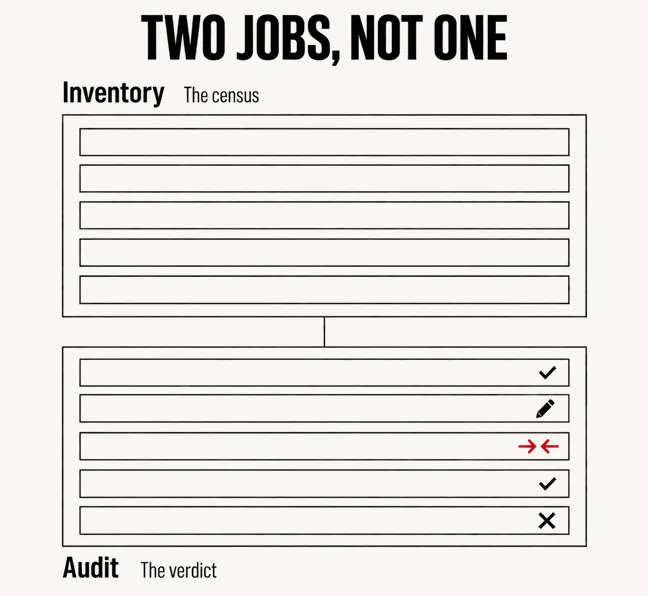

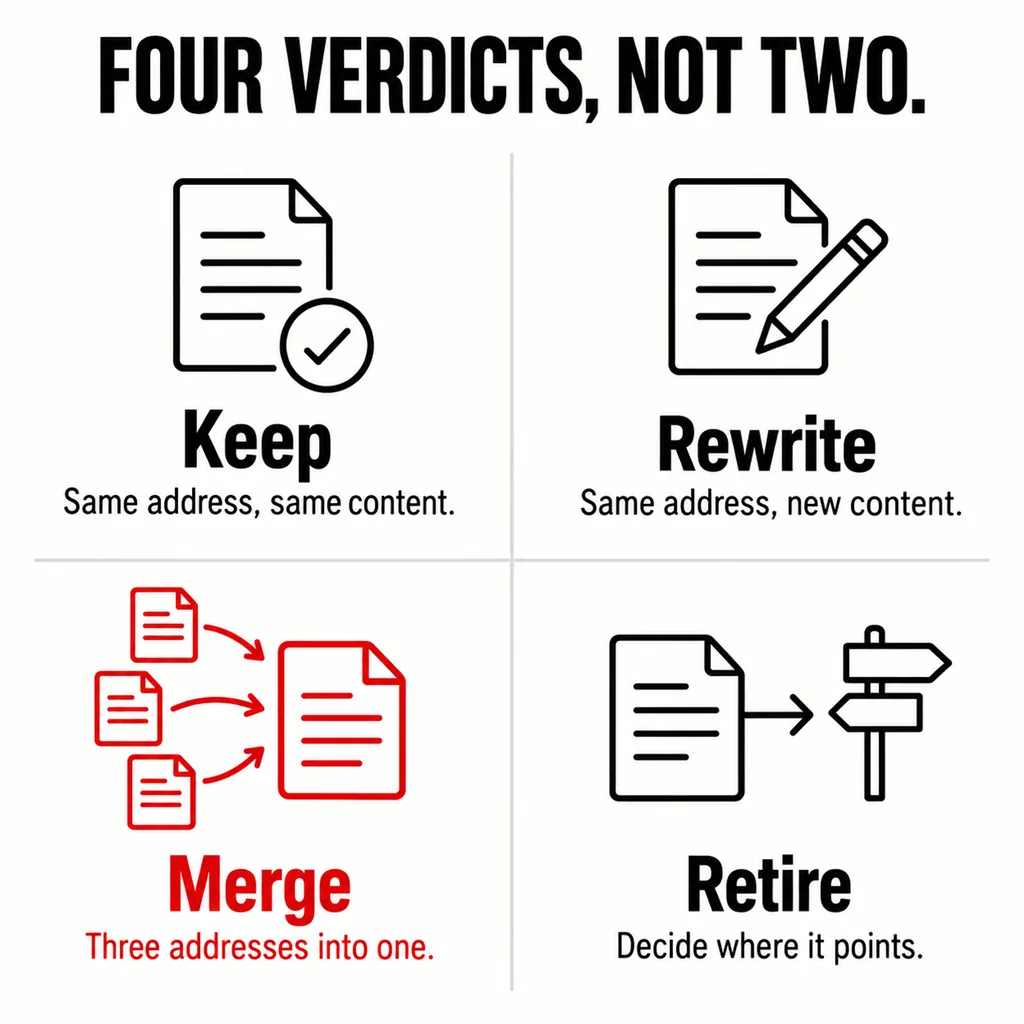
Keep or go is too blunt a choice, and it is why so many audits stall. Every row should end with one of four verdicts.
Merging is where nervous owners back out, so the mechanics are worth knowing. Google treats a redirect as a strong signal that the target of the redirect should become canonical, and consolidating brings the signals held by those separate URLs, including the links pointing at them, into a single preferred one. Three weak pages folded into one strong page is a gain, not a sacrifice.
Retiring asks the same care in reverse. An address that vanishes with nothing in its place turns every old link and bookmark into a dead end, which is why holding on to rankings through a redesign is mostly about knowing where each retired URL points the morning after launch.
These are the assets a revamp tends to lose — not because anyone decided to lose them, but because nobody wrote them down as worth keeping.
The other half of the list is the material that stays put because nobody wants the argument about it.
Google publishes a self-assessment for exactly this judgement, and one question is the most useful thing to hold an old page against: is this the sort of page you’d want to bookmark, share with a friend, or recommend? Asked honestly of a decade-old site, it clears a surprising amount. Cutting a page is still not the same as deleting its address: send the old URL somewhere sensible rather than letting it resolve to nothing.
Audits stall when they become a scoring exercise. Nielsen Norman Group points out that inventories and audits are ongoing tasks, so they’re never really finished. For a revamp you do not need finished. You need decided.
There is no right number, and chasing one is a good way to cut something useful. The test is whether every surviving page has a job you can state in a sentence: it sells a service, answers a question people ask, proves the work, or lets someone get in touch.
Removing pages that earn nothing does not cost you what they were not earning. The damage comes from how they go: an address that returns nothing breaks every link and bookmark pointing at it, while the same page merged into a stronger one passes its history along.
Usually you should. Rewriting everything is a common way to lose the specifics that made the old site work, because detail a long-standing business has accumulated is hard to reconstruct from a briefing. Reuse what is accurate, rewrite what has dated.
Every revamp we run starts with this list, and the client sees it before any design work begins — one row per page, one verdict each, the reason written beside it. Our website revamp and design service treats what your site has already earned as the starting material rather than something to clear away, which is usually why a revamp beats a rebuild. If you have put the work off for fear of losing what already works, that fear is answerable on a spreadsheet before anybody touches the site.