

- Resources
Innovative Thinking


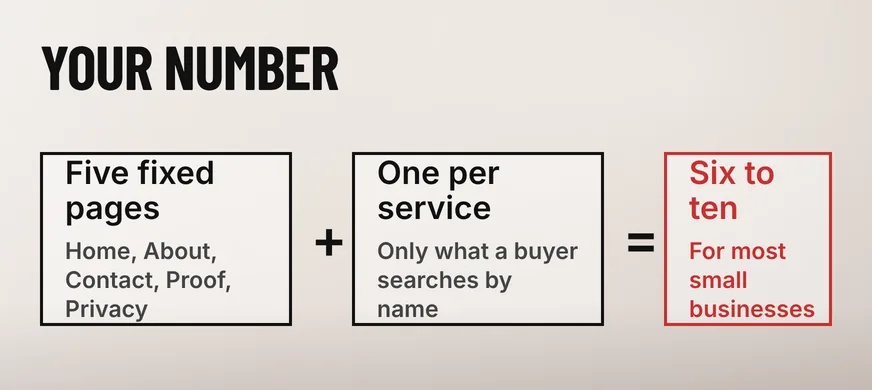
How many pages website owners need lands between six and ten for most small businesses: a homepage, an about page, a contact page, a page carrying proof, a privacy and terms page, and then one page for every service you actually sell. The services decide the number, and everything else is fixed.
A theme demo is the worst place to get that number. It carries the page list of whatever business the demo was designed around, and an aircon service in Puchong ends up with a Team page holding two stock photos, a Careers page with no vacancy on it, and a Raya promotion from two years ago. Every one of those is a page that somebody has to keep true.
Five pages are fixed for almost every small business: a homepage, an about page, a contact page, a page that carries proof, whether that is reviews, past work or certifications, and a privacy and terms page. On top of those, one page for each service you sell. Each of the five answers a question a buyer asks before they get in touch.
| The page | The question it answers | What happens without it |
|---|---|---|
| Home | What do you do, and do you work near me? | The visitor goes back to the results page to check someone else |
| A page per service | Do you do this exact job? | Google has nothing specific to show, and the buyer has to guess |
| About | Who am I dealing with? | The enquiry stalls while they look for an SSM number or a real address |
| Contact | How do I reach you now? | A visitor who wanted to WhatsApp you leaves without doing it |
| Proof | Has this worked for someone like me? | Nothing supports the claims the other pages make |
| Privacy and terms | What happens to the details I send? | You collect enquiry data with nothing published about handling it |
Five plus the services you sell is the whole arithmetic. A single-trade contractor lands on six pages. A firm with four distinct services lands on nine or ten. Nothing in that calculation depends on your industry, your competitors’ sitemaps or the number of pages in the theme you bought.
The fixed five are rarely what is missing. What is missing is usually the service pages, collapsed into one Services page carrying nine bullet points.
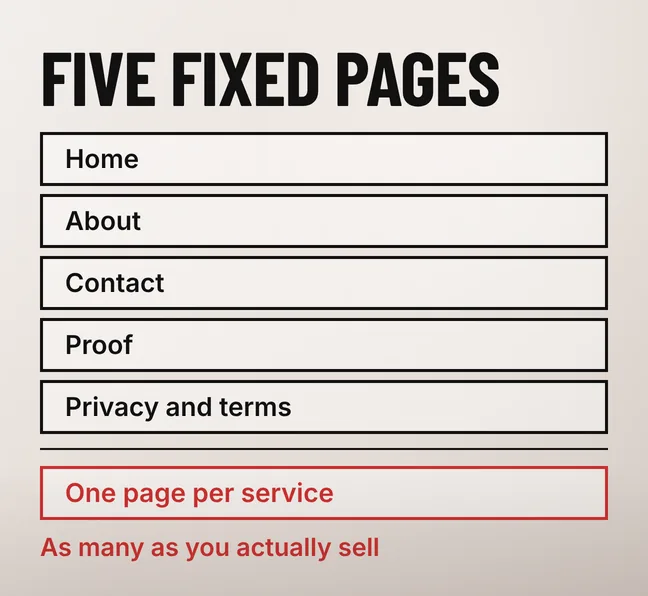
You need a separate page for every service a customer would search for by name, and no page at all for variations of the same job. An aircon company selling servicing, chemical wash and new installation needs three pages. The same company does not need one page per brand of compressor it works on.
The test that settles it is overlap. Nielsen Norman Group’s work on flat versus deep website hierarchies, written by Kathryn Whitenton in November 2013, puts the principle plainly: “Categories that are specific and do not overlap are the easiest to understand.” If two planned pages would answer the same question for the same buyer, they are one page.
The same article warns against burying the result under category pages: “Content is more discoverable when it’s not buried under multiple intervening layers.” At eight or ten pages you do not need a hierarchy. You need a menu.
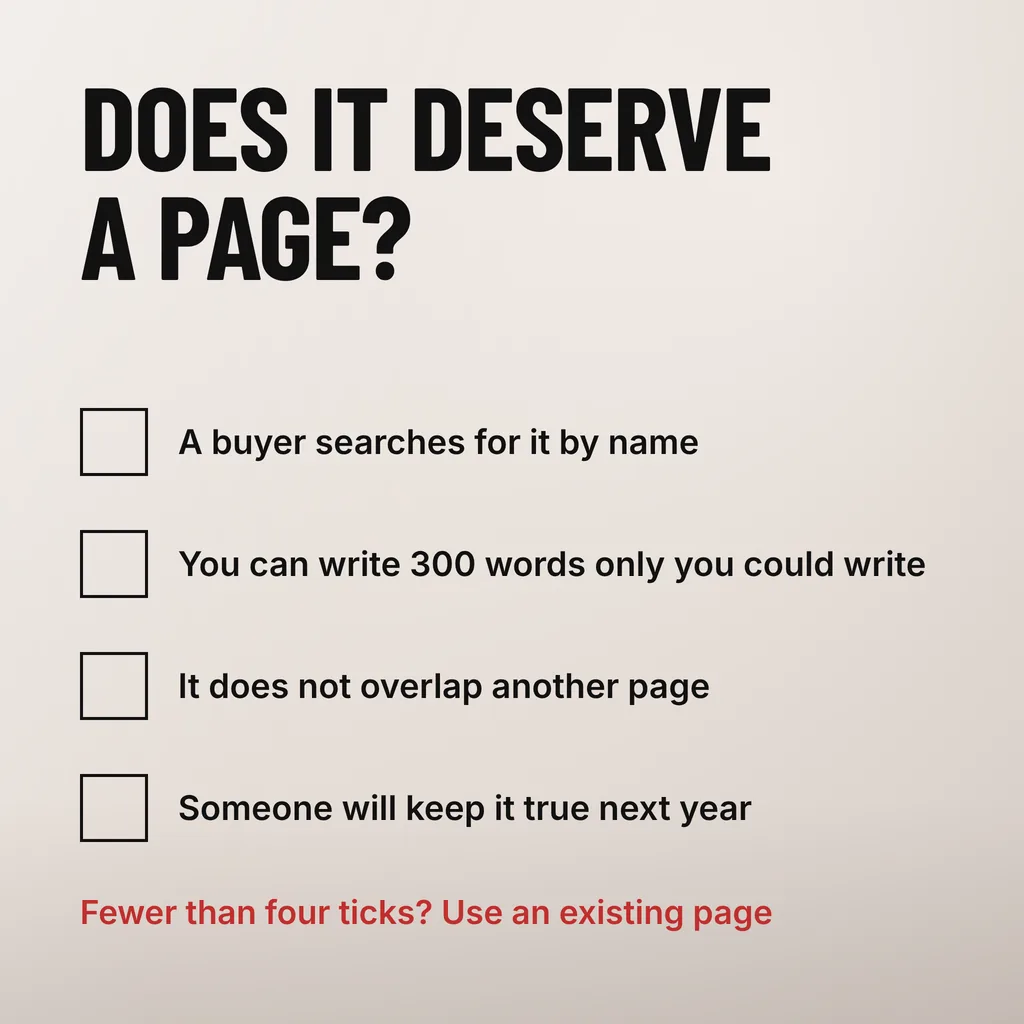
Four questions decide whether anything beyond the fixed five gets built: a buyer searches for it by name, you can write 300 words only your business could write, it does not overlap an existing page, and somebody will keep it true next year. Fewer than four yeses, and it belongs on a page you already have.
The count follows the number of distinct services and locations, so it rises with the business rather than with ambition. A sole trader with one service sits at six pages. A clinic with several treatments and regulated disclosures sits nearer fifteen. These are what the arithmetic above adds up to in each case, not measured averages.
| The business | Where the page list lands | What drives it |
|---|---|---|
| Sole trader, one service, one town | 6 pages | The fixed five plus one service page |
| Services firm with three or four services | 8 to 10 pages | One page per service, nothing else added |
| Clinic or professional practice | 12 to 15 pages | A page per treatment, plus the disclosures the profession requires |
| Business selling in two or three towns | 9 to 12 pages | Service pages, plus a town page only where the offer genuinely differs |
| Small online store | The fixed five plus one per category | Product categories, not individual products, carry the structure |
Blog posts sit outside this arithmetic. They accumulate over years and volume is normal there, so count them separately from the page list. Start one only if somebody will write the second post.
Not on their own. Google’s SEO Starter Guide sets a size threshold far above a small business site before structure even begins to matter for crawling, and it rejects the related idea that longer or more numerous content ranks better by itself. A page earns rankings by answering a question nobody else on your site answers.
On site size, the SEO Starter Guide is specific: “If you have more than a few thousand URLs on your site, how you organize your content may have effects on how Google crawls and indexes your site.” A ten-page site sits hundreds of times below that threshold. The same guide says that “search engines will likely understand your pages as they are right now, regardless of how your site is organized”.
On length it is equally direct: “The length of the content alone doesn’t matter for ranking purposes (there’s no magical word count target, minimum or maximum…)”. Twenty thin pages do not outperform eight useful ones because there are more of them.
Past a certain point extra pages stop being a waste and become a risk. Google’s spam policies for web search define scaled content abuse as “when many pages are generated for the primary purpose of manipulating search rankings and not helping users”. Publishing a page per service you really sell is not that. The difference is whether a reader needs the page.
Every page you keep carries a maintenance cost: a price that changes, a service you stopped offering, a staff photo of someone who left, a promotion that ended. Nobody budgets for that, and it is the reason a site with thirty pages and one person maintaining it drifts out of date faster than a site with nine.
Google treats deletion as ordinary maintenance. On keeping content current, the SEO Starter Guide reads: “Check in on previously published content and update it as needed, or even delete it if it’s not relevant anymore.” An expired Raya promotion is not an asset, and leaving it up is a decision rather than an oversight.
If nobody could keep the whole site true any more, the fix is a review of what each page earns, which we covered in deciding which pages to cut when a website has too many. Count the pages you would willingly update this quarter: that number is closer to the right one than anything a theme suggests.
Only where you have something different to say about that town. A page that changes a place name and repeats the same service copy is the pattern Google’s spam policies name as doorway abuse: “Doorway abuse is when sites or pages are created to rank for specific, similar search queries.” Its examples include pages “targeted at specific regions or cities that funnel users to one page”.
A town page earns its place when the offer genuinely differs there: a branch with its own address and hours, a different call-out charge, a project you can name in that area. A business covering the whole Klang Valley from one unit in Shah Alam has one service area to describe, not eight.
The same reasoning applies to any set of near-identical pages, which is why we treated it separately in whether your business needs location pages to rank in other cities. Answer one question first: what would the second page say that the first does not?
Sometimes, yes. One page is enough for a single service in a single town where enquiries arrive through WhatsApp and Google Business Profile rather than search. Its limit is that one page answers one cluster of questions well, so the moment you sell a second service people search for separately, that page has to answer two different searches under one heading.
Launch with the pages you can fill properly: the fixed five plus your service pages. A page published with a heading and two sentences of filler is worse than one that does not exist yet, because it gets indexed in that state and nobody comes back to finish it. Add the rest as the material becomes real.
Not when the page earned nothing and you redirect its URL to the closest page that remains. Google treats removing irrelevant content as ordinary upkeep. Check Google Search Console for clicks and impressions before you delete anything, keep any page that still brings enquiries, and never delete a URL without pointing it somewhere sensible.
A site with more pages than the business can maintain and fewer service pages than it needs has a planning problem before it has a design problem. Our website revamp service starts with the page list and what each page has to earn. One thing to do this week: write down the services you actually sell, add five, and compare that with the pages in your menu.