
- Resources
Innovative Thinking


The pages that should go are the ones nobody visits, nobody links to and nobody in the business can explain. Finding them takes four exports and an afternoon. Removing them takes more care, because a page on a live website is also an address, and the address outlives the page: old links, saved bookmarks, printed flyers and search results all keep pointing at it after the page itself has gone.
Search the phrase “too many pages on website” and the answer that comes back is almost always crawl budget: the idea that Google cannot get round a site this size. Google’s own guidance says that is not your problem. The things that genuinely are get far less attention, and they cost a business more.
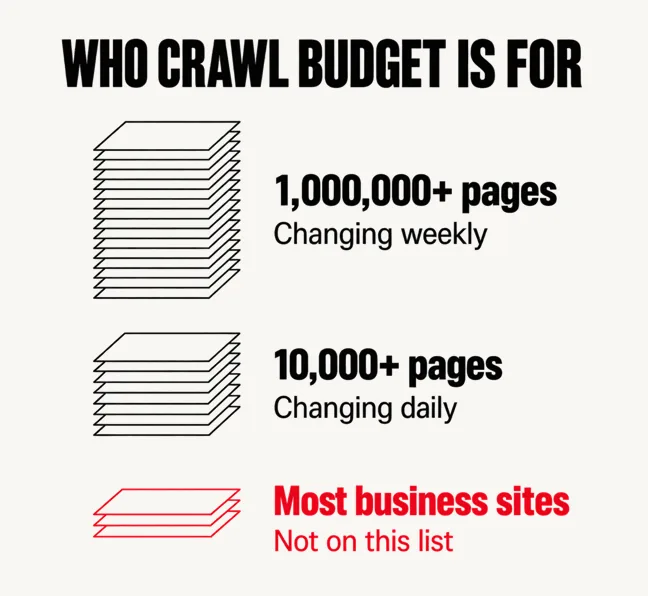
Crawl budget is the first answer anyone offers, and for a business website it is the wrong one. Google scopes its own crawl-budget guide to sites of a million pages or more changing about weekly, and to sites above ten thousand pages changing daily. Everyone else gets a plain instruction: if your pages seem to be crawled the same day that they are published, you don’t need to read this guide.
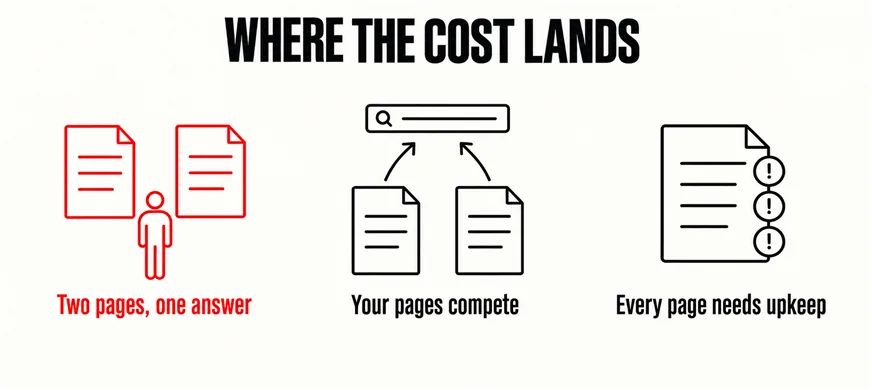
A two-hundred-page site with an unread half is not a crawling problem. It is three other problems, and all three are paid for in ringgit rather than impressions.
A fourth cost never appears on any report: nobody can say what the site contains, so improvements get argued about instead of made and every revamp quote arrives padded with the risk of pages nobody could account for. If the site is also failing on mobile, speed or accuracy, the page count is a symptom rather than the illness, and the wider diagnostic is the better place to start.
Google is not counting your pages. Your customers are choosing between them.
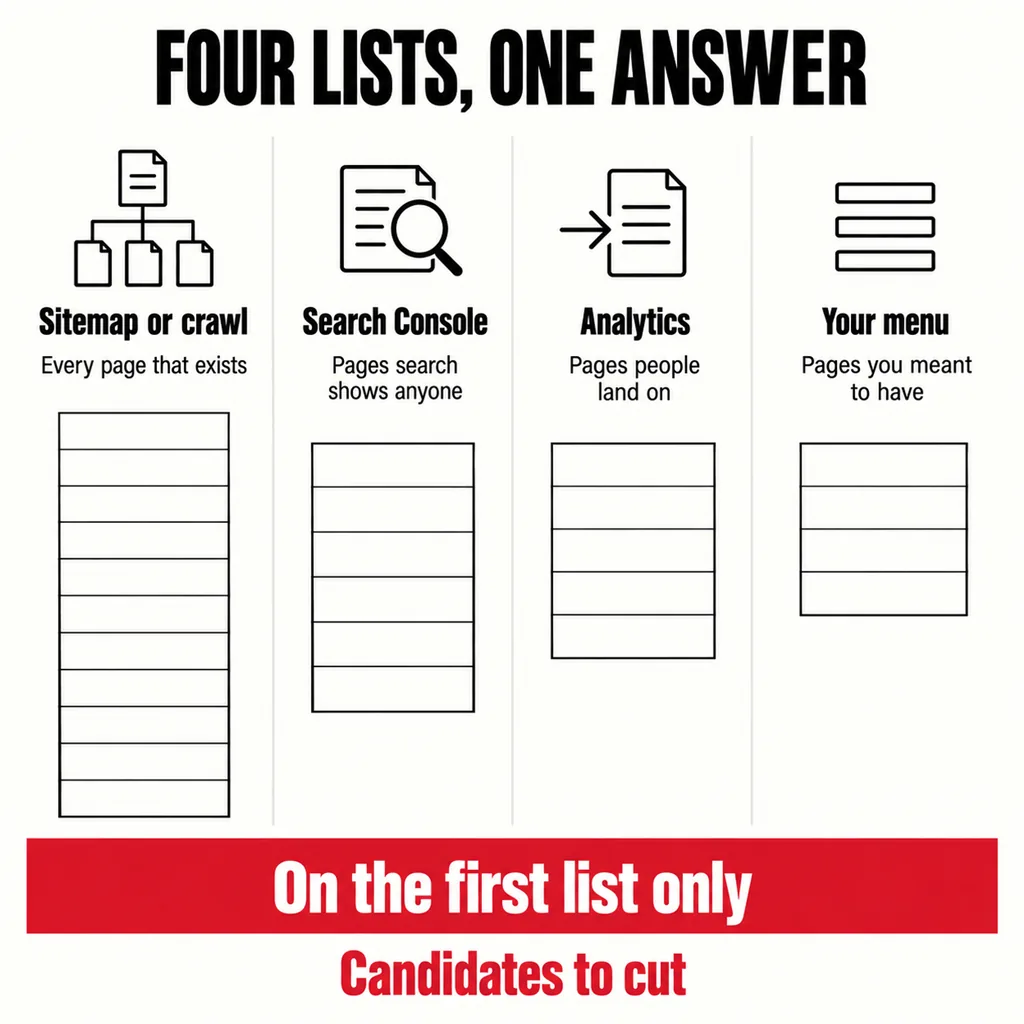
Do not start from memory, and do not start from the menu. Start from four lists, exported on the same afternoon so they describe the same site:
A URL that appears on the first list and nowhere else is a candidate. It exists, search shows it to nobody, nothing sends anyone to it and your own menu does not offer it. Most sites over a few years old carry dozens.
Candidate is not verdict, so check the usual suspects against what they are actually for before anything goes:
Deleting the page in WordPress takes a second. The decision that matters is what its address returns the morning afterwards, and there are four honest answers.
The Removals tool in Search Console is missing from that list on purpose. It is an emergency measure and a temporary one: requests made in the Removals tool last for about 6 months, after which the page returns unless one of the four decisions above was actually made.
Write the destination for every address before anything is deleted. That map is the same document a redesign runs on, and holding on to rankings through a redesign mostly comes down to whether somebody wrote it.
Two things turn a sensible cleanup into an argument: doing it in dribs over six months so nobody can tell what changed, and doing it to the wrong pages. Four rules prevent both.
Done in this order the risk stays small, because the pages leaving were not the ones bringing anybody in. What changes is that the site becomes explainable again — a list somebody can read in one sitting.
It depends on whether anyone still needs the page. A noindex tag keeps it working for people you send the link to while taking it out of search results, which suits thank-you pages, hand-sent forms and reference material. Delete when nobody needs it at all, then decide where its address points.
No. Redirect where another page genuinely takes over from the old one. Where nothing replaces it, letting the address return 404 or 410 is correct, and Google treats both as the content being gone. Redirecting everything to the homepage is the worse option: it wastes the visitor’s time and Google may read it as a soft 404 regardless.
Usually weeks rather than days, depending on how often that URL was being crawled. Google drops a page from the index when it next requests it and finds it gone, so a rarely crawled one can linger for a while. That is normal, and not a sign that anything has gone wrong.
Nearly every site we are asked to revamp turns out to be two sites: the twenty or thirty pages the business actually runs on, and a long tail nobody has opened in years. Our website revamp and design service starts by separating the two, because the cost of a revamp is driven by how many pages have to be carried across, and a page that earns nothing should not be paid for twice. Send us the sitemap and a year of Search Console data and you will see that split before anyone talks about design.