



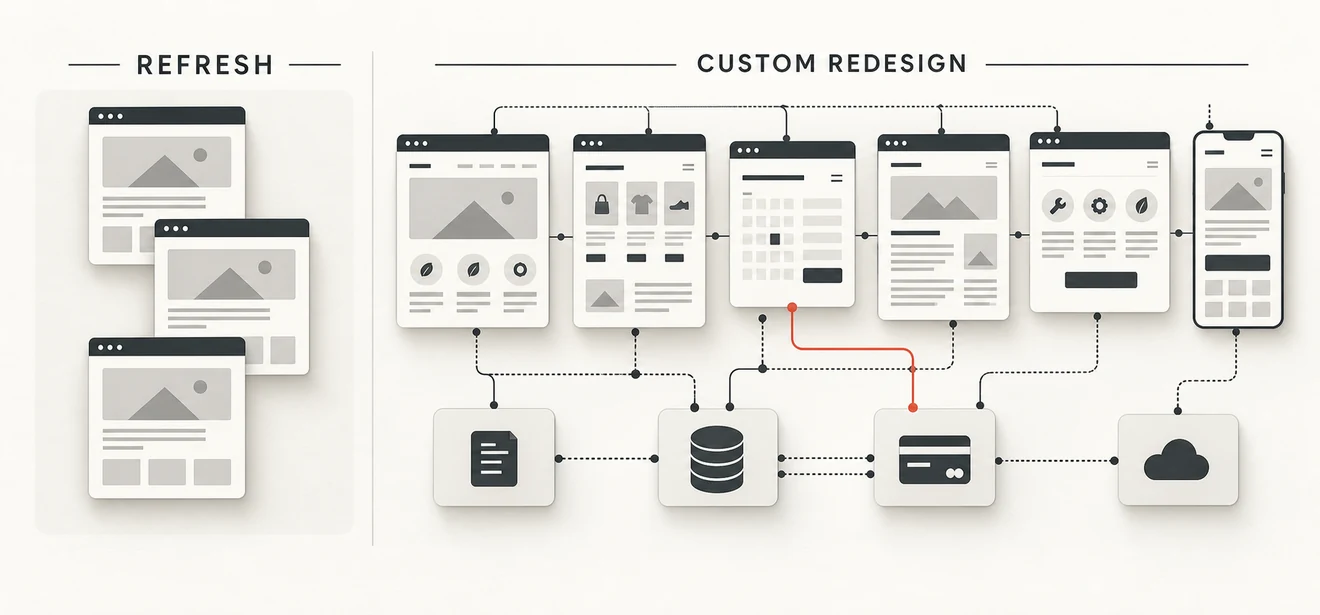
Nobody can price a revamp from the address alone, and the reason matters before you collect quotes: website revamp cost is set by scope, not by size. Two businesses with the same number of pages can be quoted three times apart, because the figure follows how many distinct page layouts are needed, who writes the words, whether the addresses change, and what has to connect.
Below are the variables an agency is actually counting, roughly in the order they move the number, and the lines that sit outside the build price. There is no figure at the end of it — we do not publish package prices, because a price without a scope gets quoted twice — but it will place your own site and show why the dearer quote is sometimes the cheaper one.
The brief an agency receives is usually one sentence: the site is out of date and we need it sorted. Two agencies can hear two different projects in that sentence and both quote honestly.
One assumes you supply the copy and photographs, keeps your existing addresses, adapts a well-built theme and prices five layouts. The other writes every word, designs each layout from nothing, restructures the navigation, migrates a catalogue and budgets for the redirect work a new structure creates. Same site, different projects, and the gap between the numbers is mostly information about what each one excluded.
It is also why a quote produced without anyone looking at the site is a guess. A sound one rests on what our website revamp checklist for Malaysian SMEs asks you to gather first: what each page earns, what has to be kept, what is broken. Gathered before design, that is a scope. Discovered in week six, it is a change order.
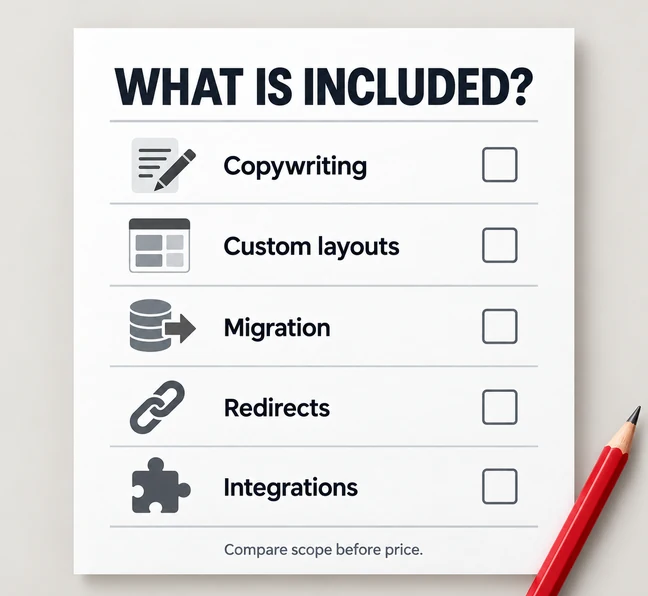
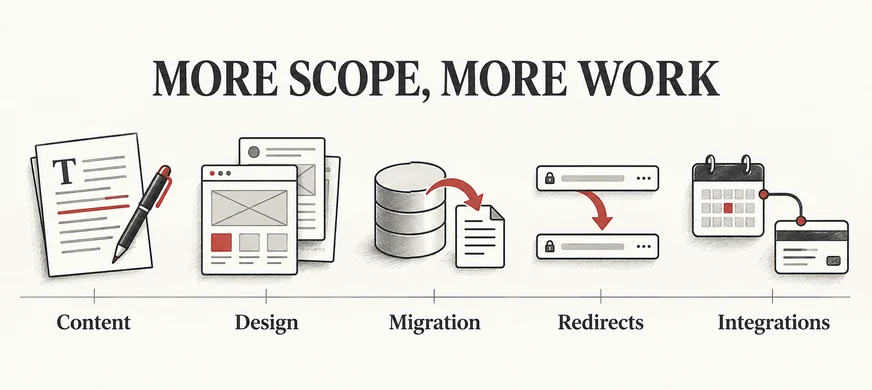
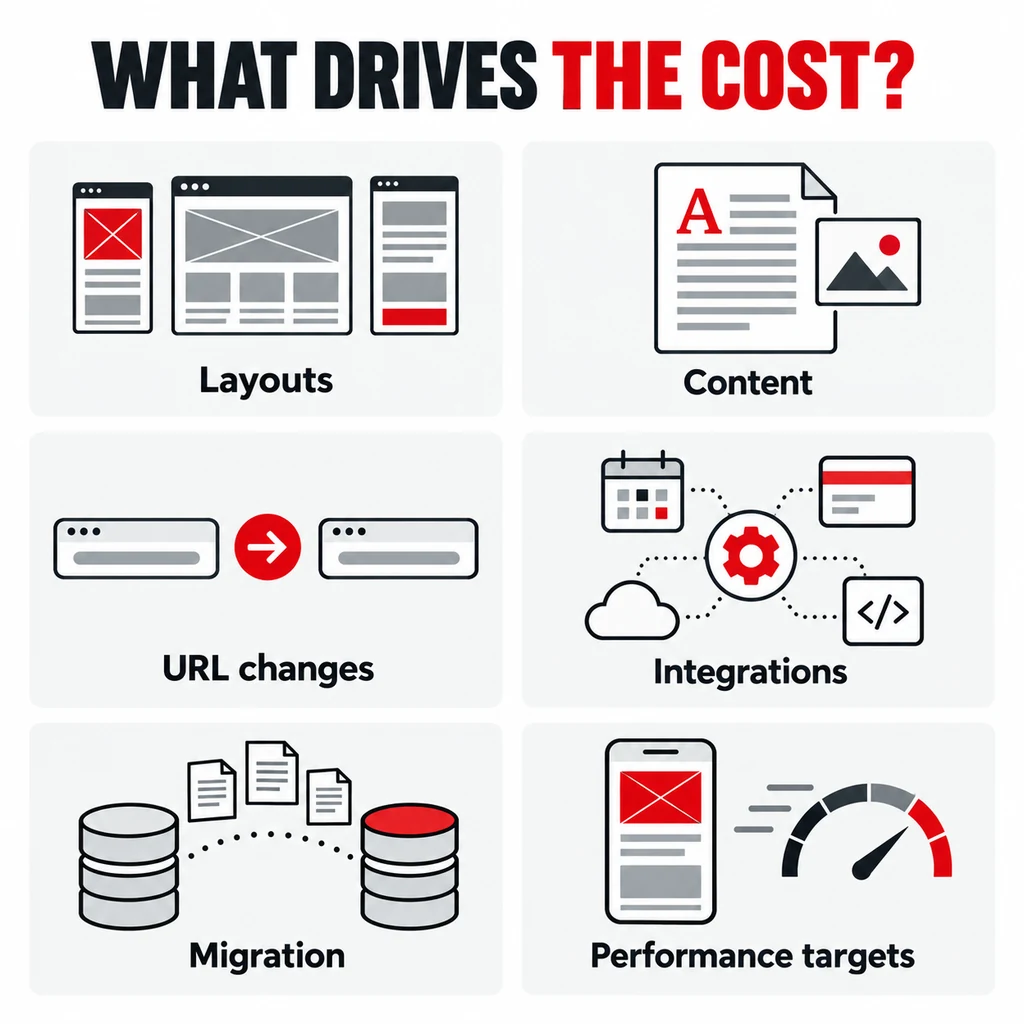
Page count is the number clients volunteer, and it is nearly the wrong one. A forty-page site on five layouts costs less than a twelve-page site where every page differs, because design, build and testing all happen per layout. Count your layouts before asking for a price: home, service page, about, contact, article, listing. Most Malaysian SME sites need five or six.
The largest single variable, and the one most often left open. Hand over final copy and real photographs and the build is short. Ask the agency to write it and someone must interview your staff, draft and revise — separate work, invoiced inside the same project. Undecided is the expensive option: design waits on words, and waiting is billed somewhere.
Keeping your URLs is the biggest saving a revamp holds over a rebuild. Change them and somebody has to map every old address to a new one. Google’s guidance on site moves is explicit: decide where each old URL should redirect to, keep those redirects up for at least a year, and expect a medium-sized site to take a few weeks or more to settle. That map, its testing and the watching afterwards carry real risk, which is why redesigning without losing rankings is a scope question before a technical one.
The build price is the part everyone compares. The lines below decide what the site costs over three years, and a quote that states them is not dearer than one that leaves them out — only more legible.
One line moves the other way. Bank Simpanan Nasional, which administers the MSME Digital Grant MADANI, describes a matching grant of up to 50% of the invoice, capped at RM5,000, claimed through a registered digitalisation partner against a set list of solution categories. A website revamp is not one of those categories, so whether part of your project qualifies depends on how it is scoped and who files it. Check the current round before budgeting around it.
Skipped for two or three years, the lines above stop being items on a quote and become the reason a site is expensive to maintain.
Three patterns account for most of the waste we are shown, and the design fee is not one of them.
The first is replacing what still earns. Long-standing guidance from the Nielsen Norman Group is blunt: drastic website changes are jarring for users and risky for business, justified only once incremental improvement has run out of room. The pages that rank, the addresses they rank on and the photographs of your own premises are already paid for. Discarding them and earning them back is the most expensive mistake on this list, which is what our guide to choosing between a revamp and a full rebuild exists to slow down.
The second is custom work for something used twice a year — a calculator, a portal, an approval flow — where a form and a person cost a fraction of the build and none of the upkeep. The third is paying for speed twice: no performance target is set, the design arrives with a video header and three font families, and after launch someone is paid again to remove them.
Put the numbers face down and ask both agencies the same seven questions. The answers are what make the figures comparable.
The quote that answers all seven often looks dearer and usually is not. One that answers none is a deposit on a conversation you will have later anyway, with the work already half built.
Because every variable that sets the figure is unknown at that point: how many layouts, who writes the copy, whether the addresses change, what has to connect. A number offered before those are settled is either padded to cover the worst case or revised upward later. Ten minutes on the site turns a guess into a range.
No, usually the narrowest. Read each quote for what it excludes rather than what it promises: one that assumes you supply final copy and keep your URLs should be cheaper, because you are carrying part of the work.
Yes, and say the figure first. A scope can be designed to a budget in ways a finished design cannot be discounted into one: fewer layouts, your own copy, addresses unchanged, integrations deferred until the revenue justifies them. A fixed budget spent on the enquiry path and the two pages that bring in work beats a full revamp abandoned half-finished.
Almost everything that decides the price is settled before anyone designs a page: how many layouts, who writes, whether the addresses move, what must connect. Our web development and design work starts with an audit of what the current site earns and ends in a quote written as those lines, so you can see which of them you can remove. If you would rather have the variables for your own site counted than guessed, send us the address and the budget you have in mind.