
- Resources
Innovative Thinking


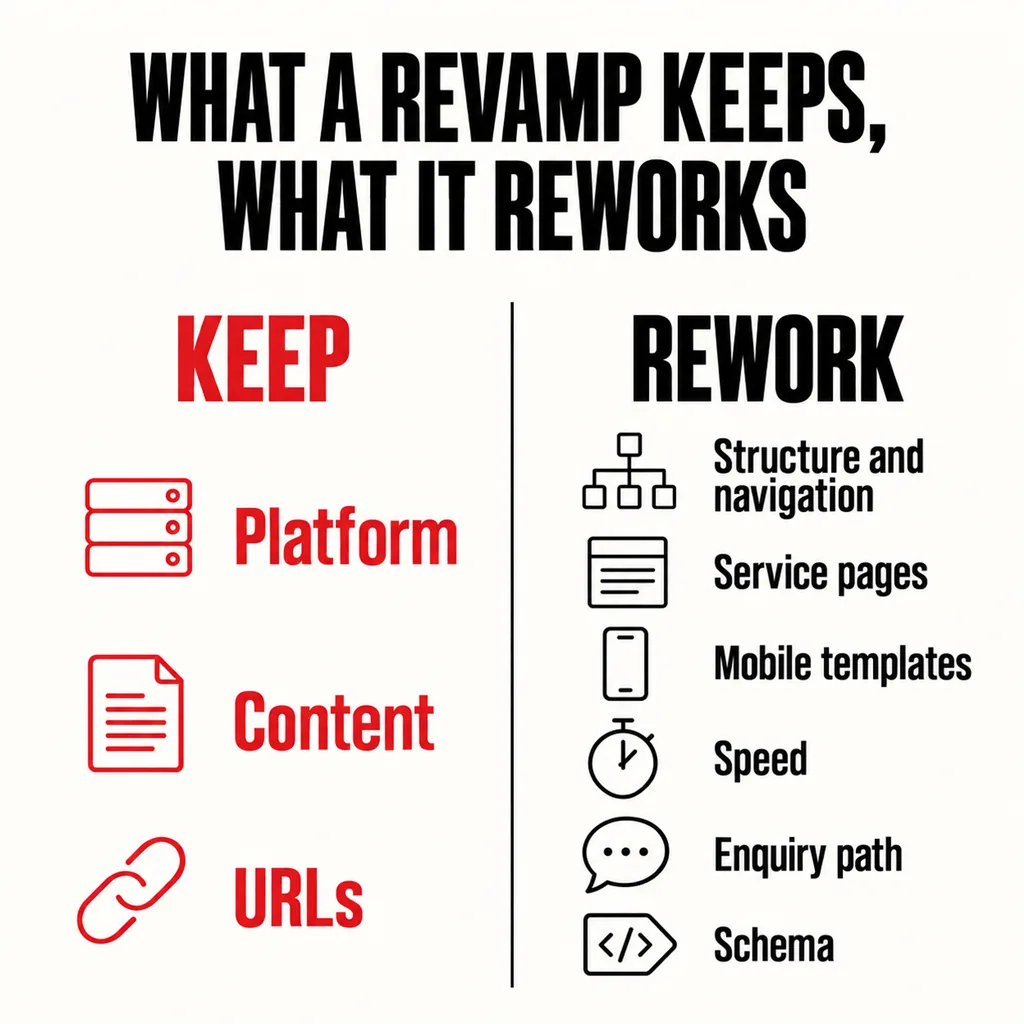
Most business websites do not need to be rebuilt from scratch. A website revamp keeps the content, the URLs and the platform, and fixes what stopped working: the structure, the mobile experience, the speed, the enquiry path, and the copy that describes a business you no longer run. A website rebuild is only the right call when the platform, the code or the business itself has changed so much that the old site cannot carry it.
You are probably weighing this decision if:
The three words get used interchangeably in quotes, which is how businesses end up paying for the wrong one. They describe different amounts of change, different timescales and very different levels of risk to the search rankings you already hold.
Keep what works. Fix what stopped working. Replace only what cannot be fixed.
Most of the sites we are asked to rebuild need the middle option. The design is dated, the mobile experience is poor and the service pages describe the business as it was in 2021, but the platform is sound, the domain has years of history, and the pages still rank. Throwing that away to fix a layout problem is expensive in ways the quote never shows.


A website revamp is the right answer when the problems live in the layer you can change without touching the foundation. That covers more than most owners expect.
What a website revamp actually includes, in our projects:
Sometimes the foundation really is the problem, and a revamp would be money spent decorating a building with a cracked slab. These are the signals that point to a website rebuild.
A rebuild done well starts with the same audit a revamp does, because the rankings, the content and the URLs still have to survive the move. The redirect map, the staging environment and the monitoring after launch are not optional extras. They are the difference between a rebuild that resets the business online and one that quietly deletes five years of search visibility.

A website revamp usually lands at a fraction of the cost of a website rebuild, because the platform, the hosting, the content and most of the pages stay. What moves the price is the number of templates to redesign, the number of pages to rewrite, the integrations to reconnect, and how much technical debt has to be cleared first. Ask any agency for a range and for the list of what changes it. A quote that only says “it depends” is a warning.
Time follows the same pattern. Four to eight weeks for a revamp is normal. Two to four months for a rebuild is optimistic once content migration and redirects are done properly. During a revamp the live site keeps working. During a rebuild there is usually a period where two sites exist and nobody is quite sure which one is true.
Risk is the number most quotes leave out. A revamp keeps the URLs, so rankings are protected by default. A rebuild changes them, so rankings are protected only by discipline. And 2026 adds a new factor: production is faster than it was, because AI tools generate layouts and first drafts in hours. The price of either option is therefore increasingly for judgement rather than production: the audit, the decisions about what to keep, the quality assurance on a real phone, and the person who answers when something breaks after launch. If a quote is cheap because the pages will be generated, ask who is doing the deciding. Google’s SEO starter guide says as much in its advice not to drop everything and start reorganising a site, because search engines will likely understand your pages as they are.
| What to compare | Website revamp | Website rebuild |
|---|---|---|
| What moves the price | Templates to redesign, pages to rewrite, integrations to reconnect, and the technical debt to be cleared first | All of that, plus a new platform, content migrated across, and a redirect map for every URL that changes |
| Typical timescale | Four to eight weeks for a small business site | Two to four months, and optimistic once migration and redirects are done properly |
| The live site during the work | Keeps working; the revamp is built on a staging copy | A period where two sites exist and nobody is quite sure which one is true |
| Risk to rankings | The URLs stay, so rankings are protected by default | The URLs change, so rankings are protected only by discipline |
| The right call when | The platform is supported, the pages still rank, and the problems sit above the foundation | The platform is unsupported, you do not own or cannot export the site, or the business model itself has changed |
Run these eight questions against your own site. They take an afternoon with access to Google Analytics, Search Console and the WordPress admin, and they settle the decision for most businesses. The Search Console performance report answers the ranking questions directly — which queries bring traffic and which pages earn the clicks — so start there.
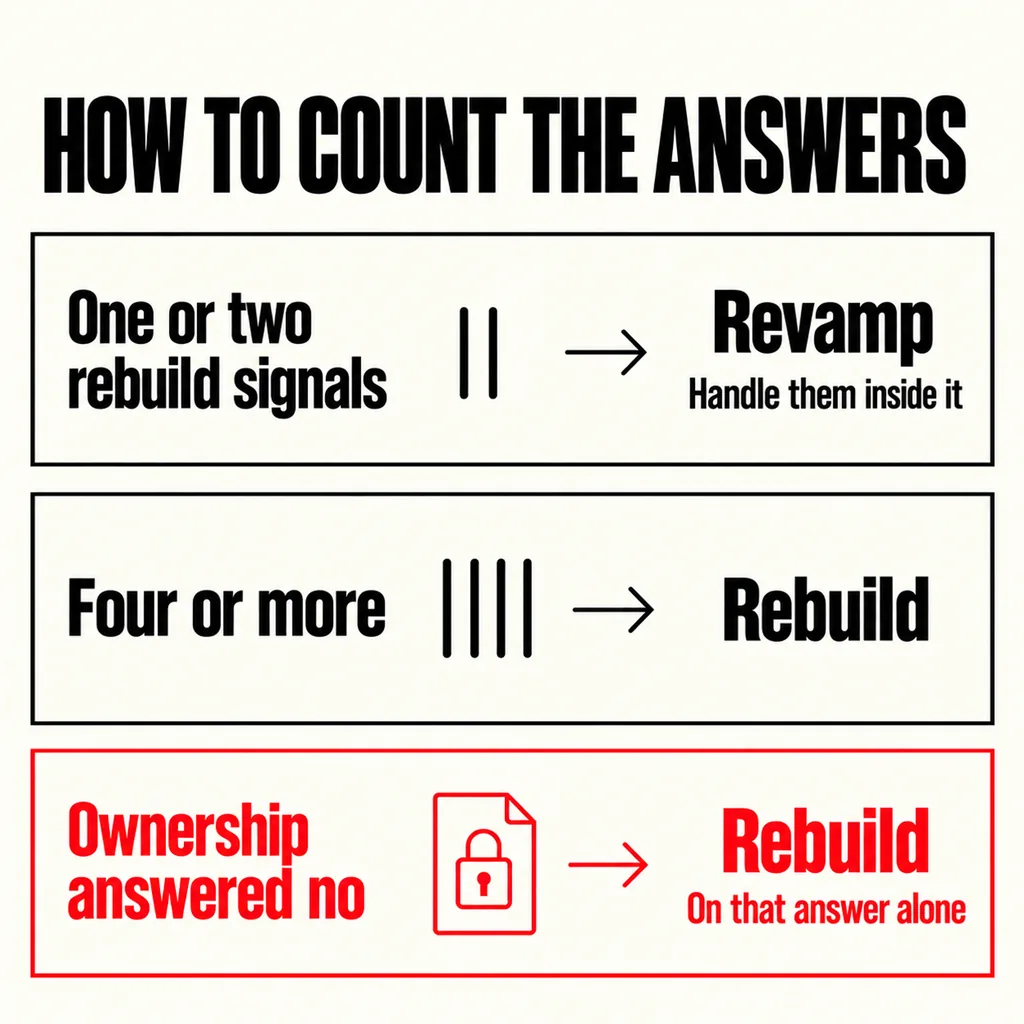
Count the answers. Most businesses land on a website revamp with one or two rebuild signals, and those can usually be handled inside the revamp: a theme replaced while the content stays, a checkout rebuilt while the catalogue stays. A rebuild is the right call when four or more answers point that way, or when the ownership question alone comes back as no.
Related reading: Your Website Gets Visitors. Why Isn’t It Generating Enquiries?, Why Website Maintenance Should Include More Than Plugin Updates, Your Website Is Mobile-Friendly. But Is It Actually Easy to Use? and Which 2026 Web Design Trends Are Actually Worth Using on a Business Website?.
For a small business site, four to eight weeks from audit to launch in our projects, depending on how many templates and pages change. A rebuild with proper content migration and redirects typically takes two to four months.
A revamp that keeps the URLs and improves structure, speed and content usually helps rankings. Risk appears only where URLs change, and a redirect map handles that. Rebuilds carry more risk because more URLs change at once.
Yes. A revamp often replaces builder-heavy templates with lighter ones while keeping the content and the URLs. If the builder itself is the source of the speed and stability problems, replacing it is part of the revamp rather than a reason to rebuild.
Review the structure every two to three years and the service pages every quarter, and the site rarely needs a rebuild at all. Sites that get rebuilt every five years are usually sites nobody maintained in between.