
- Resources
Innovative Thinking


A website revamp contract should put eight things in writing: what is in scope, who owns the design and the code at the end, what each payment buys, what happens to your page addresses, who may touch customer data, what is handed over and when, what gets fixed free after launch, and how the agreement ends if the work stalls. Most quotations cover the first and the third.
A revamp contract has to do something a new-build contract never does. You arrive with things you already own: a domain carrying years of history, the handful of pages that bring in the enquiries, a form database of customer records, a premium theme licence somebody bought in 2019, a Google Business Profile with real reviews on it. Every one of those needs a named owner and a handover date. We sign these contracts as the agency side of them and we are not lawyers, so this is what we put in writing rather than legal advice.
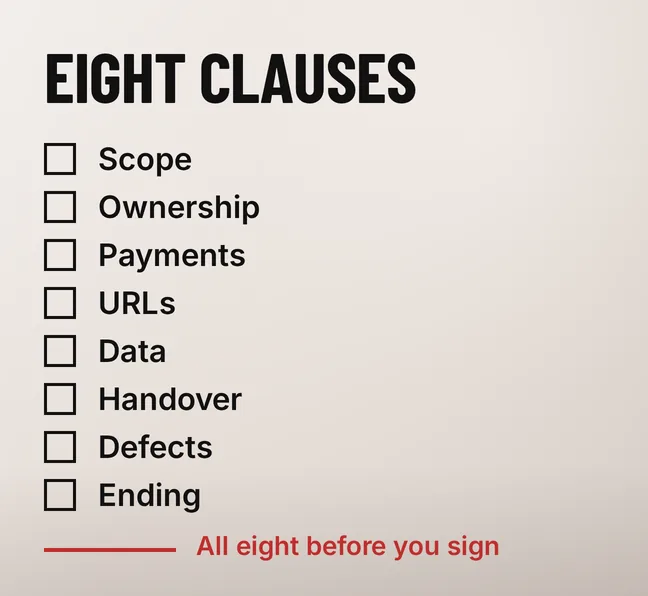
Eight clauses carry the work: scope, ownership of the design and code, payment tied to named deliverables, the URL and redirect plan, personal data, handover of accounts and licences, a defect period after launch, and termination. A revamp contract also needs one line a new build does not: the written list of what is being kept.
| Clause | What it has to name |
|---|---|
| Scope | Page count, which pages keep their copy, who writes the rest, how many rounds of changes |
| Ownership | Who holds copyright in the design and code once the final invoice is paid |
| Payments | The deliverable each instalment buys, and when the last one falls due |
| URLs | Who produces the redirect map, who tests it, and how long the redirects stay up |
| Data | Who may export the form database and customer records, and what happens to the copies |
| Handover | Each account, licence key and source file, with a person and a date |
| Defects | What is fixed free, for how long, and what counts as a new request instead |
| Ending | What is owed, what transfers and who holds the staging site if either side walks away |
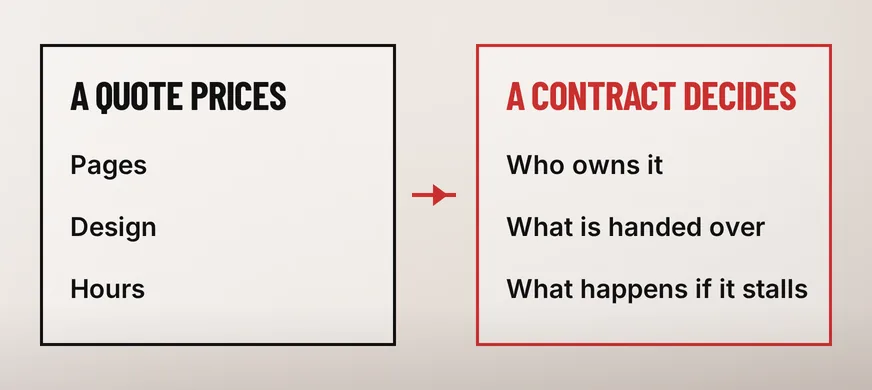
None of these is unusual to ask for. The common pattern in Malaysian SME work is an emailed quotation and a purchase order, which settles the price and leaves the other seven to goodwill.
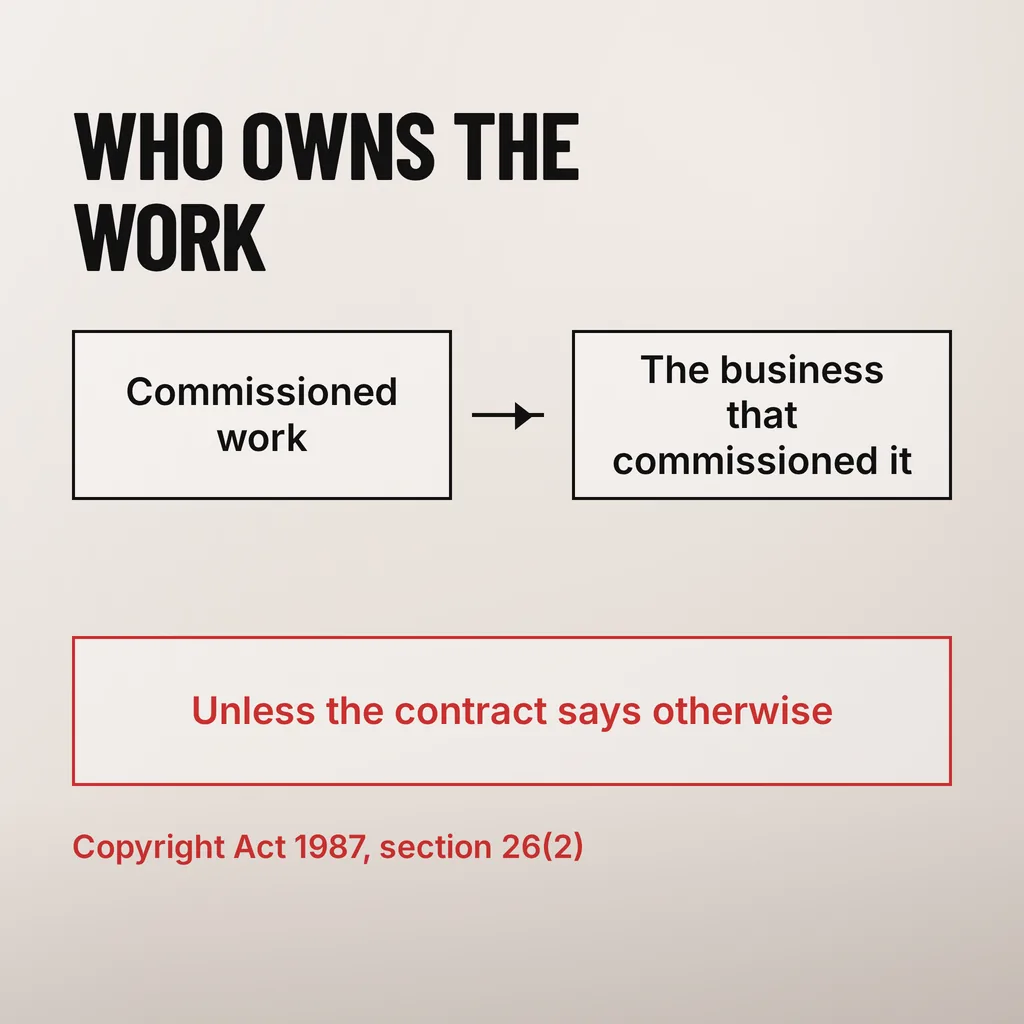
Your company does, unless the agreement says otherwise. Malaysia’s Copyright Act 1987 treats commissioned work as transferred to whoever commissioned it, so the clause worth reading closely is any clause that limits that transfer, together with whatever the contract says about third-party licences.
Section 26(2) of the Copyright Act 1987 covers a work that “is commissioned by a person who is not the author’s employer under a contract of service or apprenticeship”. In that case “the copyright shall be deemed to be transferred to the person who commissioned the work”, and the Act adds the words that matter here: “subject to agreement between the parties excluding or limiting such transfer”. Silence favours you, and the clause that reverses it — reserving the design to the agency, or licensing it to you rather than assigning it — is usually one sentence long.
Third-party licences are the part people discover later. A premium theme, a page-builder pro licence, a form plugin, stock photography and a licensed font each carry their own terms, and most tie updates and support to the account that bought the key. Ask for licences registered to your company where the vendor allows it, and for each renewal cost in writing where it does not.
By listing pages. A revamp scope should say how many pages are in the build, which of them keep their existing copy, which are rewritten and by whom, and how many rounds of changes are included. Page count and responsibility for content are the two lines that move a revamp price furthest.
Take a dental clinic with forty-odd pages, six of which bring in the appointment enquiries. A revamp scope names those six as rewritten, a dozen more as migrated with light edits, the rest as retired, and prices that. A scope promising a full content refresh prices nothing, and the argument arrives in week four when somebody has to write thirty-four pages of text.
The scope should also say what happens when you want something new halfway through: what counts as a change rather than a fix, how it is quoted, and who on your side may approve it. The revamp brief you write first is where the page list comes from, which is why the brief is worth finishing before anyone drafts a contract.
A revamp contract should name who produces the redirect map, who tests it, and how long the redirects stay up. Google’s site-move documentation is specific about the last one: “Keep the redirects for as long as possible, generally at least 1 year.” Changing your addresses commits someone to a year of keeping them alive, and redirects live on the server — if the hosting moves or a plan lapses, they go with it.
Google’s guidance on moving a site with URL changes, last updated on 20 August 2026, is worth reading before you agree a launch plan: it recommends “moving all URLs on your site simultaneously instead of moving one section at a time”, and says “a small to medium-sized website can take a few weeks for most pages to move”. Most Malaysian SME sites sit in that bracket at a few dozen pages, which is also why a clause making the final payment conditional on rankings is one no honest agency can meet.
Three deliverables are fair to require instead: the redirect map as a file you keep, the page titles and meta descriptions carried across, and a named period of Search Console monitoring after launch.
Attach each payment to a deliverable you can see rather than to a date in a plan. A signed scope, an approved design, a staging site you can click through, launch, and completed handover are five things that either exist or do not. Dates slip on both sides, so the contract also has to say what happens when content arrives late.
Keep the last instalment on the far side of handover. If it falls due at launch, the accounts, licence keys and source files are still outstanding when you have nothing left to withhold, and chasing them becomes a favour rather than a term. Ask for cost by driver too — pages, content writing, migration, integrations such as an FPX gateway or a booking system, training — because a single figure cannot be compared with anything.
The delay clause should cut both ways. If your photographs and copy are three weeks late, the launch date moves and that is reasonable; discovering a re-mobilisation charge for the first time in an invoice is not. A clause that parks a project after a stated period of silence, and names what restarting costs, is fair to both sides when it is agreed in advance.
Named items, each with a person and a date: the domain registrant record, hosting or server access, the WordPress administrator account, ownership of the Google Analytics, Search Console and Business Profile properties, every licence key with its renewal date, the design source files, and a final backup you could restore somewhere else.
Customer data belongs in the same clause. A revamp usually involves exporting the form database or the customer list, and Malaysia’s Personal Data Protection Act 2010 puts the duty to protect that data on the business that collected it, including when a contractor processes it on that business’s behalf. The contract should say who may hold a copy, where it may be stored, and that copies are deleted and confirmed in writing when the work ends.
A revamp inherits whatever the last build set up, so check the names on the accounts now. If the registrant or the hosting account is in an agency’s name rather than yours, getting the domain and hosting back into your own name is easier to agree while a contract is still being negotiated than afterwards.
A defect period with a length and a boundary. Faults in the work they built get fixed at no charge for the stated period, new requests are quoted, and there is a named route for something urgent. Launch week is when forms meet real phones and a payment gateway behaves differently with live keys, which is what this clause is for.
A care plan covering updates, backups, monitoring and uptime is a separate purchase from that defect period, and the contract should say which one it is selling. An aircon supplier whose enquiry form quietly stops sending email for a fortnight does not need design hours; it needs somebody watching.
Then the ending. Either side may walk away from a project, and the contract should already say what is owed for work completed, which licences and files transfer at that point, who holds the staging site, and whether the agency keeps access to anything afterwards. Nobody negotiates that well in the week it happens.
No. A quotation prices work. A contract says who owns the result, what is handed over, what happens when the scope changes, when payment is due and how the agreement ends. Plenty of Malaysian SME revamps run on an emailed quotation and a purchase order, which covers the price and nothing else. Ask for the scope, ownership, handover and defect clauses in the same document before you sign.
For a straightforward SME revamp, usually not: read the ownership, handover, defect and termination clauses yourself and ask for changes in writing. Get a lawyer involved when the figure is large enough to hurt, when the site handles payments or health records, or when the agreement ties you to one supplier’s hosting or licences for a fixed number of years.
Write the missing parts down now and ask for them to be agreed by email, which costs less than renegotiating after a disagreement. Settle four first: the page list, ownership of the design and code, the handover schedule for accounts and licences, and what support covers after launch. An agency acting in good faith will confirm all four.
We quote revamps against a written scope, because the scope is what the rest of the contract hangs on: the pages being kept, the pages being rewritten, where every old address points afterwards, the accounts and licence keys that come back to you at the end. Our web development and design service puts those in the proposal rather than in the conversation. If you already have a draft contract from somebody else, read its ownership and handover clauses first.