
- Resources
Innovative Thinking



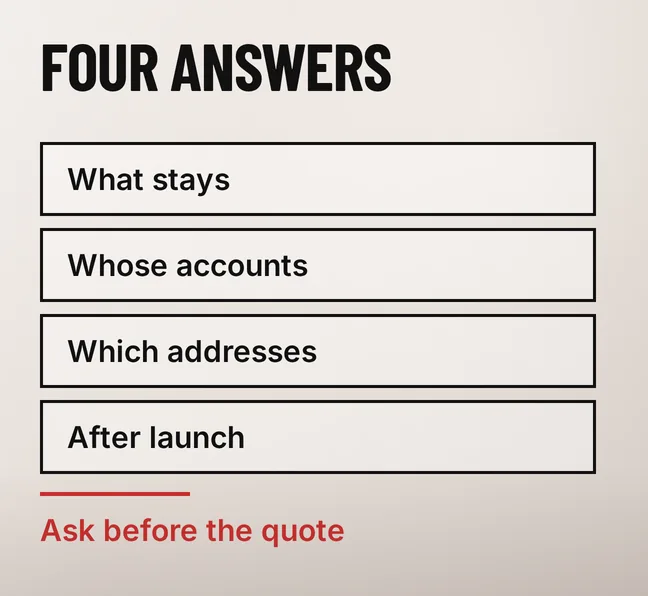
Four answers separate one revamp agency from another, and none of them is in the portfolio: what they will keep from the site you already have, whose name stays on the domain, the hosting and the Google accounts, what happens to the addresses of pages that change, and who answers when a form breaks in launch week. Get those four before you ask for a price, because they decide what the price is for.
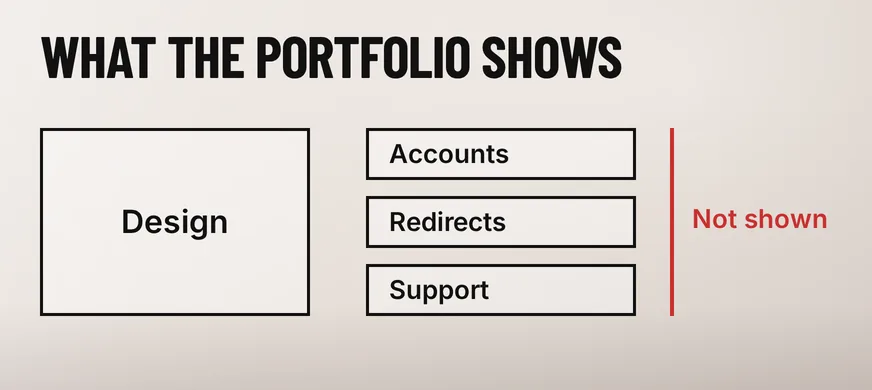
Search “choose website revamp agency” and the advice is mostly about the first meeting: study the portfolio, check they have worked in your industry, meet the team. All reasonable, and all of it about what happens before any work starts. A portfolio shows that an agency can design. It does not show who will own the accounts afterwards, who writes the redirects, or who picks up the phone in week one.
All four answers are about custody: what the agency keeps from the site you have, whose name the accounts stay in, what happens to the addresses of your pages, and who answers after launch. Each one asks what becomes of something you already own — a domain with years of history, pages that rank, photography you paid for, a Google Business Profile carrying real reviews.
A revamp hands all of that back to you in better condition. A rebuild dressed as a revamp quietly replaces it, and the invoice looks much the same. In detail:
Ask before the quote arrives. An agency that answers all four plainly is quoting for the job you think you are buying.
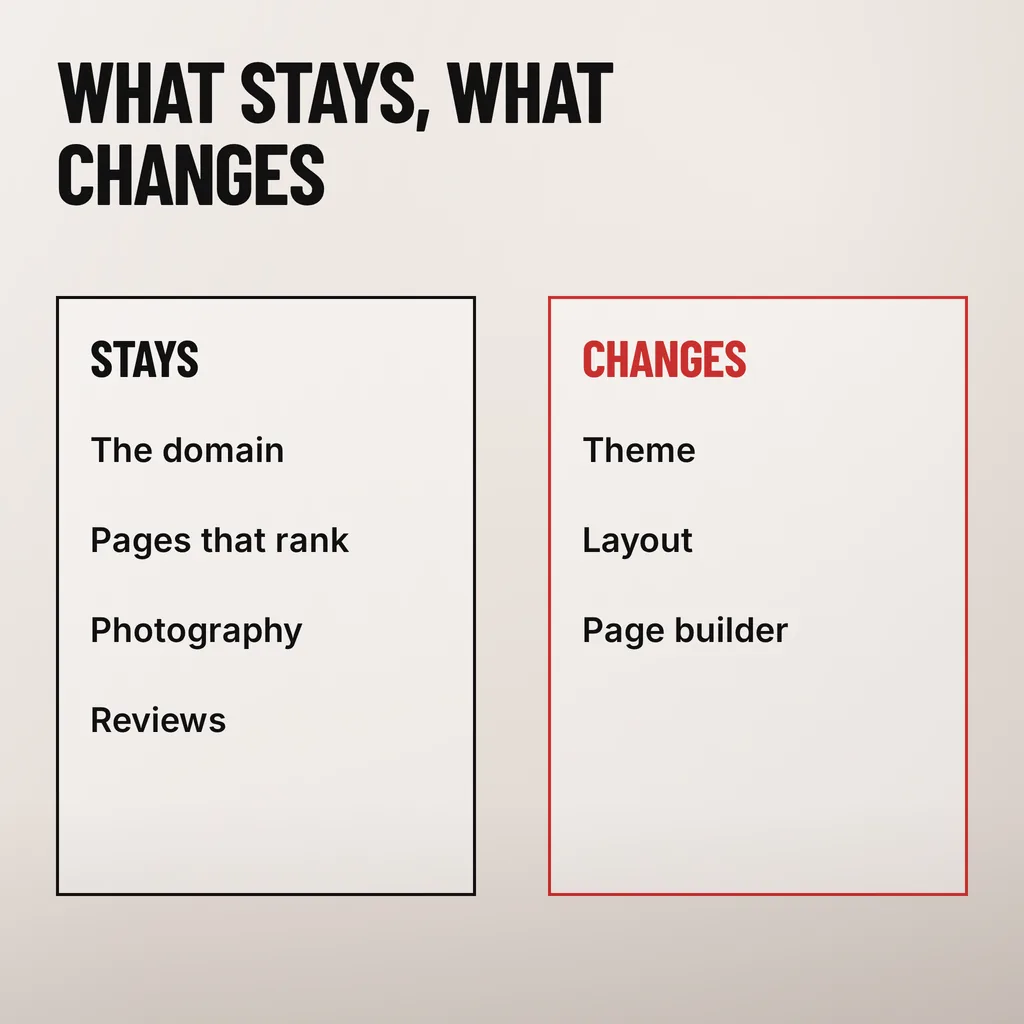
A useful answer is specific, written down and priced: these pages keep their copy, a dozen get rewritten, the product photography stays, the 2019 posts about office birthdays go. An agency that intends to start fresh on every page is quoting for a new website. Sometimes that is the honest recommendation, but it should be a decision you make with the numbers in front of you.
Take a typical aircon contractor in Johor Bahru: four service pages bring in the WhatsApp enquiries, sixty older pages bring in nothing and have not been read since 2021. Keeping the four and pruning the sixty is a revamp. Starting again on all sixty-four is a rebuild, and it costs what a rebuild costs.
What usually changes is the theme, the layout and the page builder underneath. What stays is everything that took years to earn. The audit that decides what to keep is worth running before you brief anyone, because it also tells you which quotes are comparing like with like.
Your own company, on every one of them, with the agency added as a user rather than as the owner. That means the domain registrant, the hosting account and the Google Business Profile, Analytics and Search Console properties. Owners ask this least often, usually because whoever built the current site registered everything and nobody thought about it again.
For a .my domain the registry is explicit. MYNIC’s Registrant Policy states that “the Registrant is the registered domain name holder of a .MY domain name” and that this individual or entity “holds the rights to use the domain name as long as the domain name remains active and continues to be renewed”. It adds that a domain “is based on subscription basis and is not absolutely owned by the Registrant”, which is why a lapsed renewal can cost a company its address even when nobody disputes whose it is.
If the registrant on record is the agency rather than your company, putting that right later is not a five-minute favour. Changing the registrant organisation name or number is a Change of Registrant under the same policy, subject to a verification procedure and a new Registrant Agreement. Far easier to be the registrant from the start.
If one of the accounts is already in the wrong name, it can be moved; who owns your domain and hosting covers how, and what to ask for in writing while the revamp is still being quoted.
If the revamp changes URLs, every old address needs a permanent redirect to its closest new one, written before launch and tested after it. Ask who produces that map, whether it is in the quote, and who watches Search Console for the month afterwards. A proposal that reorganises the site and mentions redirects nowhere has not costed the work.
Google’s Search Central documentation on site moves with URL changes recommends that small and medium sites move all their URLs at once rather than a section at a time, and treats a move as something to plan and monitor in its own right. Most Malaysian SME sites are firmly in that group, at a few dozen pages. The cheapest version of this answer is also the best one: keep the addresses you have wherever the new structure allows, and there is no site move to manage.
Launch week is when a revamp earns or loses its money. Forms that worked on staging meet real phones, a payment gateway behaves differently with live keys, and somebody on 4G finds the one page that will not load.
Three things are worth having in writing: what is fixed free because it is a fault in work they built, what is chargeable because it is a new request, and how to reach a person who can act. A promise of ongoing support that does not say which of the three it means is the gap you find on the first Saturday.
Support is also the part most often quoted separately, or not at all: a care plan covering updates, backups and monitoring is a different purchase from a retainer with design hours in it, and both cost less than an emergency call-out to somebody who has never seen the site.
Usually you cannot, and that is worth knowing before you try. Two quotes with a wide gap between them almost always describe different jobs, and the difference is rarely in the design.
| What a quote may or may not include | Why it moves the price |
|---|---|
| Content: rewritten, migrated as it stands, or left to you | The largest variable in most revamps |
| Redirect map, testing and a month of monitoring | Hours before and after launch, invisible on a design proposal |
| Account handover: domain, hosting, Google properties | Minutes when planned, weeks of chasing when not |
| Support after launch | A recurring cost, often priced separately or left out |
Write the scope down first and send the same document to every agency: page count, what stays, who owns what, which addresses may change, what support you expect. Identical inputs are what make two numbers comparable. Then ask for cost by driver — pages, content, integrations, migration — rather than as one figure, and ignore any package price quoted before anyone has looked at your site.
Three of them: a guaranteed ranking, a refusal to explain the work plainly, and a domain or account the agency registers in its own name as a matter of course. The first two are Google’s own warnings about hiring an SEO, and they travel to web agencies with very little adjustment. The third is particular to a revamp, because a revamp inherits what the last agency set up.
Google’s guidance on hiring an SEO is blunt about guarantees: “No one can guarantee a #1 ranking on Google.” On secrecy: “Be careful if a company is secretive or won’t clearly explain what they intend to do.” Its advice on access is worth copying exactly — while an agency is still auditing and nothing has been signed, “only grant read access to Search Console (at this stage, don’t grant them write access)”.
Four more worth asking about, none of them proof of bad faith on its own:
Each one is a question you have not had answered yet, and the answer is usually free.
For most SMEs it does, for practical reasons rather than patriotic ones: FPX and local payment gateways, a shared timezone when something breaks, and Bahasa Malaysia or Chinese content handled by people who read it. None of that outranks the four answers above: a local agency that cannot say who will hold your domain is still the wrong choice.
No, but it is usually the smallest scope. Put the four answers beside each quote and the cheap one either covers less work, leaves the content to you, or has not costed the parts that are not design. Occasionally it is simply a smaller studio with lower overheads.
We revamp rather than replace, so the first thing we do is work out what your site already earns and keep it. Our web development and design service quotes against a written scope: what stays, what changes, where every old address goes, and whose name is on the accounts at the end. Ask the four questions of whoever you are considering — including us.