

- Resources
Innovative Thinking


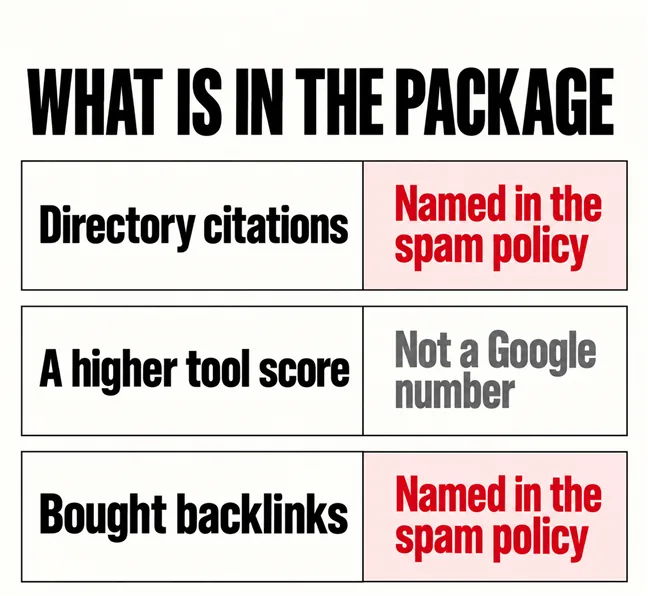
A cheap SEO package almost always contains the same three things: a batch of business directory listings, a promise to raise your score in some tool, and a bundle of backlinks. You do not have to buy one to find out whether it works. Google publishes a written policy naming two of those three as spam, and states plainly what happens to sites that use them.
That is the useful part, and it is free to read. The experiments people run — spending a few hundred ringgit, waiting six months, concluding it did nothing — arrive at the same answer the documentation gives in advance, only slower and with the site carrying the risk.
Directory citations, a tool score, and links. Taking them in turn, two are named in Google’s spam policy and one is measuring something Google does not publish.
The policy defines the category first: “Link spam is the practice of creating links to or from a site primarily for the purpose of manipulating search rankings”. Among its listed examples are “buying or selling links for ranking purposes”, which it expands to include exchanging money for links or for posts that contain links, and separately “low-quality directory or bookmark site links”. A gig that delivers fifty listings on generic directories and a spreadsheet of logins is the second of those, described almost word for word.
It is worth being fair about the exception, because it is real: the same policy acknowledges that buying and selling links is a normal part of the web’s advertising economy, and says such links are acceptable when they are marked up so they do not pass ranking signals. Paid links are not the problem. Paid links bought for ranking purposes and left unmarked are.
You do not need to spend six months finding out. The rule is published, by name, in advance.
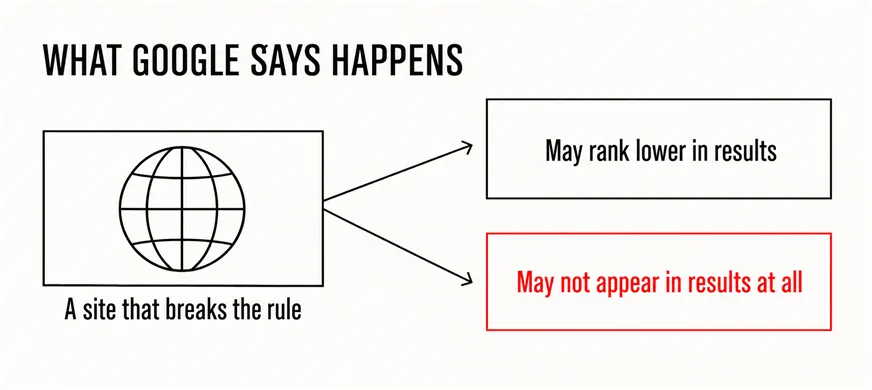
One sentence covers it: “Sites that violate our policies may rank lower in results or not appear in results at all.” Google’s guidance on hiring an SEO is blunter about who carries that risk — if an SEO creates deceptive or misleading content on your behalf, it says, your site could be removed entirely from Google’s index. The contract may be theirs. The domain is yours.
This is the part the cheap-package experiments tend to under-state. They report that the links did not help, which is the benign outcome. The outcome worth avoiding is the one where links bought years ago are still pointing at your domain when it matters, and nobody kept a list of where they came from.
Domain Rating, Domain Authority and Trust Flow are vendor metrics, not Google’s. Google’s own guidance on third-party tools is explicit: “Third-party tools don’t have access to our internal ranking data”, adding that using a service or tool does not guarantee ranking success, and that some services provide data which users misinterpret as somehow being from Google. Those scores are useful for comparing sites against each other. Paying to inflate one is paying to move a number that Google never reads. Why a rival with a worse site still outranks you is a different question, worked through in why a competitor with a worse website can outrank you.
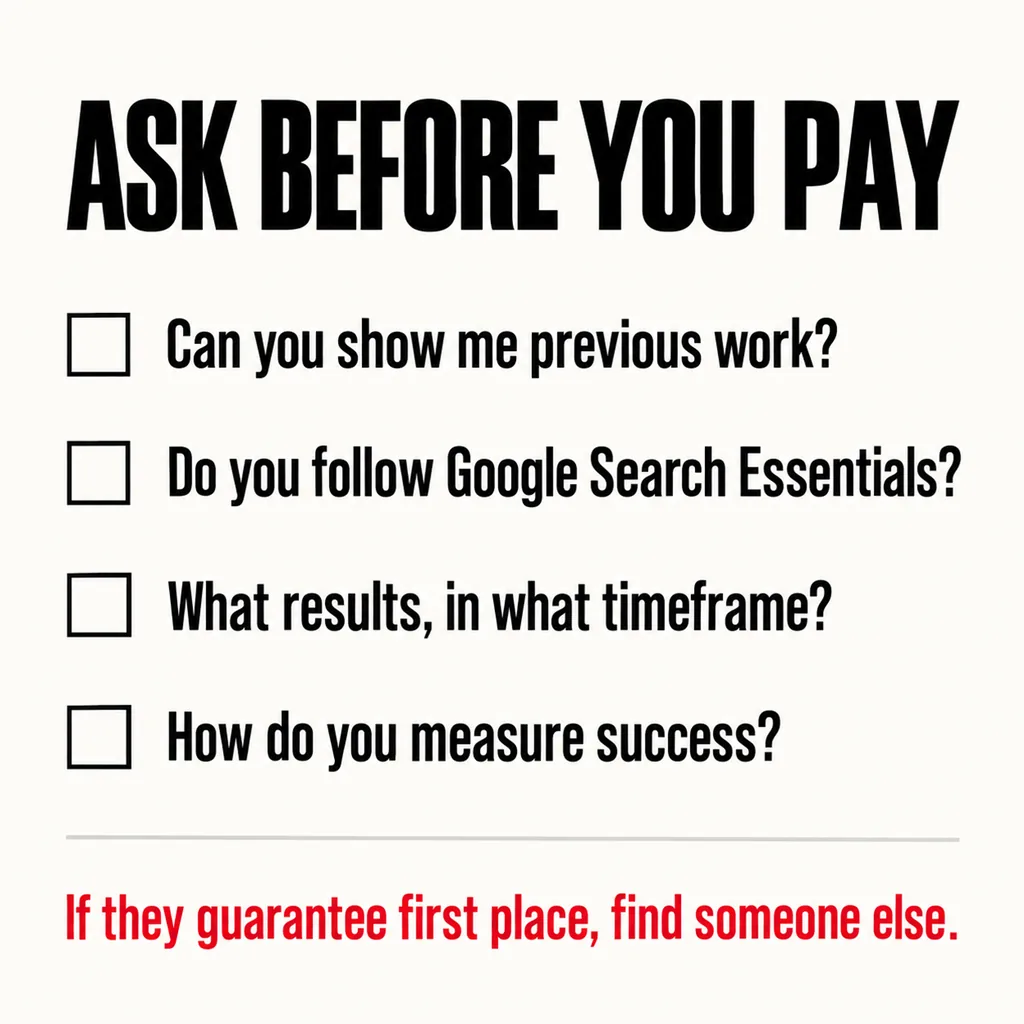
Google publishes the interview questions, which saves inventing your own. Its guidance for hiring an SEO suggests asking for examples of previous work, whether they follow the Google Search Essentials, what results they expect and in what timeframe, and how they measure success. Then it gives the clearest disqualifier in the whole document: “If they guarantee you that their changes will give you first place in search results, find someone else”. The same page states that no one can guarantee a number one ranking, and advises avoiding anyone who talks about link popularity schemes or submitting your site to thousands of search engines.
| What you hear | What it usually means | Worth paying for? |
|---|---|---|
| Guaranteed first page | A promise nobody can keep | No — this is the stated disqualifier |
| X backlinks per month | Links bought for ranking purposes | No |
| We will raise your DR to 30 | Moving a vendor score Google does not read | No |
| Fix your titles, speed and structure | On-page work you keep whatever happens | Yes |
| Write the pages you are missing | Content that can rank on its own merits | Yes |
Note the shape of the last two. They are things that stay yours — a faster site, pages that answer real questions, a structure people can navigate. That is the argument in our article on fixing structure rather than content, and it is also what holds up as search changes, which our pieces on SEO, AEO and GEO and whether your site is ready for AI search cover.
Longer than a gig delivery, and that is not a flaw. Google’s SEO Starter Guide puts it plainly: some changes might take effect in a few hours, others could take several months. Anyone selling results in two weeks is either selling something that does not work or something that works briefly and then costs you.
What a new or rebuilt site can reasonably expect is set out in how long a new website takes to show up on Google. If the aim is enquiries rather than rankings for their own sake, two more things matter more than any package: whether people believe you when they arrive, covered in website trust signals, and whether the search even sends a click at all, which is the subject of zero-click search. Service pages that answer the question outright are the most reliable way we know to earn both — see answer-first service pages.
Not illegal, but against Google’s published policy when the links are bought to influence rankings. The spam policy lists buying or selling links for ranking purposes as an example of link spam, and says sites that violate the policies may rank lower or not appear at all. Paid links are acceptable when marked so they do not pass ranking signals, which is how advertising and sponsorship are meant to work.
Get the list of every link and listing that was created, which is why the login spreadsheet matters more than it looks. Where you control the account, remove the link. Where you do not, Google provides a disavow tool, though it is a last resort rather than a first move. Then put the budget into pages and site speed, where the result stays yours.
Sometimes because the links are not doing the work people assume, and sometimes because nothing has caught up with them yet. Policy enforcement is not instant and is not uniform. Reasoning from a site that currently ranks to a tactic being safe is the same mistake as reasoning from a smoker who reached ninety. The published rule is the better guide than the visible exception.
Most Malaysian SMEs who have been burned by a cheap package did not buy the wrong vendor so much as the wrong thing: rented signals instead of owned assets. Our SEO service starts with what the site itself is missing — the pages that answer what people search for, the structure underneath them, and the technical faults holding the whole thing back. If that work keeps hitting the limits of the existing build, our guide to choosing between a revamp and a full rebuild sets out how to tell.