


Guides to writing a sales page are plentiful and mostly sound. Pick one audience. Lead with the outcome, not the feature. Put proof near the claim. End with a call to action that says what happens next. Follow all of it and the page will be better for it.
Then the guide stops, the page goes live, and nothing happens — not because the writing failed, but because nobody arrived to read it. A different fault from the one in why visitors come and nobody contacts you, which is traffic that lands and leaves. This is traffic that never lands, and it has a checkable cause.
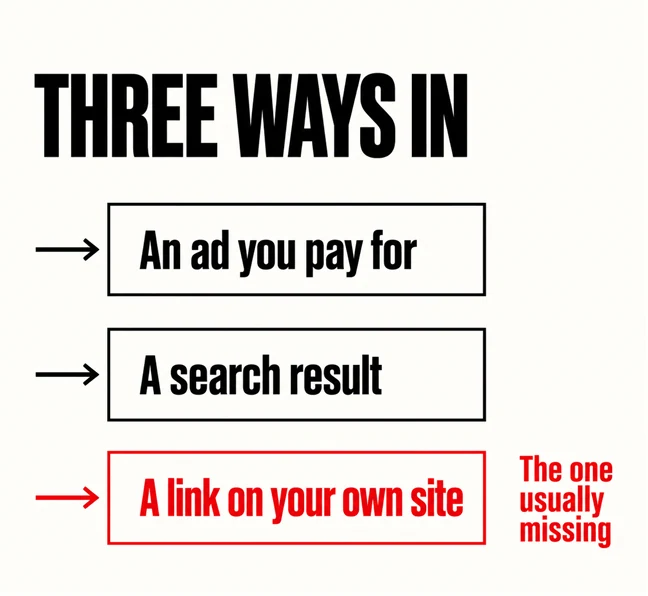
Three routes, and no fourth. A reader clicks an ad you are paying for, finds the page in a search result, or follows a link from somewhere else on your own site.
Most are built for the first and quietly assume the other two. That is where the trouble starts, because the second depends on the third. Google’s documentation on link best practices opens by saying it uses links as a signal when determining relevancy and to find new pages to crawl. Its sitemap page puts the mechanism plainly: crawlers crawl the web by accessing URLs found in previously crawled pages.
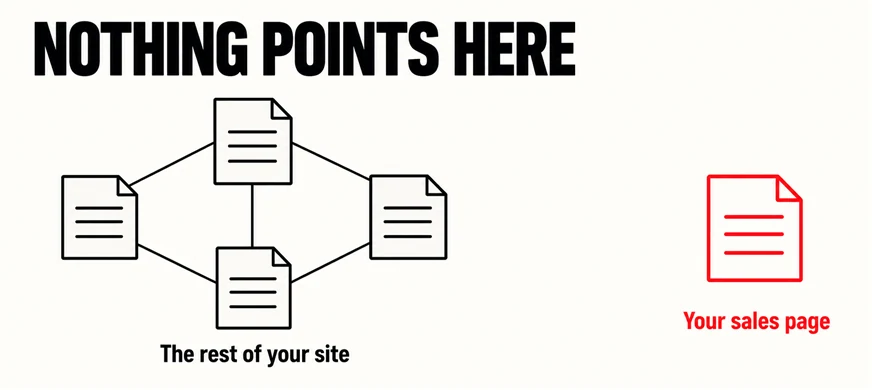
Read that with your sales page in mind. It was built outside the main navigation on purpose — no menu item, nothing in the footer, because a focused page should not offer exits. So of the three routes in, you have paid for one and removed the only one that feeds the other.
A sales page is the page on your site most likely to have nothing pointing at it.
If it exists to catch ad traffic and nothing else, that is a legitimate decision — though read where ad traffic should land first. If you expected search traffic too, it cannot currently earn any.
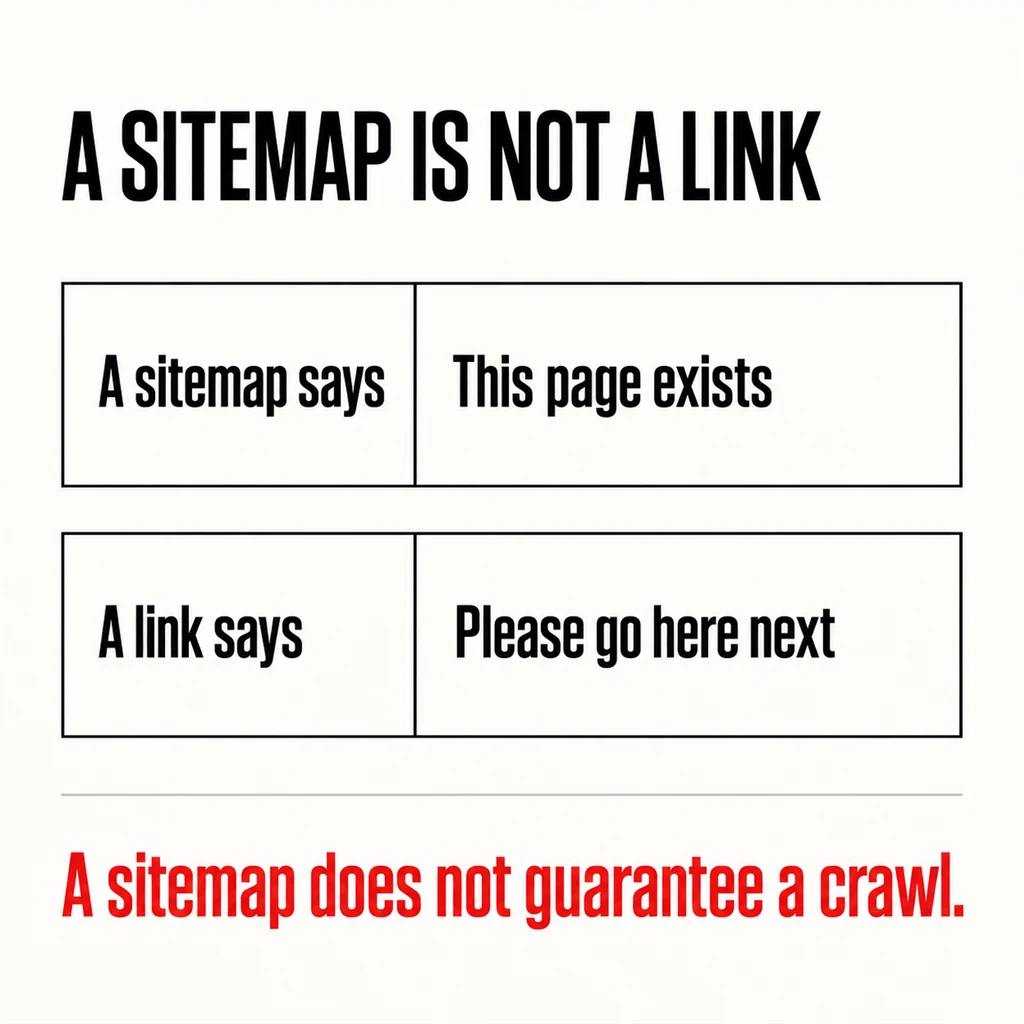
The usual reply, and half right. The page is in the sitemap because the CMS puts every published page there automatically. What it is not is a substitute for a link.
Google’s page on what a sitemap is for says it in one sentence: a sitemap helps search engines discover URLs on your site, but it does not guarantee that all the items in it will be crawled and indexed. The same page describes what it prefers — if a site’s pages are properly linked, Google can usually discover most of it, and proper linking means every page you deem important can be reached through some form of navigation, be that the menu or links placed on pages.
Note the phrasing. Not “listed in a file”. Reached. The sites needing no sitemap at all are the ones it calls comprehensively linked internally. A sitemap is a courtesy. A link is a route.
Underneath this sits a habit worth naming: that a page is safe because it exists somewhere in the system. The same instinct leaves pages up long after anyone needs them and listings up after the property has sold.
Suppose you add a link. It is worth checking that what you added is one. Google is specific: generally it can only crawl a link that is an <a> element with an href attribute, and cannot reliably extract URLs from tags made to behave like links through script events.
That sounds like a developer’s concern until you notice how often the button you dropped in from the page editor produces exactly the markup Google cannot read — a widget wired to an onclick handler, or a card made clickable by a script. Both work perfectly for a person with a mouse and are invisible as routes.
Page builders are a common source of this — one more item on the list of what a builder costs after the build. View source, look at the element behind the button: no href with a real address means you have a button, not a link.
Having made it a link, give it words that earn the click. Google’s guidance is that good anchor text is descriptive, reasonably concise, and relevant both to the page it sits on and the one it points to. It offers a three-second test: read the anchor text alone, out of context, and see whether it is specific enough to make sense by itself.
By that test “click here” and “read more” fail at once, and they are the phrases most likely to be attached to the one link that matters. “See what a website revamp includes” passes. It costs nothing and serves both the reader skimming for the right link and the crawler working out what sits at the other end — small wording doing more than a redesign would, which is also the lesson of the trust signals a visitor reads first.
None of it needs a tool you do not have. Four steps, in order:
| Check | How | What a bad answer looks like |
|---|---|---|
| Is anything linking to it? | Search your own site for the page title and see which pages mention it | Nothing does, or only the sitemap |
| Are those links real links? | View source and look for an href on the element | A button with an onclick and no href |
| Does the anchor text say anything? | Read it out of context | “Click here”, “read more”, or the bare URL |
| Is the page indexed? | Search Console, URL Inspection | Not on Google, or a status you have not read |
On that last step, two statuses in Google’s page indexing report get misread constantly. “Crawled — currently not indexed” means what it says: crawled, not indexed, may or may not be later, no need to resubmit. “Discovered — currently not indexed” means found but not yet crawled, which Google attributes to crawl scheduling — it wanted to crawl the URL, expected that to overload the site, and rescheduled.
Be careful with the second. Whatever you may be told, it is not a verdict on your internal linking. Fix the linking because the linking is worth fixing on its own terms.
Once traffic arrives the questions change shape — whether the page holds attention, whether the form works, what follows the click. Those are a landing page audit without guessing, the problems behind ads that do not convert and what happens after a form is submitted.
It changes the page from unreachable to reachable, which matters more than any wording change on the page itself. Google describes crawling as following links from pages it already knows, so one link from an already-crawled page puts yours on the map. It is not a ranking trick; it removes a blocker.
Usually not, and that is the honest tension. A focused page works partly by removing exits, and a menu item puts them back. One contextual link from the most relevant page gets you the crawl route without undoing the design. If the offer is the whole business rather than one campaign, the menu becomes reasonable.
The discovery problem is solved; the rest applies in a smaller way. Descriptive anchor text helps readers choose the link, and links from related pages send people who are already interested. If the page is indexed and getting no clicks, that is a different question, and the landing page audit is the better starting point.
Pages with nothing pointing at them turn up on almost every audit we run — a campaign page, a service page added in a hurry, an offer linked from a banner taken down two years ago. Our web development and design service maps what links to what before anything is redesigned, because moving a page is easy and finding the routes into it afterwards is not.