


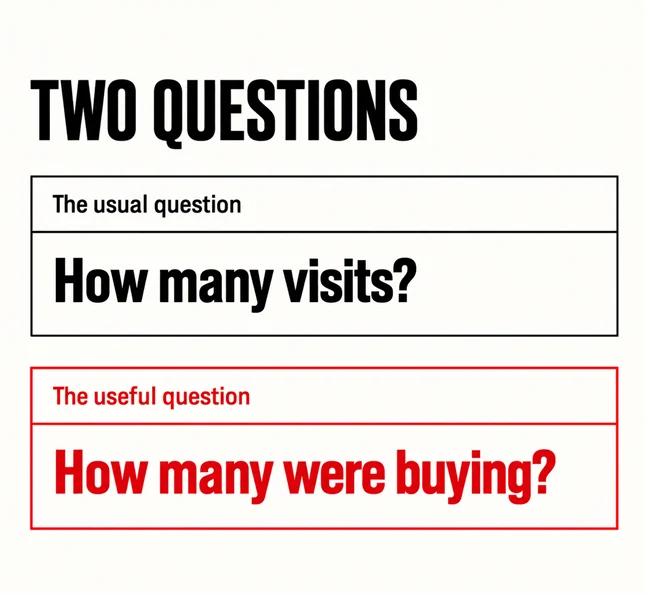
Most writing about corporate website traffic reaches the same sensible conclusion — that volume on its own proves nothing, and a thousand uninterested visits are worth less than one interested one — and then stops there. The next question goes unanswered: if the number is not the measure, what is?
For a manufacturer website the question is sharper than for most sites, because the audience is genuinely small. There may be only a few dozen companies in the country that specify your kind of component. Nothing you do to the site changes that, so the useful work is not getting more people in. It is being able to tell which ones came.
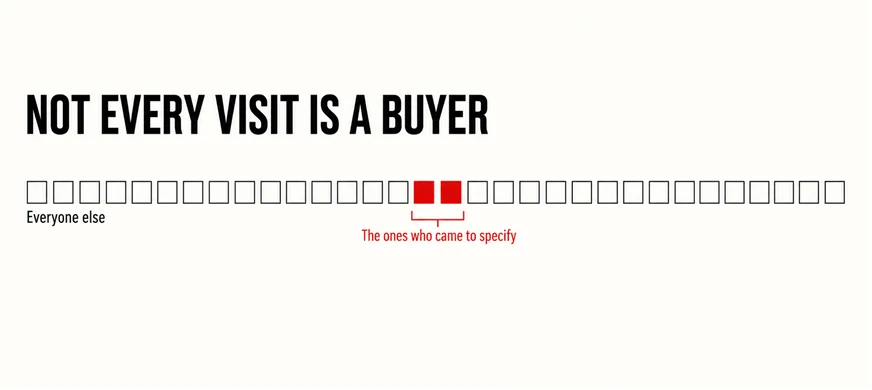
A consumer brand can treat traffic as a reasonable proxy for interest, because almost any adult could plausibly buy. An industrial supplier cannot. The people who matter are a procurement officer comparing two suppliers, an engineer checking whether a part meets a spec, and a distributor deciding whether to carry a line. Everyone else — students, jobseekers, rival suppliers, bots — lands on the same pages and is counted the same way.
Which means the headline number in your analytics is mostly made of people who were never going to buy, and a change in it mostly tells you something about them. A month where traffic doubles because one blog post was shared is not a better month for sales.
The useful question is not how many came. It is how many of the right ones came.
This is the same distinction behind rankings rising while traffic falls and behind a worse-looking competitor outranking you: the number on the dashboard and the thing you care about are two different quantities that happen to move together sometimes.
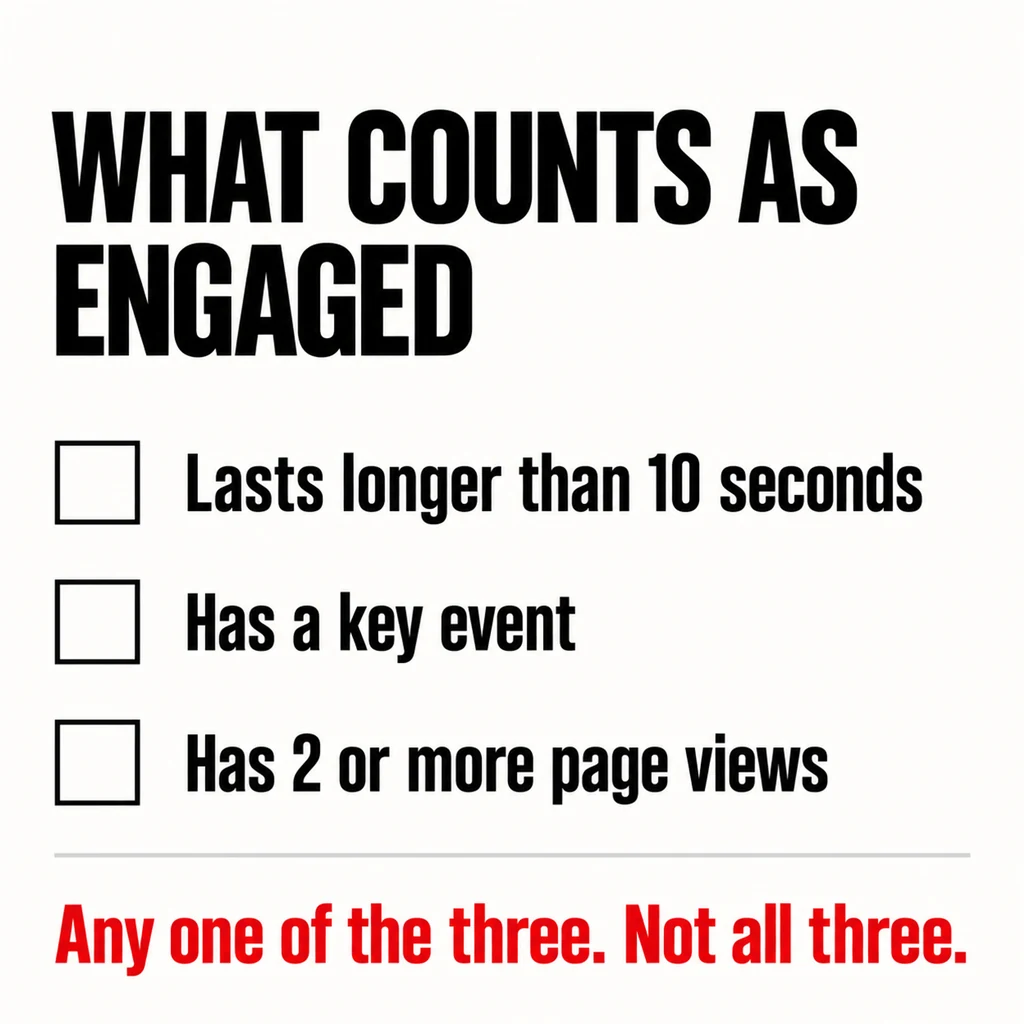
You do not need a new tool for this. Google Analytics publishes its definition, and it is stricter than most people assume. Its documentation on engagement rate and bounce rate says an engaged session is one that meets any of three criteria: it lasts longer than ten seconds, it has a key event, or it has two or more screen or page views. The engagement rate is the percentage of sessions that qualify, and bounce rate is simply its opposite — the percentage that did not.
Read the three criteria as a buyer would. A visitor who opens one page, does not scroll, and leaves inside ten seconds fails all three. A visitor who opens your product page, then the specification page, has met the third. Nothing here measures intent, but it separates arrival from attention, which is the first real cut.
Two cautions worth keeping. Ten seconds is a low bar, so a high engagement rate is not a compliment — it only means most sessions cleared it. And a key event counts only if someone configured one; a site with no events defined is measuring two of the three criteria and does not know it.
In Search Console the same confusion appears one step earlier. Google’s page on how impressions, position and clicks are counted defines an impression as how often someone saw a link to your site, a click as how often someone clicked through, and click-through rate as clicks divided by impressions.
The detail that changes how you read the report is this: an impression is generally counted whenever an item appears in the current page of results, whether or not it was scrolled into view. So a page sitting near the bottom of page one collects impressions from people who never looked that far down. A rising impression count can mean more interest, or it can mean you are appearing on more searches that were never yours.
That is also why average position moves without anything happening to your site — and why how long a new site takes to rank is a question with no tidy answer.
The single most useful filter on a manufacturer website costs nothing: split search queries into those containing your company name and those that do not.
Search Console’s performance report exists for this. Its queries dimension groups the data by the search query people typed, which lets you see which queries bring traffic and which pages earn the clicks. Filter the query list to exclude your brand name and what remains is the demand you earned rather than the demand you already had.
For most industrial sites the second list is short and that is the finding. People who search your company name were sent by a salesperson, a trade show or a catalogue; they were already yours. The queries that name a product, a material, a standard or an application are the ones that found you without an introduction.
| Look at | Where | What you are deciding |
|---|---|---|
| Engagement rate by page | Analytics, Pages and screens | Which pages hold anyone at all |
| Non-brand queries | Search Console, Queries | What you are found for without your name |
| Pages with impressions but no clicks | Search Console, Pages | Where the title and description are failing |
| Product pages missing entirely | Your own catalogue | What has no page to be found by |
Four readings, one decision each. None of them is a traffic number, and that is the point. If the honest answer after an hour is that the site has visits but no enquiries, the problem has moved downstream and why visitors come and nobody contacts you is the next thing to read; if a specific page is the one underperforming, a landing page audit without guessing is more use than another month of reports.
Two things are changing this picture and are worth watching rather than acting on yet: assistants now answer specification questions without sending a click, covered in whether your site is ready for AI search, and buyers increasingly start on a marketplace instead of a search engine, which is the argument in competing with a marketplace listing.
We will not quote a number, because a credible one does not exist for a category this narrow and anyone offering one is guessing. The useful comparison is your own site against itself over time, and page against page within it. A specification page with a far lower engagement rate than a product page is telling you something; the same page compared with an industry average is not.
It is normal for an established supplier and it is not a fault. It does mean search is currently confirming demand you created elsewhere rather than creating any, so the opportunity is in the non-brand list. Start with the products that have no page of their own — those cannot be found under any query.
Ads buy you the visits, which is reasonable while the organic list is short, but they do not fix the reason the list is short. The pages still have to answer the question a buyer typed. Running ads to a page that does not specify, certify or explain anything pays for the same failure at a faster rate.
On an industrial site we start by reading these four things rather than proposing a design, because they usually show that the problem is a missing page rather than an ugly one. Our web development and design service will say plainly when the existing site is sound and the gap is in what it covers — that answer costs less than a revamp and is sometimes the true one.