
- Resources
Innovative Thinking


A website revamp on a budget is decided by what you leave alone. Pick the three or four pages that already bring you work, spend the money there, and keep the platform, the addresses and the photographs that still do their job. The same amount spread evenly over twenty pages changes nothing a visitor would notice.
That order matters more when the budget is small, because a thin version of a full rebuild is the one outcome worse than doing nothing: new everywhere, better nowhere, and the search positions you had taken with it.
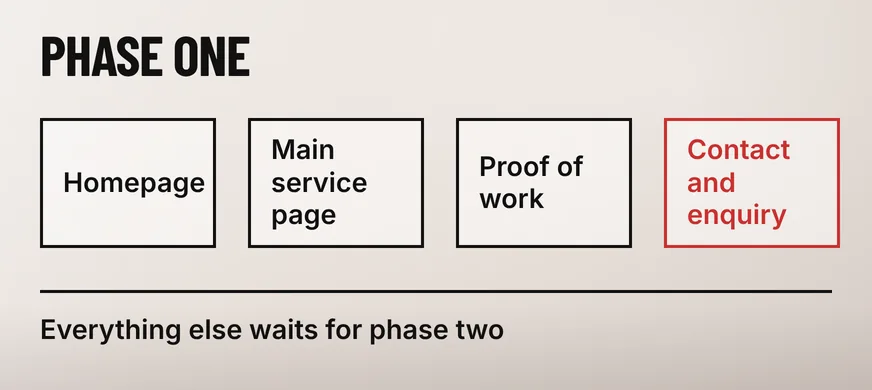
The pages a buyer actually passes through on the way to contacting you, and the speed of those pages on a mid-range phone. For most small business sites that is the homepage, one or two service pages, something that proves the work is real, and the enquiry path itself. Four pages done properly beat twenty done cheaply.
A buyer does not browse a site. They land on one page from a search or a WhatsApp link, decide in a few seconds whether this looks like a business that can do the job, look for one piece of proof, and then either message you or leave. Every ringgit spent outside that path is spent on something nobody is reading on the way to the enquiry.
The pages left out keep their current design until a later phase pays for them. Four current pages and sixteen dated ones read as a business getting on with things; twenty slightly improved pages read as nothing at all.
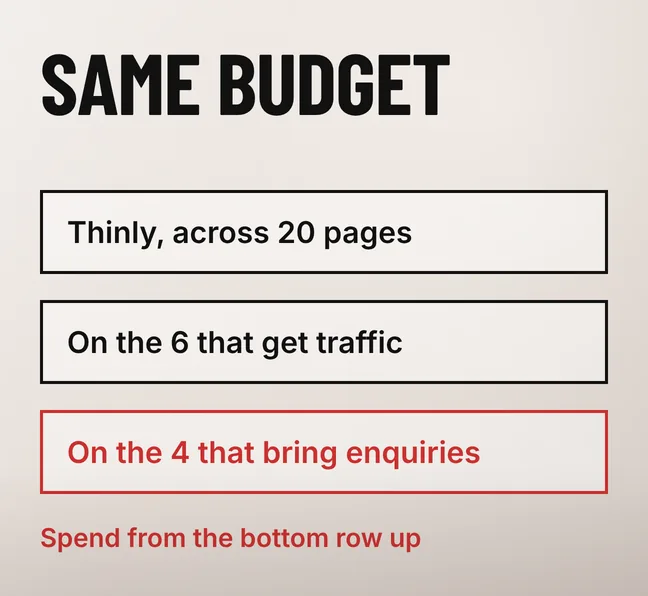
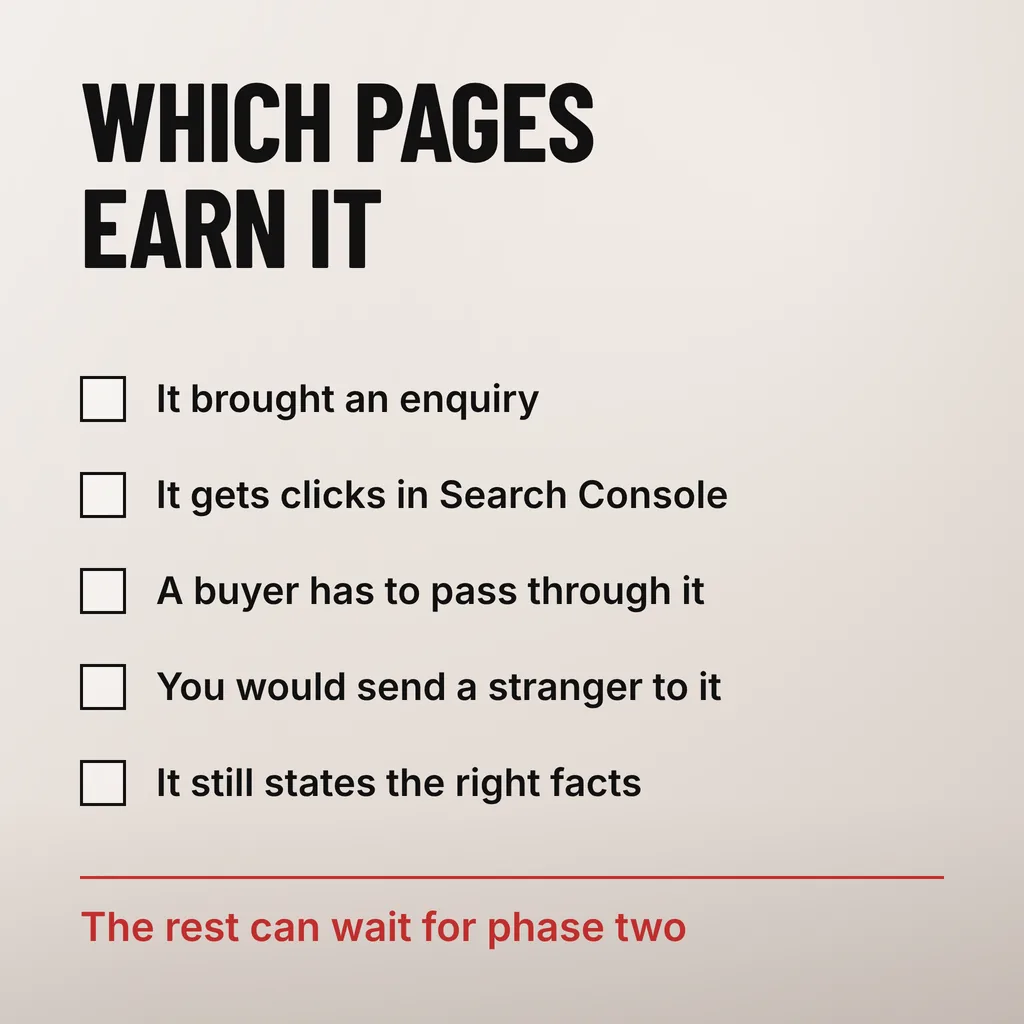
From two records you already have, not from an opinion about which page looks worst. Take the pages that produced a real enquiry in the last six months, add the pages that earn clicks in Google Search Console, and keep the ones that appear on both lists. That overlap is usually four to six pages on a small business site.
Search Console reports which queries brought people to which page, and your inbox, your WhatsApp and your quotation file say which of those visits turned into work. One without the other misleads. A blog post can pull steady traffic and never produce an enquiry; a service page can get almost no search traffic and close most of the jobs because everyone arrives there from a referral.
Pages that fail all five are candidates for deletion rather than redesign, and deleting a page costs nothing. Keep the address alive with a redirect to the nearest page that still answers the question.
Six things move the number far more than the rest: how many pages are in scope, whether the design is drawn from scratch, how much new content and photography is needed, whether the platform changes, how many custom functions are built, and whether the addresses change. Each has a cheaper option that keeps most of the result.
| What drives the cost | Why it moves the number | The cheaper choice |
|---|---|---|
| Number of pages in scope | Every page is designed, written, built and checked separately | Start with the four to six pages that passed the test above |
| Design drawn from scratch | Bespoke layouts are drawn, built and tested with nothing to start from | Adapt a well-built theme and spend the saving on photographs and copy |
| New content and photography | Someone has to write the words and shoot the pictures | Reuse what is still accurate; commission one proper shoot of your premises and finished work |
| Changing platform | Everything is rebuilt, migrated and re-tested, including things that worked | Stay on the platform you have if it still receives updates and someone can maintain it |
| Custom functions | Booking, payment and member areas need specification, building and testing | Launch with a form or a WhatsApp link, and build the function once the demand is proven |
| Changing the addresses | Redirects, re-indexing and a period of unstable search positions | Keep the URLs that already rank, even when they are untidy |
The published price ranges for Malaysian revamps vary widely between agencies, and none of the ranges on those pages is sourced, so treat them as advertising rather than a budget. The number you can rely on comes from asking two or three suppliers to quote against one written scope: the same page list, the same functions, the same content arrangement. We have written separately about what moves the cost of a website revamp, and the useful question is which drivers you are paying for, not which package you are in.
Because a rebuild usually changes the addresses, and the addresses are carrying your search positions. A cheap quote that starts from a blank site often arrives with a new URL structure, no redirect plan and no inventory of what the old site ranked for. The design saving is real and the lost enquiries are larger.
Google is explicit about what a move of that kind does. Its site move with URL changes guidance says that “With any significant change to a site, you may experience ranking fluctuations while Google recrawls and reindexes your site”, warns against the shortcut most cheap rebuilds take — “Don’t redirect many old URLs to one irrelevant single URL destination, such as the home page of the new site” — and tells you to “Keep the redirects for as long as possible, generally at least 1 year”.
So the questions to put to any quote are short. Do the page addresses stay the same? If not, is there a redirect from every old address to the page that answers the same question, and who writes that list? A supplier who cannot answer both has not priced the work, whatever the figure at the bottom says.
Three things: how fast the chosen pages load on a mid-range phone, whether the enquiry path works end to end, and whether the facts on the page are current. All three are cheap to get right during the work and expensive to retrofit, and a slow or broken page undoes whatever the design achieved.
Speed has a published target rather than an opinion. Google’s guidance on Largest Contentful Paint says “sites should strive to have Largest Contentful Paint of 2.5 seconds or less”, measured at “the 75th percentile of page loads”. Largest Contentful Paint “reports the render time of the largest image, text block, or video visible in the viewport”, which on most small business pages is the big picture at the top — so compressing that one image properly is often most of the fix.
The enquiry path needs testing on a phone, by someone who did not build it, before launch and again a week after. Send the form and confirm it lands in the inbox people actually read. Tap the WhatsApp button and check it opens the right number. A form that quietly stops delivering complains to nobody.
The facts are free to fix and the most embarrassing to leave: your registered name and number, the areas you serve, the services you still offer, the prices or ranges that have moved. None of that needs a designer.
Cut the phases by what each one is supposed to earn rather than by section of the site. Phase one takes the four to six pages on your list to a standard you would send a stranger to. Phase two takes the next tier of pages once the first has had a few months to show whether the enquiry count moved.
Set the work up so that phase two reuses phase one. The same theme, the same components, the same content pattern, so the second phase is content and arrangement rather than design. Running a revamp in phases only saves money when the phases share a foundation; otherwise it is two projects with one invoice each.
Give each phase a decision point rather than a date. Three months after phase one, read the same two records you used to choose the pages and see whether the enquiries moved. A flat result is useful information, and it is cheaper to learn on four pages than on twenty.
There is no single figure worth quoting, and the ranges published on agency pages are unsourced marketing. Get two or three quotes against one written scope — the same page list, the same functions, the same content arrangement — and compare them line by line. The spread between quotes for identical scope tells you more about the suppliers than any published range does.
Usually yes, and the saving is largest on a small site. A well-built theme has already solved the mobile layout, the typography and the component library, so the work becomes arranging your content inside it. The trade-off is that your site will share its underlying structure with others; on a four-to-six page revamp, photographs and copy do more for distinctiveness than a bespoke grid.
Yes, and the part to take on is the content. Gathering the service details, the photographs, the proof and the answers you already type into WhatsApp is the work that stalls most projects, and nobody outside the business can do it. Leave the build, the redirects and the speed work to whoever is accountable for the site still working afterwards.
We would rather do four pages properly than twenty thinly, and we start by asking which pages brought you an enquiry this year. Our website revamp service keeps the platform and the addresses wherever they still work, so the budget goes into what a buyer sees. One thing to do this week: open Search Console, sort your pages by clicks, and write down the four you would send a stranger to.