


Start by working out who can change the site, not what it should look like. An inherited website — the one nobody still at the company can explain — is usually revampable, and what makes it feel hopeless is rarely the code. It is that nobody knows which account controls the domain, and nobody knows what the site is quietly doing in the background.
The person who built it has gone. The staff who briefed them have gone. What is left is a live site, a renewal that lands every year, and a folder of logins that may or may not still work. That is a reason to spend the first week finding things out, and not a reason to rebuild from scratch.
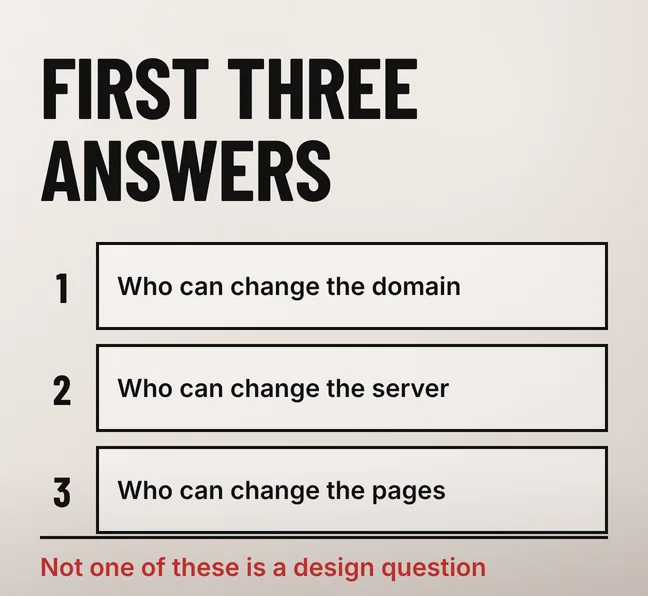
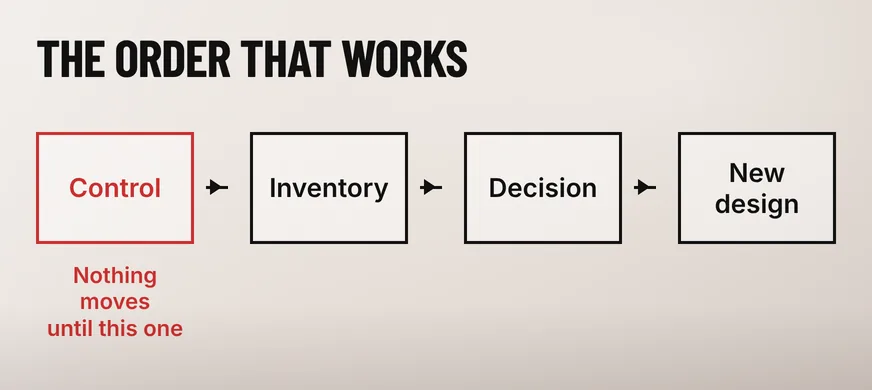
Start with control. Before anyone discusses layout, establish which account can change the domain, which can change the server, and which can change the pages. A website with no clear answer to those three is a business risk before it is a design problem, and the order matters: no redesign fixes a domain you cannot reach.
The sequence that works is control, then inventory, then the decision about scope, then the new design. It gets run backwards often enough to be worth naming: the redesign is quoted first, and the domain renewal notice turns out to go to a personal address belonging to someone who left years ago. The design work stops there, because it has to. Neither of the first two stages needs a developer, only somebody with the company’s own billing records and patience for hold music.
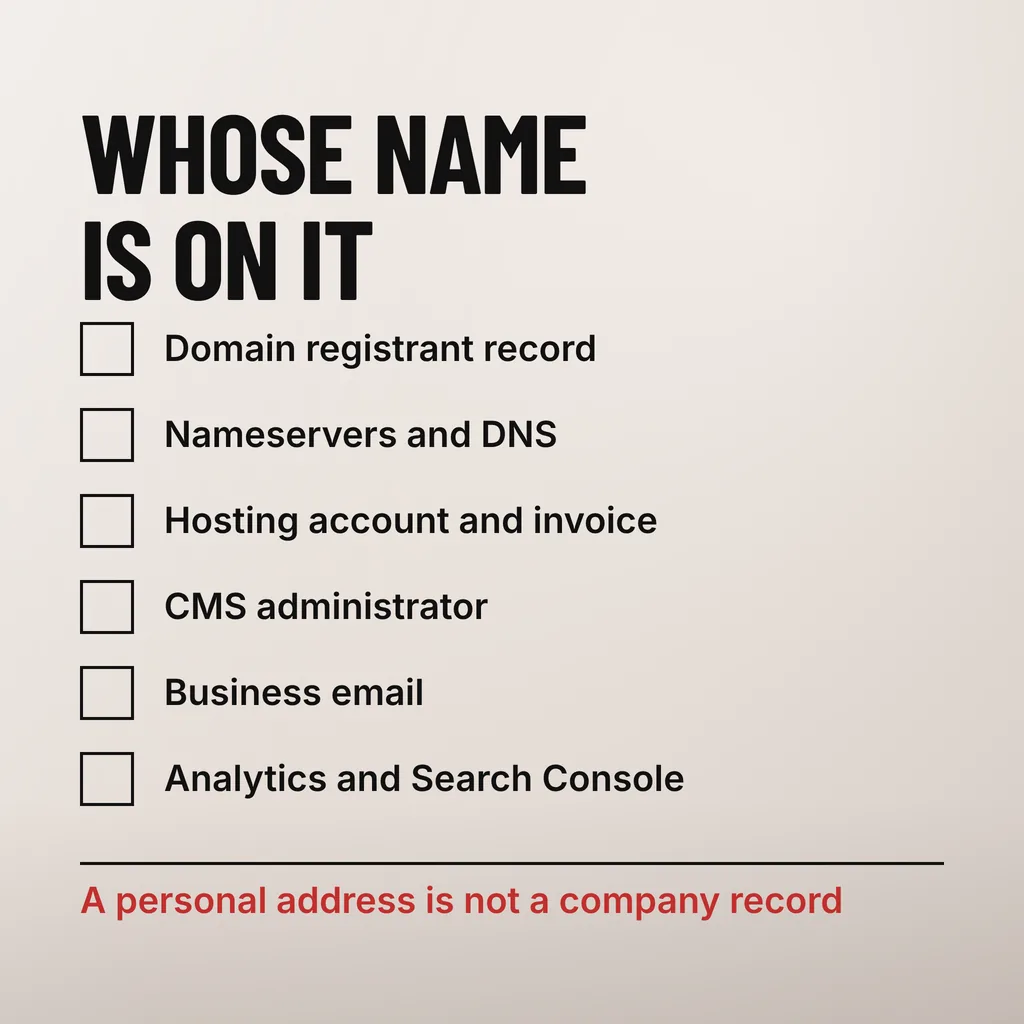
Look up the domain’s registrant record first, then the hosting invoice. The registrant record names whoever the registry treats as the holder of the name; the invoice names whoever is paying for the server. For a Malaysian domain the email address sitting on that record matters as much as the name, because recovery runs through that address.
MYNIC is the registry for .my domains, and its Registrant Policy, effective 26 May 2025, is strict about what counts as a change. Its paragraph 12 states that registrants may transfer a registration to another registrant “provided they meet the eligibility criteria outlined in Paragraphs 6, 7, and 8 of this Policy”, that such changes are “subject to verification procedure implementation”, and that “the new Registrant must enter into a Registrant Agreement”. The same paragraph counts a change to the registrant’s email address as a change of registrant, not a detail edit.
Two readings follow, and they are ours rather than MYNIC’s. A .com.my cannot sit in an individual’s name in the first place: every eligibility criterion in the policy’s paragraph 8 is an entity — a company under the Companies Act, a business registered under the Registration of Businesses Act 1956, a professional firm, a statutory body. And because changing the email on the record triggers verification and a fresh agreement, a domain whose contact address belongs to a former employee is a form-and-document job with a lead time rather than a phone call.
Six records need checking, not one: the registrant record, the nameservers, the hosting account and its invoice, the CMS administrator list, the business email and the analytics properties. Any of them standing in a personal name is a loose end. Email deserves particular care, because on a small business setup it usually runs on the same DNS as the website, so a careless nameserver change takes the enquiries down with the pages.
Where the records themselves are the argument — a developer claiming the domain, or a company that has closed — who actually owns your website, you or your developer sets out how that question is settled.
Build an inventory from the outside in, from sources that need nobody’s memory: the sitemap, Search Console, the analytics account and the live pages themselves. An undocumented website gives up most of what it is doing to somebody willing to read its own public records for an afternoon, long before anyone opens the code.
| What you need to know | Where the answer is, with nobody to ask | What it changes |
|---|---|---|
| Which pages exist | The XML sitemap, then the page list inside the CMS | The real scope, and which pages nobody has opened in years |
| Which pages earn anything | Search Console queries and clicks; analytics landing pages | What has to survive the revamp untouched |
| What it is built on | The page source, the login screen, the hosting control panel | Whether an upgrade path exists, or the platform is the problem |
| Where enquiries go | Submit every form yourself and follow where it lands | Whether enquiries are being lost right now |
| What renews, and when | The company card statement and the billing inbox | Which deadline is closest, usually the domain |
| What runs on a schedule | Scheduled tasks in the control panel, plugin task lists | Whether something has been failing quietly for months |
Submit the forms yourself. It is the cheapest check on the list and the one skipped most often. A contact form posting to an inbox nobody monitors, or to an address that started bouncing when a mailbox was closed, is losing work today, and no design brief would have found it.
If Search Console was never set up, set it up now and accept that the data starts from today: a property that did not exist has no history to show you. One more argument for doing the records stage in week one rather than week six.
Usually not. A site nobody understands has a documentation problem, and documentation can be written after the fact. Rebuild when the platform itself blocks the work: software too old to update safely, an account or licence that genuinely cannot be recovered, or custom code holding the content in a format nothing else can read.
The test is narrower than it feels. Can you log in, change a page, and see the change appear? Can you take a backup and restore it somewhere else? Two yeses mean you have a site you can work on, however untidy its insides are. Nobody understanding it is a cost — the first developer you hire spends time learning what the last one knew — rather than a blocker.
What does turn a revamp into an expensive mistake is losing the addresses. Google’s site-move documentation, “How to move a site”, says it is important to map your old site’s URLs to the URLs for the new site, and advises keeping the redirects “for as long as possible, generally at least 1 year”. On an inherited site that mapping is harder than usual, because nobody can tell you which old pages mattered. The Search Console export from the previous section is what answers it.
Deciding what survives is a piece of work in itself, and what to keep from an old website and what to let go covers how that choice is made.
Write one page, and keep it where the company keeps its other records. The page names every account the website depends on, who holds it, what it costs and when it renews. A website becomes unmanageable through the loss of that page rather than through the loss of the person who built it, which is why rewriting it is the last task of the revamp.
Keep it in the finance folder rather than on the website, and read it again whenever somebody with access leaves. The handover that failed here was never a technical one.
Almost never. Recovery runs through whoever is named on the records rather than whoever remembers a password: the registrar holding the domain, the host holding the server, the provider holding the mailboxes. Each has a recovery process, and each asks for proof that you are the business — invoices, company registration documents, the card that paid. Start with the domain, because that is the one with a deadline.
Rarely the cheaper route. A rebuild discards the pages that already bring in search traffic and the addresses behind them, and it does not fix the real problem, which is that nothing was written down. Establish what you have first, then decide. Rebuild when the platform cannot be updated safely, or the content cannot be got out of it in a usable form.
Allow about a week for the records and an afternoon for the content inventory, provided the logins work. Where control has to be recovered from a former employee or a company that has closed, the timeline belongs to the registrar and the host rather than to you, and verification can add weeks. Begin before the next renewal date, not after it.
An inherited site is the case a revamp is built for: it stays up, the addresses stay put, and whatever still earns its place is kept. Our website revamp service starts from what the current site is doing rather than from a new design, which on a site nobody can explain is the only sensible place to begin. One thing to do this week: look up your own domain’s registrant record, and check whose email address is on it.