
- Resources
Innovative Thinking


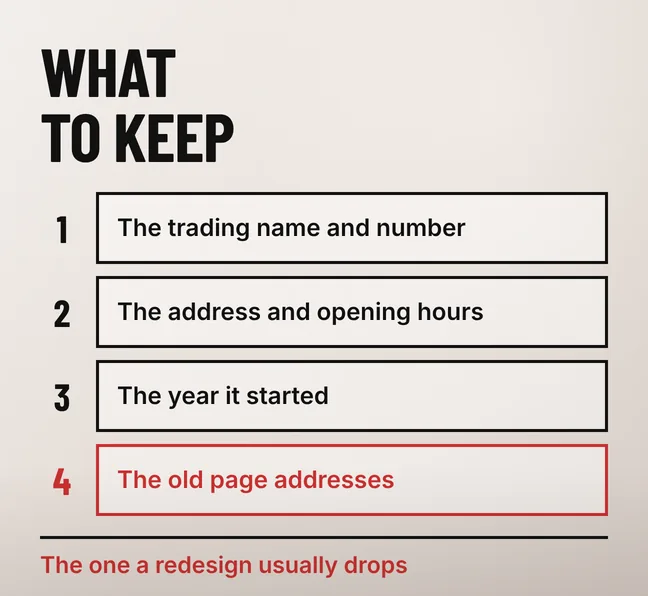
Keep the things the business spent years earning, and change the things that were never the point. On a family business website that means holding on to the trading name as customers say it, the registration number, the shop address, the year it started and the page addresses that already collect links — while the layout, the enquiry path and the loading time are rebuilt underneath them.
Most handovers do the opposite. The new site arrives looking current, the history page is gone, the old addresses return 404, and the enquiry form is still the one that stopped sending email in 2021.
Keep the identity and the evidence: the trading name spelled the way customers search for it, the company registration number, the physical address and opening hours, the year the business began, the names of the people who answer the phone, and every page address that other sites already link to. Those took years to accumulate. A layout takes weeks.
| What to keep | Why it is worth money | How it usually disappears |
|---|---|---|
| Trading name and registration number | Customers and procurement check both before they buy | A new footer drops the number as clutter |
| Address and opening hours | The detail a local searcher is looking for | Moved into a form and never written out again |
| The year it started | The one credential a newer competitor cannot copy | Cut with the history page in a tidier rewrite |
| Old page addresses | Years of accumulated links point at them | A new URL structure with no map from the old one |
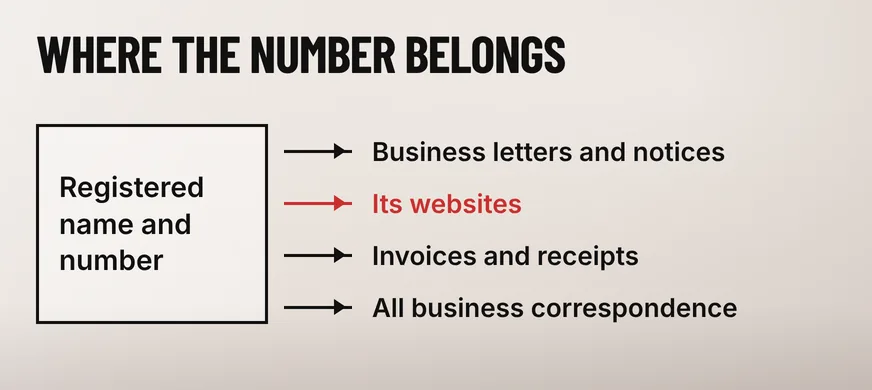
The registration number is not a style choice for a company. Section 30 of the Companies Act 2016, as consolidated by the Companies Commission of Malaysia to 31 January 2025, requires that a company “disclose its registered name and company registration number on” a list of places that includes “its business letters, notices and other official publications, including in electronic form” and, as its own paragraph, “its websites”. Subsection (5) adds that “the company and every officer who contravene this section commit an offence”.
One subsection matters more than owners expect during a handover. Where a company has changed its name, section 30(4) requires that “the former name of the company shall appear beneath its present registered name for a period of not less than twelve months from the date of the change”. A second-generation rename is not just a new logo: for a year, the footer carries both names. Whether the business needs a rename at all is the question our comparison of a revamp against a full rebuild works through.
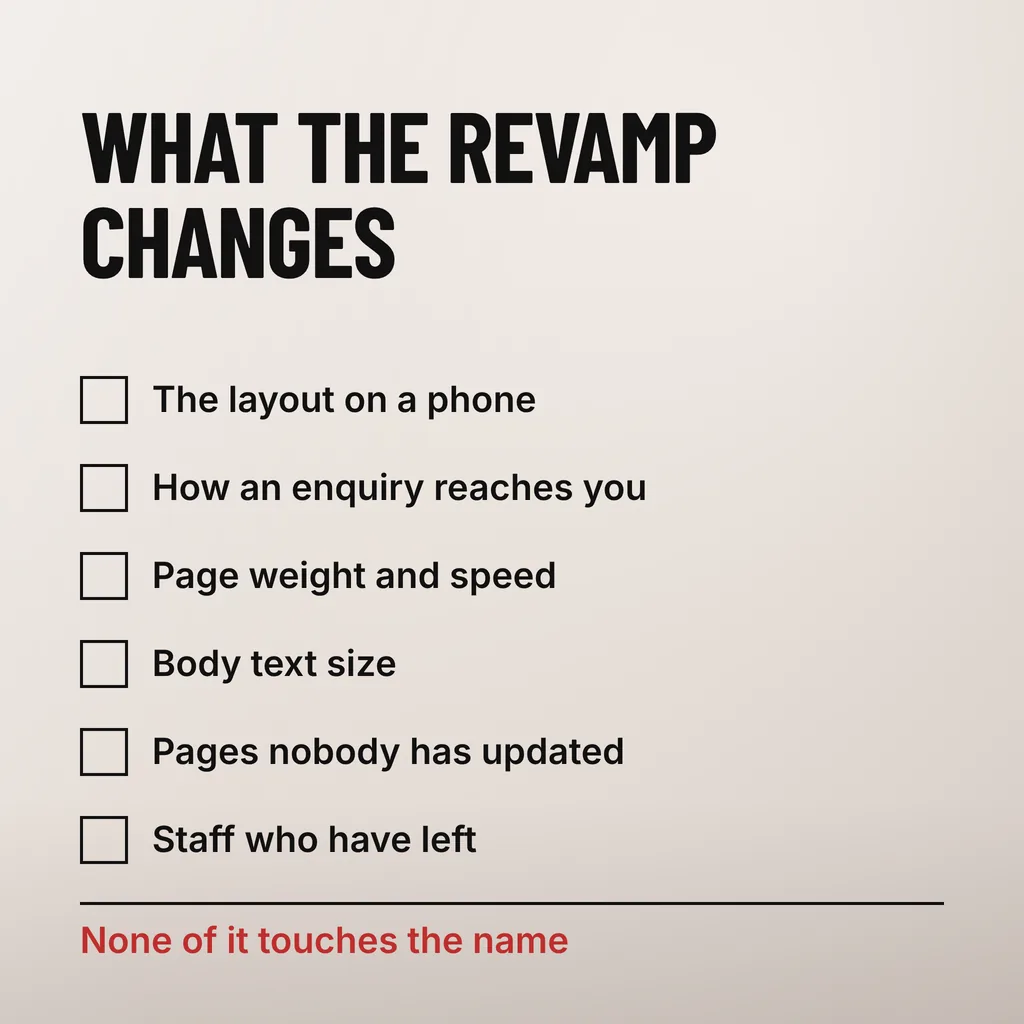
Change the things the last fifteen years of phones and browsers made obsolete: the desktop-only layout, the enquiry path, the page weight, the body text size, and the pages nobody has opened since they were published. None of that touches the name, the address or the history, which is why a revamp can be aggressive about it.
Changing the design of a page is not the same as changing its address. If the revamp moves content to new URLs, map every old address to its replacement and keep a permanent redirect at each one: Google’s site-move documentation says to “keep the redirects for as long as possible, generally at least 1 year”, because that “timeframe allows Google to transfer all signals to the new URLs”, and states plainly that “301 and other permanent redirects don’t cause a loss in PageRank”. Keeping them longer costs nothing.
Name both on the same page. An about page that says who founded the business, in which year, and who runs it now reads as continuity; one that says only “established 1987” with a stock photograph reads as a business hiding something. The founder stays on the page after the handover, with the dates stated rather than implied.
Search guidance points the same way. Among its self-assessment questions for expertise and trust, Google’s Search Central documentation asks “does the content present information in a way that makes you want to trust it, such as clear sourcing, evidence of the expertise involved, background about the author or the site that publishes it”, and of the aspects it groups as experience, expertise, authoritativeness and trustworthiness it states that “of these aspects, trust is most important”. It also asks whether content demonstrates “first-hand expertise and a depth of knowledge”, which a workshop that has rebuilt the same gearboxes for thirty years has and a new competitor cannot assemble. Who is behind your website sets out what belongs on that page.
Two things to avoid. Do not quietly remove the founder once the next generation takes over: the customers who still ask for them by name will read the absence. And do not date the handover vaguely, because a sentence naming the year the business passed over beats “recently modernised”.
Settle the list before anyone opens a design tool, and give each item one owner. Most family revamps stall because the argument happens over a mockup, where every objection sounds like a matter of taste. Written as three columns — fixed, open, and decided by whoever owns the outcome — the same discussion takes an afternoon.
One honest limit: this is a process for agreeing, not a guarantee of agreement. Where a family genuinely disagrees about what the business now is, the website cannot settle it, and a revamp built on an unresolved split tends to arrive as a compromise nobody defends.
If the business is a company, yes. Section 30(2) of the Companies Act 2016 requires a company to disclose its registered name and company registration number on its websites, among other places, and subsection (5) makes a contravention an offence. A sole proprietorship or partnership is registered under different legislation and is not bound by that subsection, but showing both anyway is the quickest way to answer a cautious buyer.
Keep it, and put it where it is read rather than in a footer. A founding year is the one credential a newer competitor cannot match, and for a family business it is usually the reason a customer chose it. Pair it with something the years produced — work the business does now that it could not do in its first decade — so the date reads as evidence rather than decoration.
Partly, and it is often the right first move. Page weight, image compression, body text size, the enquiry path and broken links can all be fixed inside the existing design, and that work is what a visitor actually feels. What it cannot fix is a desktop-only layout or a structure nobody can navigate on a phone; at that point the layout itself is the problem.
A family business site is usually worth more than it looks, and the risk in a handover is throwing away the part that was earned. Our website revamp service keeps the name, the history, the registration details and the page addresses intact while the layout, the enquiry path and the speed are rebuilt. One thing to do this week: write the fixed list — name, number, address, founding year, the pages that must survive — and have both generations initial it before any design starts.