
- Resources
Innovative Thinking


Google’s helpful content guidance means your blog is judged post by post on whether a reader got what they came for, and the fastest way to act on it is to stop publishing and start sorting. The guidance is a self-assessment rather than a switch: it hands you a list of questions to ask about a page and expects you to answer them honestly about your own.
For a Malaysian business with eleven posts, four of them written to fill a schedule, that is good news. There is no penalty to appeal and no target to hit. There is a decision to make about each post you already have, and the three questions below make it in about ten minutes a post.
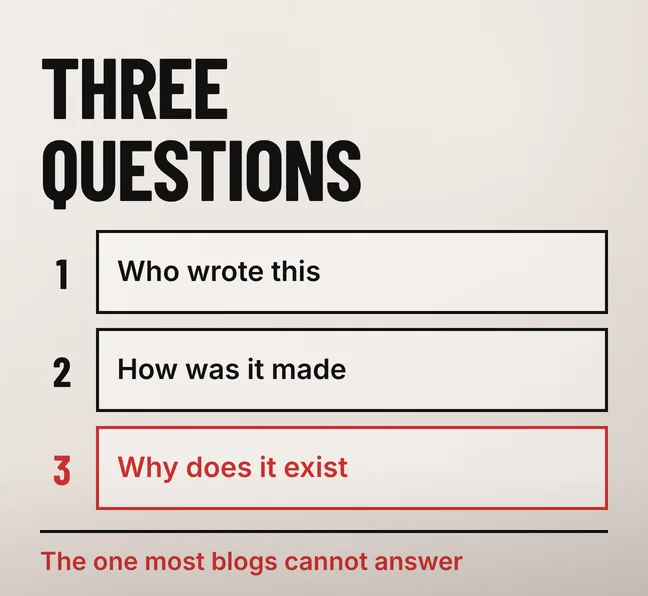
Content made primarily to help a reader rather than to rank, assessed through three questions about every page: who created it, how it was produced and why it exists. Google publishes those questions as a self-assessment and states the test for the third one outright — the reason for publishing should be to help people, not to attract search traffic.
The questions come from Google Search Central’s guidance on creating helpful, reliable, people-first content, and they are blunter than most summaries of them. Two are worth reading against your own last post: “Does the content provide insightful analysis or interesting information that is beyond the obvious?” and “Is this the sort of page you’d want to bookmark, share with a friend, or recommend?”
One clarification saves wasted effort: Google states that experience, expertise, authoritativeness and trust — E-E-A-T — is not itself a specific ranking factor, and that of the four, trust matters most. It describes what the systems try to reward, so adding an author box moves nothing on its own.
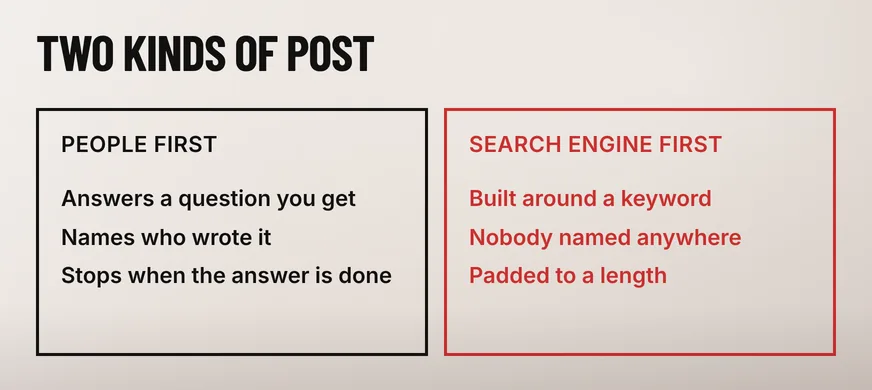
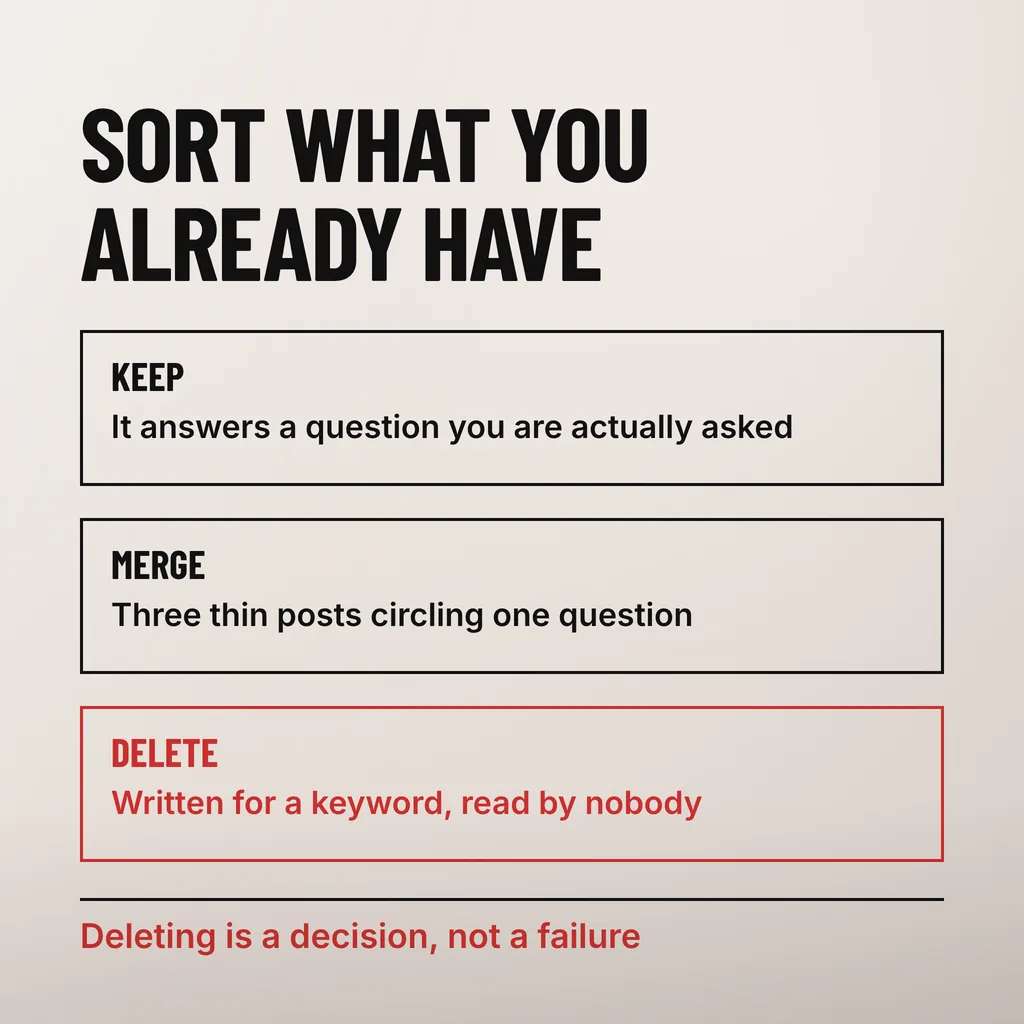
Keep the posts that answer a question a customer actually asks, merge the thin ones circling the same question, and delete the ones written for a keyword that nobody reads. Most small business blogs hold more of the third kind than the owner expects, and removing them is the fastest response to this guidance.
| The post you have | What to do with it | Why |
|---|---|---|
| Answers a question you get on WhatsApp every month | Keep, and keep it current | It earns its place before search enters it |
| Three 400-word posts circling one question | Merge into one, redirect the other two | One complete answer beats three partial ones competing |
| A keyword-led post with no enquiries and nothing original in it | Delete and redirect to the nearest real page | This is the search-engine-first page Google’s warning signs describe |
| A post that ranks but brings nothing back | Diagnose before you touch it | A ranking with no clicks is a different problem; rankings that stop sending traffic covers the causes |
Do the sort against your own records rather than a tool: list every post and write beside it the last enquiry or conversation it produced. A post with nothing in that column after two years is not waiting for an algorithm to notice it.
Deleting is the part owners resist, and it admits nothing. A page nobody finished reading was costing you the internal links pointing at it and the five minutes a year spent wondering whether to refresh it.
No. Google’s guide to its ranking systems lists the helpful content system under retired systems: announced in 2022 as the Helpful Content Update, it evolved in March 2024 and became part of the core ranking systems, which Google describes as using “a variety of signals and systems to present helpful results to users”.
That changes how you read advice written between 2022 and early 2024. There is no separate classifier to recover from and no update date to pin a traffic change to; Google says its retired systems have “either been incorporated into successor systems or made part of our core ranking systems”. Nothing you do here produces a dated recovery, so rewriting six posts properly is worth doing for the readers who open them, which is also the only honest way to describe it.
No, and Google answers this one directly. Its guidance on people-first content asks whether you are “writing to a particular word count because you’ve heard or read that Google has a preferred word count?” and replies, in its own parenthesis, “(No, we don’t.)” Length is a symptom of the answer being complete, not a target to reach.
Readers make the case more forcefully than Google does. Jakob Nielsen’s Nielsen Norman Group analysis How Little Do Users Read?, published on 5 May 2008 from 45,237 page views, concluded that “on the average Web page, users have time to read at most 28% of the words during an average visit; 20% is more likely”. That figure is eighteen years old, and no measurement since has argued that people read more.
The padding is read by nobody and still has to be maintained. Write the answer, add what the reader needs to act on it, and stop: a 700-word post that settles the question beats a 2,000-word one with the same answer in paragraph nine. If the question behind this is whether blogging is worth the effort at all, whether blog posts still work for a small business is the prior decision.
Not by itself. Google’s position is about effort and oversight rather than the tool: using generative AI “to produce large amounts of text without manual oversight or curation represents little to no effort”. A post drafted and then rewritten with your own knowledge in it is a different object from forty pages generated overnight.
The line Google polices is scale without judgement. Its March 2024 spam policy announcement, written by Chris Nelson for the Google Search Quality team, defines scaled content abuse as the case where “many pages are generated for the primary purpose of manipulating Search rankings and not helping users”. Forty posts in a week from one prompt is that; one post you argued with and corrected is not.
Disclosure is a judgement call, which Google frames as answering a reader’s likely question about how the page was made. The useful version on a service blog is positive: say where the content came from. A line noting that the measurements come from your own jobs, or that a range reflects quotations you issued this year, settles the Who and the How at once.
There is no fixed window, and anyone offering one is guessing. Since March 2024 the helpful content system has been part of Google’s core ranking systems rather than a separate classifier, so there is no update date to count from and no recovery announcement to wait for. Judge the work by whether the page now answers the question, then watch Search Console impressions over months rather than days.
Rewrite it when the question behind it is one your customers ask and the post simply answers it badly. Delete it when the question was never theirs — a keyword-led post on a topic you do not serve has nothing to rescue. If you delete, redirect the URL to the nearest genuinely relevant page rather than the homepage, so the few links it has keep pointing somewhere useful.
Not for being AI-written. Google’s guidance targets text produced at volume “without manual oversight or curation”, and its spam policies name the generation of many pages to manipulate rankings. A post you drafted with a model, then corrected, sourced and filled with what you actually know, is judged on the same questions as any other page.
Most blogs we are asked to look at do not need more posts; they need a decision about the ones already there. Our SEO service starts with that sort — which pages answer a real question, which three should become one, which should go — because the archive is where the work is cheapest. One thing to do this week: open your five oldest posts and write down, for each, the last customer conversation it caused.