
- Resources
Innovative Thinking


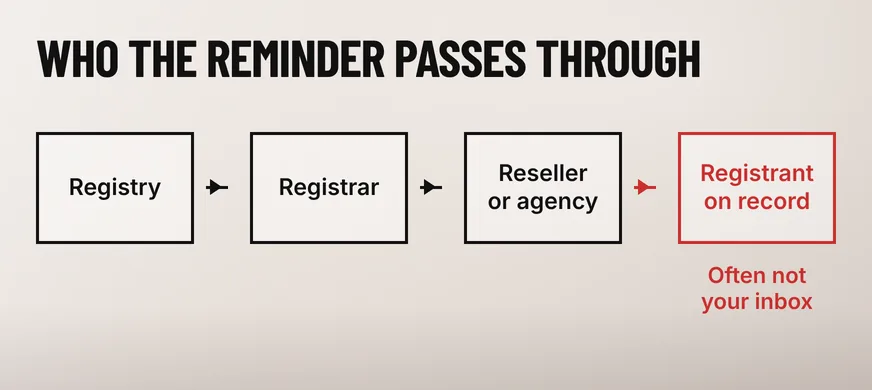
A domain name can lapse without anyone at your company hearing a word about it, because the domain renewal notice is addressed to the registrant on record rather than to your company inbox. On many Malaysian business sites that address still belongs to the developer who registered the name years ago, or to a staff member who left in 2021.
The second reason is quieter. A .my domain past its expiry date can keep serving your website for weeks while the registrar waits to be paid, so nothing breaks and nothing prompts anyone. The website and the email then stop on the same morning, and by then renewing costs more than it did.
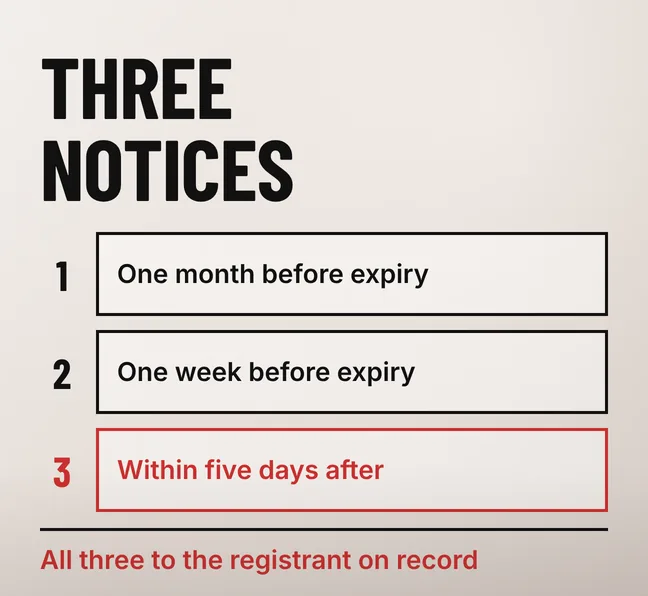
The registrant on record receives it, and nobody else is guaranteed to. ICANN’s Expired Registration Recovery Policy requires a registrar to send at least two notices before a generic domain expires and one more after. Every one of them goes to the registered name holder, so if that holder is your former developer, that is where all three land.
The timing is specified rather than left to the registrar. One notice “must be sent approximately one month prior to expiration” and one “approximately one week prior to expiration”. If the name is still unrenewed, the policy requires that “within five days after the expiration of the registration, the registrar must transmit at least one additional expiration notice” that “includes instructions for renewing the registration”.
The recipient is defined too, and it is not the person paying the invoice. ICANN’s term is the Registrant at Expiration, “the Registered Name Holder who is eligible to renew a domain name registration immediately prior to its expiration”. Where an agency registered the name under its own company, the agency is the party these rules protect. Who actually owns your website sets out how to tell which of those you are.
The policy also requires notices to be sent in a way “that does not require affirmative action to receive the notification” — email, rather than a banner inside a control panel nobody logs into. That rules out the worst case and nothing else: a spam filter, a full mailbox or an address at a domain that has itself lapsed will still swallow all three.
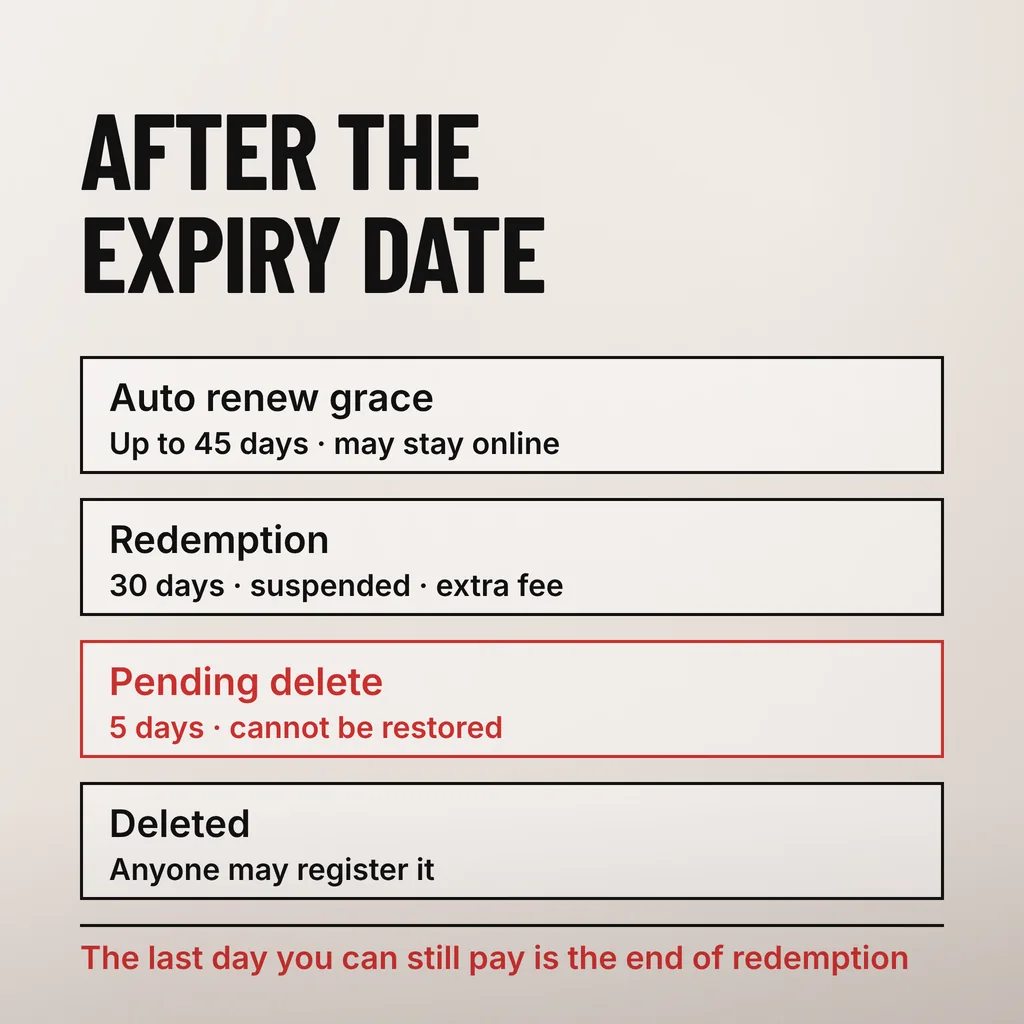
A .my domain passes through three timed stages after its expiry date before anyone else can take it. MYNIC’s published lifecycle gives an Auto Renew Grace Period of up to 45 days, then a Redemption Grace Period of 30 days with an added fee, then five days of Pending Delete. Only after that is the name released for general registration.
The first stage is the one that catches people out. In MYNIC’s .MY Domain Name Lifecycle Overview, the registry states that this period “varies depending on Registrars, with up to 45 days for domain name holders to pay”, and that your domain name “may either remain active or become suspended, depending on your Registrar”. Two businesses missing the same deadline can have opposite experiences: one site goes down that week, the other runs normally for six weeks.
| Stage | How long | Website and email | Getting it back |
|---|---|---|---|
| Auto Renew Grace Period | Up to 45 days, set by your registrar | May stay up, or may be suspended | Renew at the normal price |
| Redemption Grace Period | 30 days | Suspended; both stop | One year’s renewal plus a redemption fee |
| Pending Delete | 5 days | Down | Not possible |
| Deleted | — | Down | First come, first served, to anyone |
Redemption is where it turns expensive and visible. You can still renew, “but you will be charged a redemption fee in addition to the renewal fee of one year”, and that fee “may vary between Registrars”, which is why no figure appears here. The name sits on server hold for the month, and “your website and email address will cease to function”. Pending Delete then runs five days, during which the name “can no longer be restored or modified”.
Add the stages up and the longest path from a missed renewal to losing the name is about eighty days, only the first stretch of which is comfortable, and its length is your registrar’s choice rather than the registry’s.
No, and in one respect it is harsher. A generic domain has no guaranteed grace period at all: ICANN’s policy says registrars “may delete registrations at any time after they expire”. What it guarantees instead is a visible failure, because the registrar must stop the domain resolving while renewal is still possible.
The Expired Registration Recovery Policy, updated on 21 February 2024, is precise about it: “for at least the last eight consecutive days (after expiration) that the registration is renewable”, the DNS resolution path “must be interrupted by the registrar”. Any holding page shown in that window “must conspicuously indicate that the domain name registration is expired and provide renewal instructions”.
After deletion there is still a route back for a month: the policy requires “all gTLD registries” to offer a Redemption Grace Period of “30 days immediately following the deletion of a registration”, and throughout it the registry “must disable DNS resolution and prohibit attempted transfers”.
The practical difference is worth holding on to. A lapsed .com announces itself by taking the site offline for at least eight days before deletion; a lapsed .my may say nothing for six weeks. On a .my name, the absence of an outage is not evidence that the renewal went through.
Only while the stored card works and the notices still arrive. Auto-renew is a setting in your registrar account, not a guarantee from anyone, and it shares a name with something entirely different: MYNIC’s Auto Renew Grace Period, which is the registry extending your expiry date because the renewal has not been paid.
That overlap causes real mistakes. MYNIC’s WHOIS status table defines “auto renew period” as “this domain name is expired and has been temporarily extended for 1 year by Registry”. Seeing those words in a lookup means the domain has already expired, and the date shown beside them is the registry’s temporary extension rather than a date anyone has paid for.
Auto-renew fails in ordinary ways nobody notices for a year at a time: the company card is reissued with a new expiry date, the finance address that receives the receipt is retired, the reseller stops trading, the invoice is filed as spam. None of them shows a symptom until the name stops working.
There is a trap at the end of that chain. MYNIC notes that “client transfer prohibited” is usually set “due to domain name expiry or the domain name is in the auto renew grace period”, so once a name has expired, moving it to a registrar that answers the phone is the thing you can no longer do. For generic domains ICANN requires renewal, post-expiration renewal and redemption fees to be “clearly displayed on the registrar’s website”, so read the late price before you need it.
Look the name up in a public WHOIS record and read three fields — the expiry date, the status and the registrant contact — then confirm that the registrar account behind it is billed to an address your company still reads. MYNIC runs the WHOIS service for .my names; ICANN Lookup covers .com, .net and the other generic endings.
Do this for every domain the business owns, not only the one on the signboard: the names that lapse are usually the campaign redirect and the second spelling nobody remembers registering. Putting those dates somewhere a person actually looks is the whole job, and it belongs with the other recurring checks — what a website care plan covers in Malaysia sets out the rest of that list.
Rarely, and not as of right. For generic endings ICANN requires a 30-day Redemption Grace Period after deletion, in which only the registrar that deleted the name can restore it, at the former registrant’s request and for a restore fee. Once that window and the five-day Pending Delete period pass, MYNIC releases a .my name on a first-come, first-served basis, and you are bidding against everyone else who wants it.
Not necessarily on a .my name. MYNIC states that during the Auto Renew Grace Period the domain “may either remain active or become suspended, depending on your Registrar”, so a site can run normally for weeks past its expiry date. A generic domain is stricter: ICANN requires resolution to be interrupted for at least the last eight renewable days. Email stops with the website either way, which is usually what gets noticed.
For the name your business trades under, usually yes. MYNIC allows .my registrations and renewals of one to ten years, and a ten-year term removes nine chances to miss a notice, lose a card or change finance staff. It does not remove the need to keep the registrant contact current, and ten years is long enough for everyone who set it up to have left.
A domain renewal is nobody’s job by default: not design, not hosting, not marketing, so it sits in the gap between them until the morning the site goes down. Our website maintenance service keeps the renewal dates, registrar logins and registrant contacts in one place someone reads. One thing to do today: look up your own domain, read the registrant email address, and ask whether anyone there still opens it.