
- Resources
Innovative Thinking


Most advice about a clinic website in Malaysia is written as though a clinic were a shop: rank for “clinic near me”, publish helpful articles, collect reviews, build authority. The advice is not wrong so much as incomplete, and the missing piece is the one with consequences. In Malaysia, putting information about healthcare services in front of the public is classified as advertising, and that classification includes your website.
The Ministry of Health states it directly: all types of dissemination of information about products and healthcare services to attract public attention, “including on the internet, are classified as an advertisement”, and Medicine Advertisements Board approval is required before an advertisement can be published to the public. None of the generic clinic SEO advice we have read mentions it.
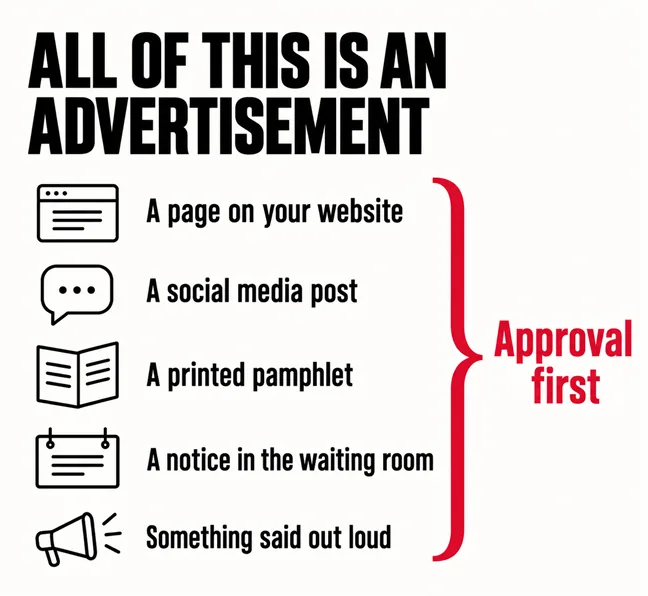
More than you would assume, which is the point of reading the definition rather than guessing at it. The Board’s own guidelines define advertisements to include “any notice, circular, report, commentary, pamphlet, label, wrapper or other document”, as well as any announcement made orally or by any means of producing or transmitting light or sound. A web page is a document. A video is light and sound. A social post is a notice.
The Board itself was established under the Medicine Advertisements Board Regulations, and its remit is explicitly not limited to medicines: the Ministry describes it as handling “the approval for application on medical products or healthcare facilities and services advertisement”. Facilities and services. That is a clinic. Its listed powers include issuing an approval and cancelling or withdrawing one already granted.
A web page is a document. A video is light and sound. The definition was written to be broad.
Be clear about what this article is and is not. It is a prompt to go and read the rules, not a substitute for them, and it is not legal advice. The detailed requirements — including what may be said about treatments, and which categories of service are exempt from approval — live in the Board’s own guideline documents, and a clinic should work from those or from its own adviser rather than from any agency’s summary, including this one.
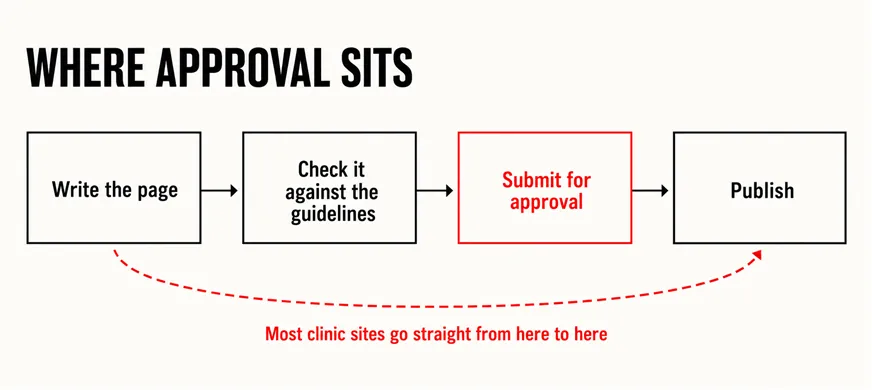
Before publication, which is the part that surprises people mid-project. The usual sequence for a clinic website is: write the pages, check them against the guidelines, submit what needs approval, publish. What happens in practice is that an agency builds the site, the clinic signs it off on aesthetics, and it goes live the same afternoon.
That has a practical consequence for how you plan a revamp. Copy for a regulated page is not a thing to finalise in the last week. It needs to exist early, in plain text, so it can be reviewed while the build carries on around it. In the clinic projects we have worked on, the sites that went smoothly were the ones where the words were settled first and the design was fitted to them — the inverse of the usual order, and a good argument for treating structure and content as the real project.
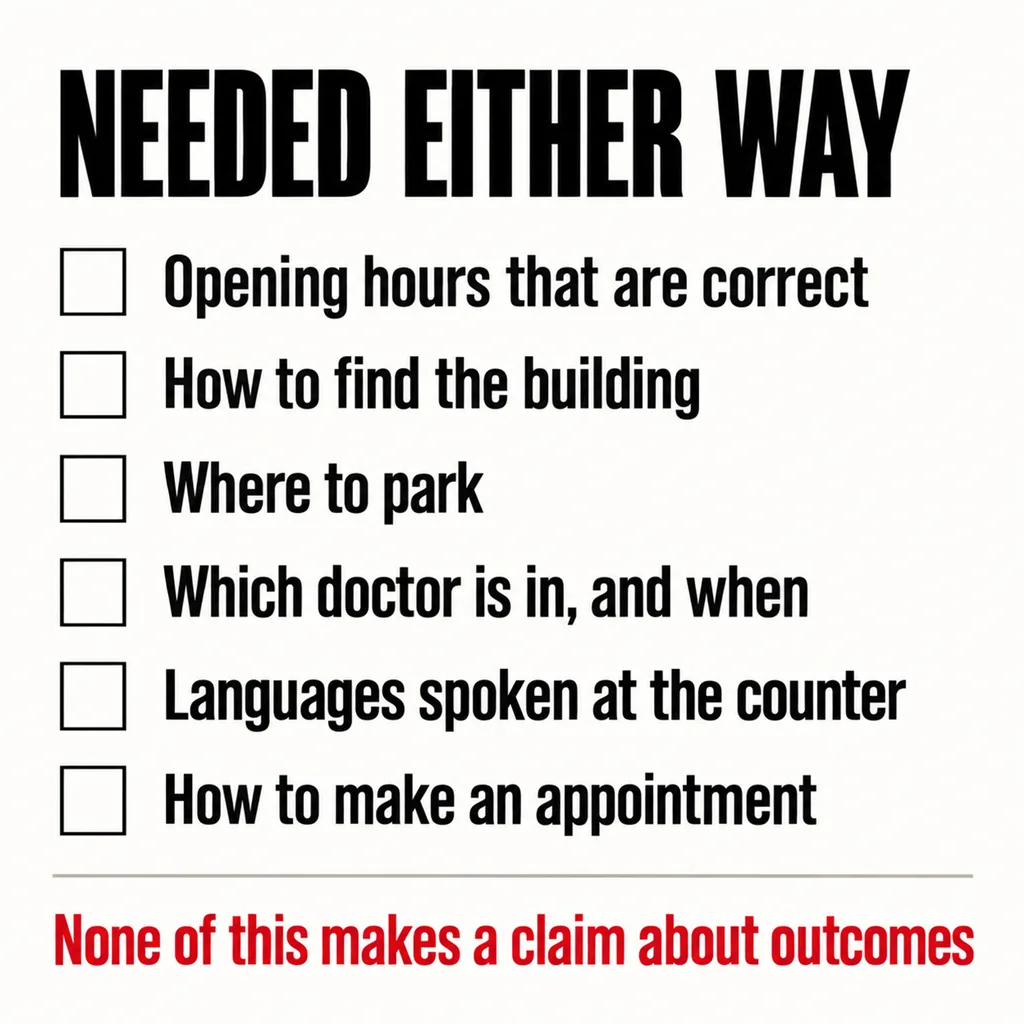
Quite a lot, and it is worth saying so, because the regulatory framing can read as though a clinic may publish nothing. Practical, factual information about the practice itself is the backbone of a useful clinic site and makes no claim about outcomes at all:
The same things any service website needs, with the regulated parts handled deliberately rather than accidentally. Sorted by what changes the number of appointments:
| Priority | The work | Regulated? |
|---|---|---|
| 1 | Correct hours, location, parking, how to book | No — factual practice information |
| 2 | Which practitioners, their registration and languages | No — factual, but keep it accurate |
| 3 | Pages describing services offered | Yes — this is where approval applies |
| 4 | Patient-facing education content | Yes — treat as advertising, not as blogging |
| 5 | Reviews, testimonials and outcome claims | Yes, and the most constrained of all |
Row five is where generic advice does the most damage, because “collect patient testimonials” is standard marketing guidance everywhere else. For a Malaysian clinic it is the area to check before doing, not after. We are not setting out what is permitted here, because we could not verify the detail from a readable official source — which is precisely why the Board’s own documents are the thing to read.
Everything that is true of any service website, and clinics tend to be behind on all of it. Most of the clinic sites we see are slow, difficult to use on a phone at the moment someone needs them, and silent on the practical questions above. Whether a site is genuinely usable under a thumb is covered in is your website easy to use on a phone, and what belongs on the first screen in what visitors see first.
Two more things carry weight in healthcare specifically. The first is believability — real names, real credentials, real photographs of the actual premises, which our article on website trust signals covers. The second is security, because a clinic site often collects appointment details: see whether your website is still secure. If a nearby practice with a plainer site is outranking yours, the reasons are usually mundane and are worked through in why a competitor with a worse website can outrank you. And where a site gets traffic but no bookings, the diagnosis in why your website gets no enquiries applies to clinics much as it does to anyone, as does writing pages that answer the question outright.
The Ministry of Health states that information about healthcare services disseminated to attract public attention is classified as an advertisement, and that this includes the internet, with Board approval required before publication. What that means for your specific pages — and which categories are exempt — is set out in the Board’s guideline documents. Read those, or take advice, rather than relying on a general article.
Treat it as one until you have established otherwise. The published definition covers notices, reports, commentary and other documents, which is broad enough to include an article on your own site. The safer working assumption for a clinic is that anything patient-facing on your domain falls inside the framework, and the exemptions are something to confirm rather than assume.
Yes, and you should — that is factual information about the practice rather than a claim about treatment, and it is the most useful thing on most clinic websites. Correct hours, a findable address, parking, which doctor is in and how to book will change your appointment numbers more than any content strategy, and none of it requires a claim about outcomes.
A clinic website is one of the few cases where the words have to be settled before the design, because some of them are reviewed by someone outside your practice. Our web development and design service plans clinic projects in that order — practical information and page structure first, regulated copy drafted early enough to be checked, build fitted around both. If the existing site is too tangled to work that way, our guide to choosing between a revamp and a full rebuild sets out how to decide.