
- Resources
Innovative Thinking


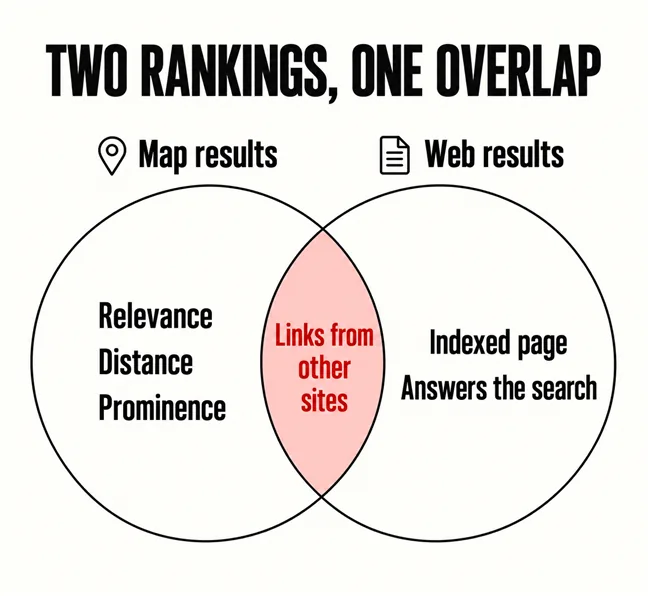
Your Google Business Profile and your website are ranked by two separate systems, which is why one can appear while the other is nowhere. The profile competes in the map results, judged on its own details, its distance from the searcher and its reviews. The website competes in the web results, where it needs an indexed page that answers the words someone typed. A profile can win the first race on its category, address and reviews while the website never entered the second. That is the whole Google Business Profile vs website ranking gap, and it nearly always comes down to one of four things: the site has no page for the search, it is not in Google’s index, the profile links somewhere else, or the search is one the map was always going to answer.
That does not mean the profile is doing anything wrong; it is usually the part working best. But it holds an address, opening hours, photos and reviews. It cannot explain how you price a job or answer the questions people ask before they send a WhatsApp message. Those need pages, and pages are what the web results rank.
Google’s help page for business owners sums up the map side in one line: local results are “mainly based on relevance, distance, and popularity”. All three are measured on the profile. Relevance is “how well a Business Profile matches what someone is searching for”. Distance is how far the business is from the person searching. Prominence, which the same page also calls popularity, is “how well-known a business is”. How those three play out against a rival is in why a competitor with a worse website can outrank you. The point here is narrower: none of them needs your website to appear in the web results.
The web results work differently. There is no address to be near and no star rating to count: a page appears because Google has indexed it and because it answers the search better than the other pages that could. A homepage, an About page and a contact form give that system very little to rank.
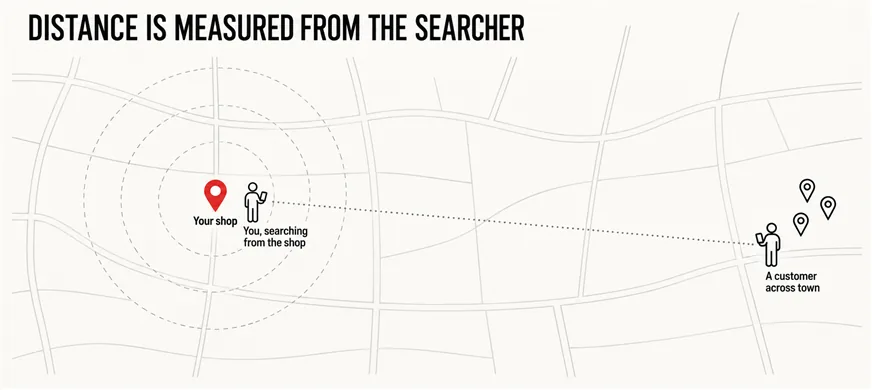
Searching for yourself misleads in two ways. Your business name brings up the profile as what Google’s structured-data documentation calls “a prominent Google knowledge panel with details about a business that matched the query”. That panel is the profile, not your website. And Search Console’s help pages warn that results are “specific to the time, place, device, and recent history of the person searching”, so a search made from the shop, where the distance is nil, shows the profile at its best.
The two systems do meet at one point. Prominence, Google says, is “also based on info like how many websites link to your business and how many reviews you have”. And when Google compiles a profile, its own help pages say its sources include “crawled web content (e.g., information from a business’ official website)”. A website Google cannot find is one it cannot read for either purpose.
A profile can rank on an address and its reviews. A website can only rank on its pages.
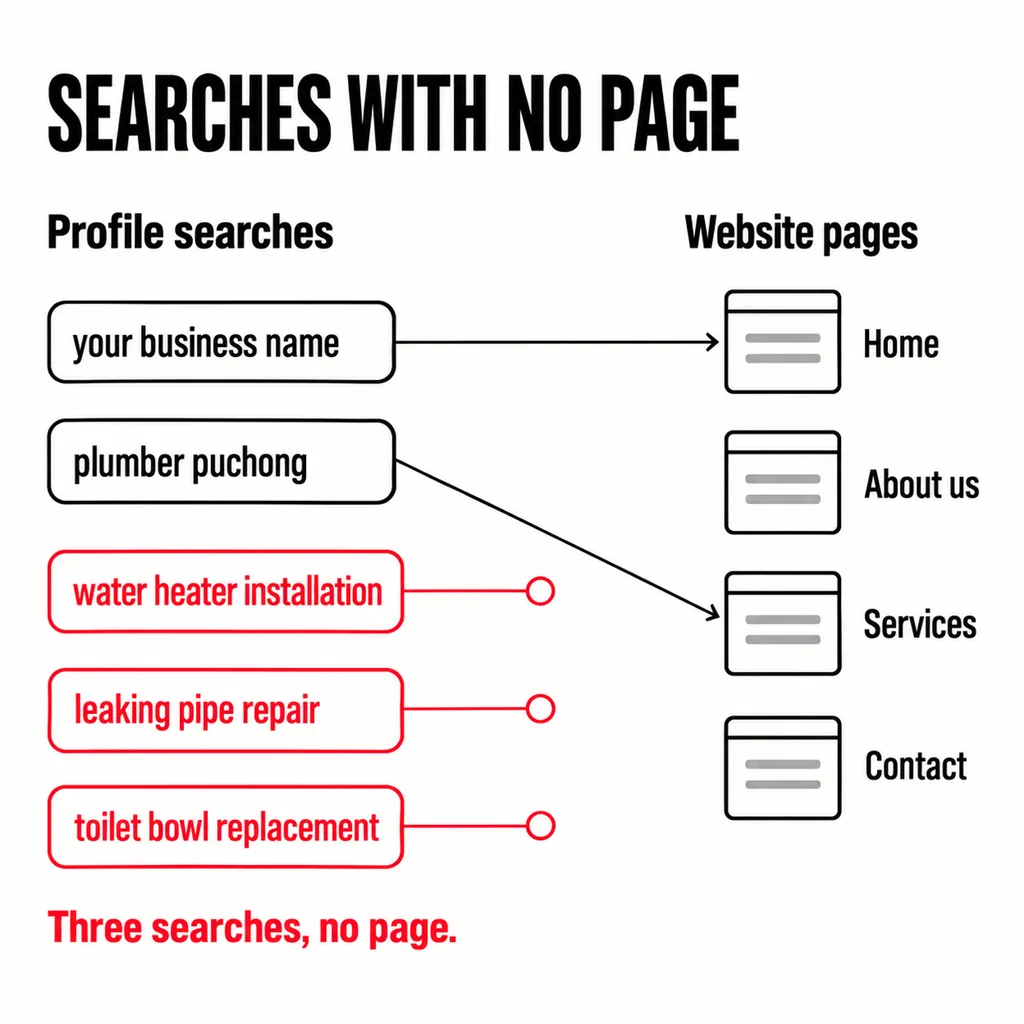
It is the cause we see most often. Take a plumber in Puchong as an example. The profile’s category, Plumber, matches “plumber Puchong” by itself. The website has a homepage reading “Quality service since 2008” and one Services page listing eight jobs in a bulleted list. For a search on water heater installation in Puchong, the profile has a matching category and a nearby address. The website has one line in a list.
Google’s SEO Starter Guide asks site owners to “think about the words that a user might search for to find a piece of your content”, and suggests a page title can carry “the physical location of the business, and maybe some information about what the particular page has to offer”. A page for each main service, naming the job and the area, gives the web results something to rank. How those pages are grouped and named matters more than their wording, as our article on fixing website structure rather than content explains.
Each kind of search is answered by a different part of the results page:
| Someone searches | What usually answers | What the website needs |
|---|---|---|
| Your business name | The profile, as a panel beside or above the results | To be indexed, so the homepage appears under the panel |
| plumber near me | The map results; the web results below are often directories | To be where the profile’s Website button lands |
| water heater installation Puchong | The map results and the web results together | A page about that service that names the area |
| how much to replace a water heater | The web results and AI answers, often with no map at all | A page that answers the question and explains what drives the price |
You can see the gap in your own data. In the profile, Performance shows “the search terms people used to find your business”, updated once a month. In Search Console, the Performance report lists the queries that showed your website. Write the profile’s top ten terms in one column and look for each in the other. Every term that brings people to the profile but never shows the website is a page the site does not have yet.
If the site does not appear even for its own name, the problem is earlier. The SEO Starter Guide gives the quickest check: search for site: followed by your domain, and “if you see results pointing to your site, you’re in the index”. If nothing comes back, Search Console’s URL Inspection tool will say why, and its verdict is blunt: “URL is not on Google means that the URL can’t appear in Search results”.
On WordPress the usual culprit is one checkbox, under Settings, Reading: “Discourage search engines from indexing this site”. It adds a noindex instruction to every page. Developers tick it during the build so Google does not index a half-finished site, and sites go live without anyone unticking it. Google then “will drop that page entirely from Google Search results, regardless of whether other sites link to it”. The profile lives on Google’s own systems and is untouched, which is how a business ends up with a busy profile beside a website Google has been told to ignore. Turning the blockers off is a launch step in our guide to redesigning a website without losing SEO rankings.
Google’s help page on editing the profile makes the same point from the other side: “Make sure that Googlebot isn’t blocked on your site”. A site that has only just launched may simply need time. At a Google event in Barcelona on 2 October 2026, Gary Illyes put the typical time to discover a new URL at about 20 hours, and the slowest at “weeks to never”, according to the agency ROAST’s published recap of the talk. Our article on how long a new website takes to show up on Google covers the rest of that wait.
Open your profile on your phone and tap Website. Google’s profile guidelines ask for “a website that represents your individual business location”, and the profile’s Performance page counts the “number of times people clicked on the website link on your Business Profile”. Those are some of the warmest visits a small business site gets, from people who have already picked you on the map. In the profiles we check, the link often goes somewhere else:
While you are there, check that the name, phone number and address match the website exactly. Our article on whether ChatGPT can understand what your business does explains why three slightly different phone numbers cost more than they seem to.
Not head-on, for most small businesses. For a search like plumber near me, the map results sit near the top of a phone screen, and the web results beneath are often directories. A ten-page business website is not built to compete with those, and does not need to. The profile is the right tool, and such a search can end in a call or a route without any website visit, the pattern our article on zero-click search describes.
The website’s work is elsewhere. It is the page the profile’s Website button opens, so its first screen should answer what the profile cannot: what the job involves, what drives the price, how soon you can come. And it can rank for the searches the map does not answer at all, the questions people type before they pick a business, where a clear answer gets quoted as well as ranked. Our articles on answer-first service pages and on SEO, AEO and GEO cover those.
In this order, because each step depends on the one before:
Not directly. Google ranks the profile and the website separately, and its help pages describe no way for a profile to lift a website’s position in the web results. The connection runs mostly the other way: Google reads your official website when it compiles profile information, and links from other websites count towards the profile’s prominence. What the profile can do is send visitors to your website, as long as its link is right.
If the profile brings all the work you can handle, a new website is not urgent. But the profile is a listing on Google’s platform, with the fields Google chooses to offer, and owners of the free business.site websites found out in 2024 how quickly a platform can change its mind. A website is the one place where you decide what customers read, and the natural home for answers to the questions people ask before they choose a business.
It helps Google read the details on your site. With it, Google’s documentation says, “you can tell Google about business hours, different departments within a business” and more, so it is worth adding to keep your site and profile in agreement. It is not a ranking switch. The same page says “Google does not guarantee that features that consume structured data will show up in search results”, and markup on a page Google cannot index does nothing at all.
A profile that ranks while the website does not is rarely a reason to start again. Usually the site needs three things: to be visible to Google, to have a page for each service people actually search for, and to be where the profile’s link sends them. That is a revamp, not a rebuild, and our SEO service starts with the checks above: the index, the profile link and the two lists side by side. If the answer turns out to be bigger than that, our guide to choosing between a website revamp and a full rebuild sets out how to tell.