
- Resources
Innovative Thinking


Because Google writes the title of every search result itself, and your SEO title is only its first choice. Most of the time it uses what you wrote. When it does not, it has usually found something on the page that made your title look wrong, incomplete or unlike the page, and it has reached for other text instead. If Google changed page title text on one of your results, the useful question is not how to stop it, but what it saw.
Below: where Google takes a title from, the problems that make it look elsewhere, and what a WordPress site owner can change, quoted from Google’s own documentation.
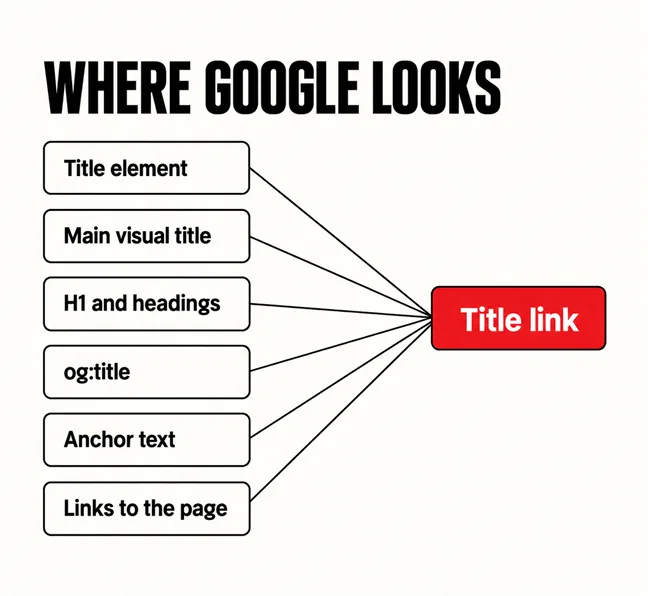
Google does not call it your title. It calls it the title link, and its documentation on influencing title links is plain about who decides: “Google uses a number of different sources to automatically determine the title link, but you can indicate your preferences”. Indicate, not set. The SEO title you type into Rank Math or Yoast is one source among nine.
The nine, in Google’s order: the title element, the main visual title shown on the page, heading elements such as the H1, the og:title meta tag, other large and prominent text, other text on the page, anchor text on the page, text within links that point to the page, and WebSite structured data. Most of those you control.
The reason Google looks past your title is stated in one sentence: “If we’ve detected an issue on the page, we may try to generate an improved title link from anchors, on-page text, or other sources.” Something about the title did not match the page.
A rewritten title is Google telling you it found a problem. Read it as a diagnosis, not an insult.
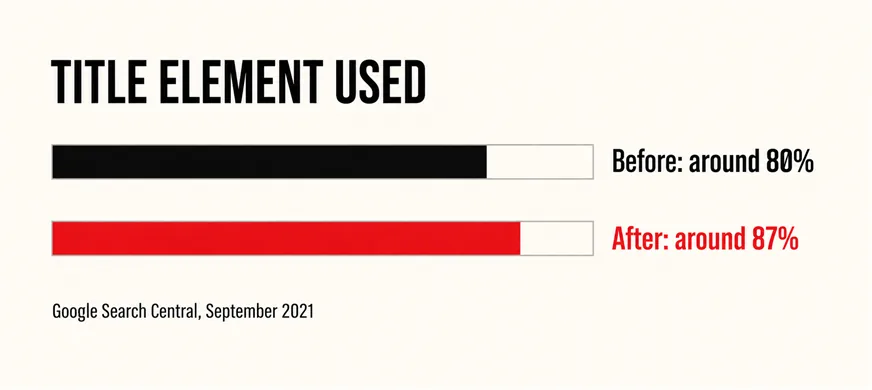
It is also the exception rather than the rule. When Google changed how it generates titles in 2021, the Search Central Blog followed up with more information on how titles are generated, reporting that “title elements are now used around 87% of the time, rather than around 80% before.” Its August 2021 announcement added that titles changing with the search query “generally will no longer happen with our new system.” A rewrite is usually about the page, not the search.
Google names seven. Each has a cause you can find on the page and a fix that removes Google’s reason to look elsewhere:
| Google’s name for it | What it looks like on a site | What to change |
|---|---|---|
| Half-empty title | A template leaves the first part blank: just “| Site Name” | Fill the SEO title field, or fix the template variable |
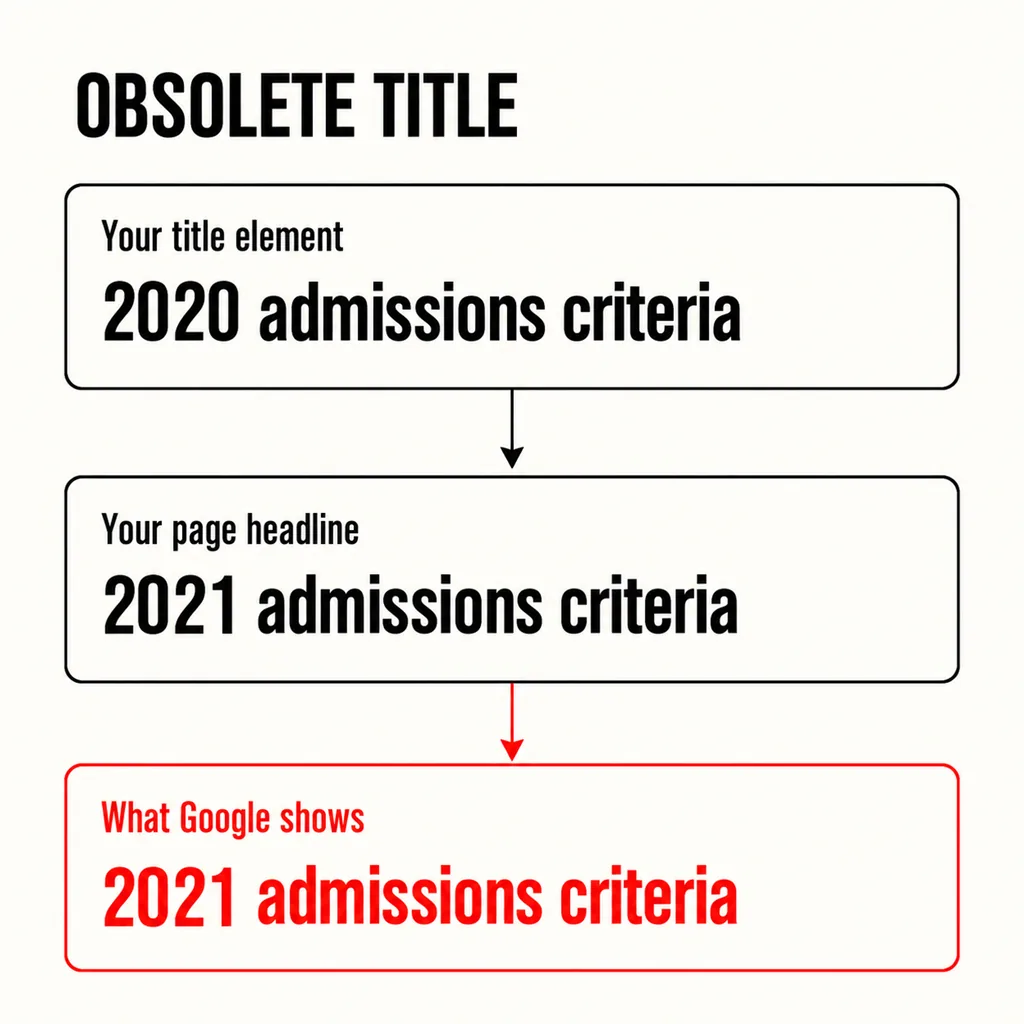
| Obsolete title | Title says last year; the page headline says this year | Update the title when the page is updated |
| Inaccurate title | Title names products or services the page no longer shows | Describe what the page holds today |
| Micro-boilerplate | A group of pages share one title, such as every branch page | Put the distinguishing detail in each title |
| No clear main title | Several headings carry the same size and weight | One visible H1 that stands out from the rest |
| Language mismatch | A Bahasa Malaysia page with an English title | Write the title in the page’s own language |
| Repeated site name | The brand appears in the title and again as the site name | Expect Google to drop the repeat; no fix needed |
The obsolete case is Google’s clearest example. A page reused every year has a title element reading “2020 admissions criteria” while its visible headline says “2021 admissions criteria”; Google notices the inconsistency and uses the date from the headline. Malaysian sites do the same with a Raya promotion page or a “2025 packages” title nobody edited.
Language mismatch matters more here than in most markets. When a title does not match “the writing system or language of the page’s primary content, we may choose a different text as the title link.” Translating the body of a Malay page and forgetting the SEO title invites exactly that; how a two-language site should be set up covers the rest.
Micro-boilerplate comes from copying pages: twelve area pages titled “Aircond Service | Company” give Google nothing to tell apart, and too many near-identical pages is often the deeper issue.
Not always, and Google asks you to check before treating it as one. Its own advice on modified titles is to see whether the page has one of the issues above and, if not, to “consider whether the title link in search results is a better fit for the query.” Sometimes it is.
Three things look like rewrites and are not:
When it is a problem, it shows up as a result people do not click, which is the lost-click question in why rankings can hold while traffic falls. Search Console’s click-through rate for the page is where to look. A vaguer title than a rival’s is also one of the quieter reasons in why a weaker site can outrank yours.
More than it seems, because most rewrites trace back to template and theme habits.
They need not match word for word, but they must describe the same page. An SEO title about “website revamp cost” above an H1 reading “Welcome to our services” gives Google two candidates that disagree. What visitors see first is the visible-title side of the same decision.
Page builders make it easy to set three hero lines in the same large type. Google’s advice is to make the main title “distinctive from other text on a page” and to put it in “the first visible <h1> element on the page.” structure rather than content is usually where that fix lives.
The site name above every result is separate from the title link. Google’s documentation on providing a site name says “WebSite structured data is most important, if you want to specify a preference.” Rank Math and Yoast both output it; check the name there is the one you want.
A page disallowed in robots.txt can still be indexed from links, and then, in Google’s words, it will “rely on off-page content to generate the title link, such as anchor text from other sites.” To keep a page out of results, use noindex rather than a robots.txt block; the launch checklist catches the leftover staging rules that cause this.
Days to weeks, and you cannot make Google use your wording. The title-link documentation is blunt on both points: “While we can’t manually change title links for individual sites”, Google “has to recrawl and reprocess the page to notice updates to these sources, which may take a few days to a few weeks.”
You can shorten the wait for a single page. Google’s guide to asking for a recrawl points to the URL Inspection tool in Search Console for a few URLs and a sitemap for many, with a warning worth taking seriously: “requesting a recrawl multiple times for the same URL won’t get it crawled any faster.” Ask once, then wait. How long Google takes to pick up a new site sets out why the timing varies.
Still rewritten weeks later? Look at the page, not the title field: a second prominent heading or a template default is the usual culprit. If a revamp is coming, settle titles before launch, because rewrites across dozens of new pages are one of the quieter ways a redesign loses search visibility. The same applies to the other parts of a search result you cannot set directly.
No. Google states that title links are generated automatically and that it cannot change them manually for individual sites. What you can do is remove the reasons it looks elsewhere: an empty or outdated title, a title that does not match the page, or several competing headings.
Google does not say the title link affects ranking, and we would not claim it does. What it can affect is whether people click. Judge a rewrite by the page’s click-through rate in Search Console, not by the fact that it was rewritten.
Google sets no length limit. It truncates titles to fit the device width, so put the words that matter first and keep the brand short or at the end. A title that still makes sense when cut off is safer than one that has to be read in full.
When we revamp a site, titles and headings are checked page by page against what Google is actually showing, because the rewrites point straight at the template habits that need fixing: half-empty titles, duplicate H1s, untranslated meta fields. Our SEO service starts there, keeping the pages and URLs that already work and correcting what Google is quietly rewriting on them.