
- Resources
Innovative Thinking


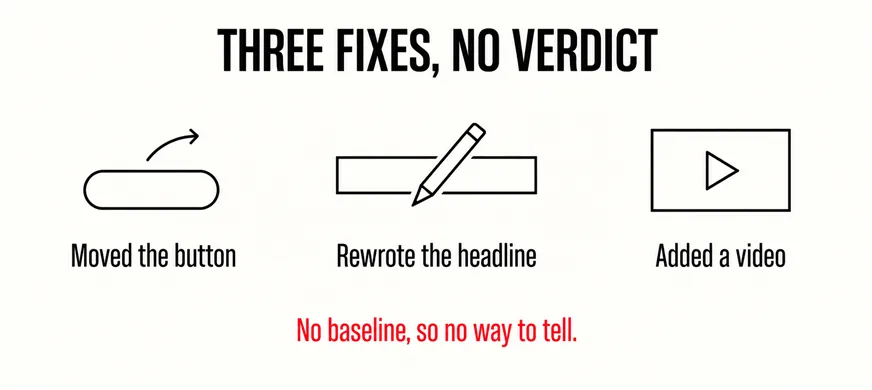
A landing page audit usually starts the same way. Someone decides the page is underperforming, the button moves, the headline gets rewritten, and a fortnight later nobody can say whether it helped. The page changed. What it produced did not obviously change, or it did, and the weather changed too.
The problem is not the fixes. Most of them are reasonable. The problem is that they were made without a way of telling afterwards, which turns a decision into a hunch wearing better clothes. And the usual answer to that — run a proper test — is not available to a business this size, for reasons worth being precise about.
Not to produce a list of things that are wrong. A list is easy, and you probably already have one. It is to produce a change you can defend afterwards.
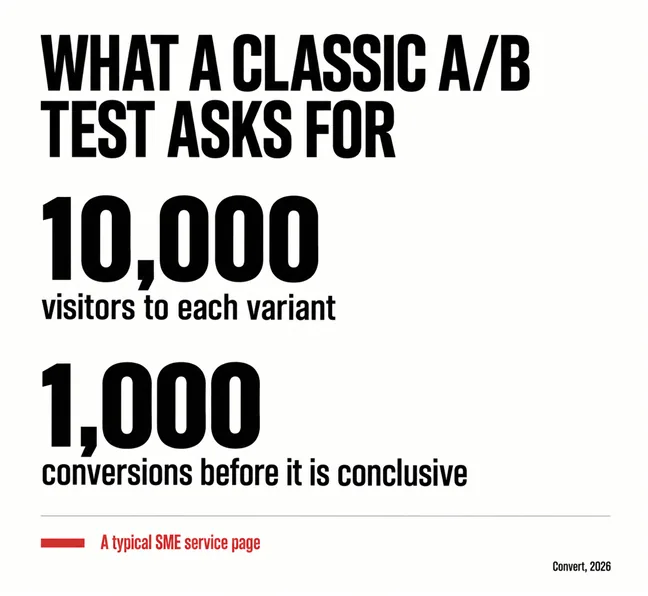
That matters because the standard method is out of reach. Conversion testing platforms are blunt about the traffic involved: Convert recommends running an A/B test only if you can send “about 10K visitors to each variant”, and suggests “recording around a 1000 conversions to yield conclusive evidence of the superiority of the control or variant”. A service page for a Malaysian SME might see a few hundred visits in a month and a dozen enquiries in a good one.
So the honest position is this: you will not reach statistical significance, and pretending otherwise is how businesses end up paying for a redesign justified by a number that meant nothing. What you can do is run the audit as a method — record, change one thing, wait, compare — and accept that the verdict will be a judgement supported by evidence rather than a proof.
An audit you cannot measure is just a list of opinions with a date on it.
This article is about that method. It deliberately does not repeat the checklist of what to inspect on a page that receives paid traffic — message match, speed on a real phone, whether the enquiry path works, whether conversions are being counted at all. That is covered in full in our piece on what to fix before raising your Google Ads budget, and section five below says when to go there instead.
Five things, none of which takes longer than an afternoon, and all of which are impossible to reconstruct once the page has changed.
If nobody has been counting enquiries, start counting and wait. That is an unsatisfying instruction and it is still the right one, because the alternative is changing the page and then inventing a before.

One change at a time is the part everyone knows and nobody does. It is also the only thing that makes the waiting worth anything: two changes at once and a result tells you nothing about which caused it.
There is a real tension here. Optimizely’s guidance for low-traffic sites is to test “high-impact changes”, on the basis that these are “more likely to achieve a drastic difference in conversion rates and statistically significant results within a reasonable timeframe”. A bolder change is more likely to show up above the noise. But a bolder change is also several changes bundled together, so when it works you have learned that the new page beats the old page, and not much else.
For a small site that trade is usually worth taking, with one condition: decide before you start what you would do if it wins. If the answer is “keep it”, a bundled change is fine. If the answer is “do more of whatever worked”, you need the changes separated, and you need to be patient.
Long enough to cover a normal cycle of your business. If enquiries arrive mostly on weekday mornings, a fortnight is two working weeks and not much data. If your trade is seasonal, a quiet month proves nothing. The rule that holds up: wait until you have seen at least as many enquiries after the change as you recorded in a comparable period before it, and if that takes two months, it takes two months.
This is where small numbers do their damage. A page that produced four enquiries last month and six this month has improved by fifty per cent, which sounds like a headline and is very likely nothing at all. Two enquiries is inside the range that ordinary variation produces on its own.
Three habits keep you honest.
And if you want a firmer answer sooner, the temptation is to relax the standard. It is worth knowing what that costs: “Lowering your statistical significance increases the likelihood of false positives” — you will more often conclude something worked when it did not, and then build the next change on top of it.
An audit that keeps finding nothing is sometimes telling you the truth. Before running another round, check that the page is being asked to do a job it can do.
None of that is a reason to skip the audit. It is a reason to run the mechanical checks before you start recording, so the baseline you write down is a baseline of a working page.
The inspection is an afternoon. The measurement is the slow part: a baseline of at least three months of history where you have it, then long enough after the change to see a comparable number of enquiries. On a small site that is usually four to eight weeks, and it is the part most often skipped.
You can install one, and on a small business site it will rarely reach a conclusive result. The published guidance is around 10,000 visitors per variant and roughly 1,000 conversions before a result is conclusive. Most SME service pages are two orders of magnitude away from that, which is why the method in this article is sequential — change, wait, compare — rather than split.
Use a distinct link or number on the page you are auditing, so a message that arrives through it is attributable. It is imperfect and it is far better than a total you cannot break down. Counting badly beats not counting.
Audit first if the page is broadly right and you want to know which part is weak. Rebuild if the page was never written to do this job — a catalogue entry that ads now point at, for instance. The audit method still applies afterwards: record before, compare after.
We run this as part of a revamp rather than as a separate exercise, because the recording has to start before anything is redesigned and the comparison only means something if somebody kept the before. If you want the page looked at properly, our web development and design work starts with what the page currently produces, not with what it currently looks like.
And if the honest answer after a month of measuring is that the page is fine and the traffic is wrong, we would rather tell you that than sell you a redesign.