
- Resources
Innovative Thinking


Long enough to answer every question a buyer asks before they get in touch, and then it stops. Service page length is the result of that list rather than a number to aim at: once a page covers the problem, the scope, the process, the price drivers, the proof and the next step, it has usually landed somewhere between 600 and 1,200 words without anyone counting them.
Google has written down that length alone does not rank a page, so a 1,500-word service page sitting below a 500-word one is not losing on volume. It is losing on coverage, or on how long the answer takes to arrive. Neither is fixed by adding paragraphs.
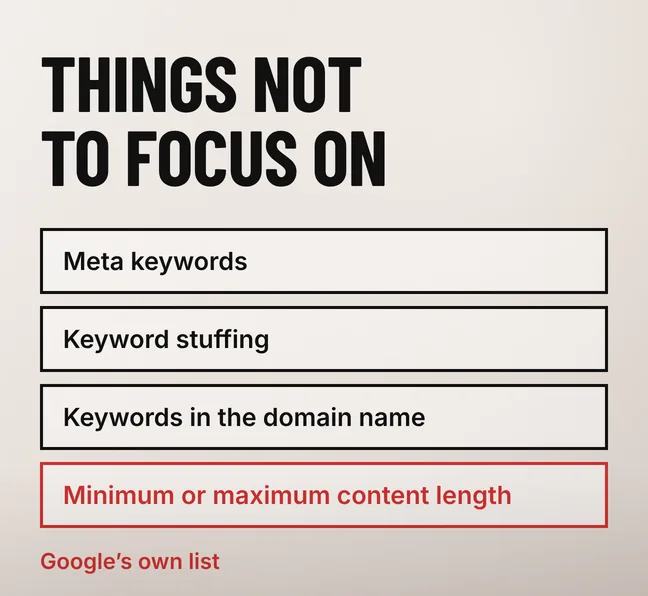
No. Google lists minimum and maximum content length among the things site owners should not focus on, alongside meta keywords, keyword stuffing and keywords in the domain name. There is no threshold a page has to clear, and no advantage in matching the word count of whoever currently sits above you in the results.
Google’s SEO Starter Guide states it under that exact heading: “The length of the content alone doesn’t matter for ranking purposes (there’s no magical word count target, minimum or maximum, though you probably want to have at least one word).” The one qualification it adds is about variety rather than volume — writing naturally, without repeating yourself, gives a page more ways to match what people type.
The word-count habit comes from the editor rather than from search. SEO plugins score content length against a generic default and keep the indicator amber until the page clears it, which is a writing prompt, not a ranking signal. A service page written to turn that indicator green reads exactly like one, and the reader who came to find out what you charge is the person paying for it.
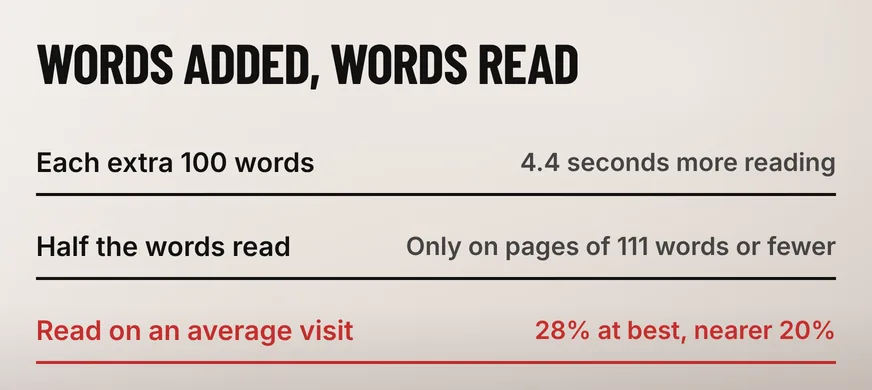
Extra words also cost something, because attention does not grow to match them. Nielsen Norman Group’s analysis of 45,237 real page views, published in 2008, found that “on the average Web page, users have time to read at most 28% of the words during an average visit; 20% is more likely”, and that readers “spend only 4.4 seconds more for each additional 100 words”.
The same reading analysis puts the point where half the information gets read at pages of 111 words or fewer, against an average page of 593 words. The data is old and the underlying study, by Weinreich and colleagues in ACM Transactions on the Web, recorded behaviour from 2005, before anyone browsed on a phone in a car park. Nothing since has suggested people read more than they used to.
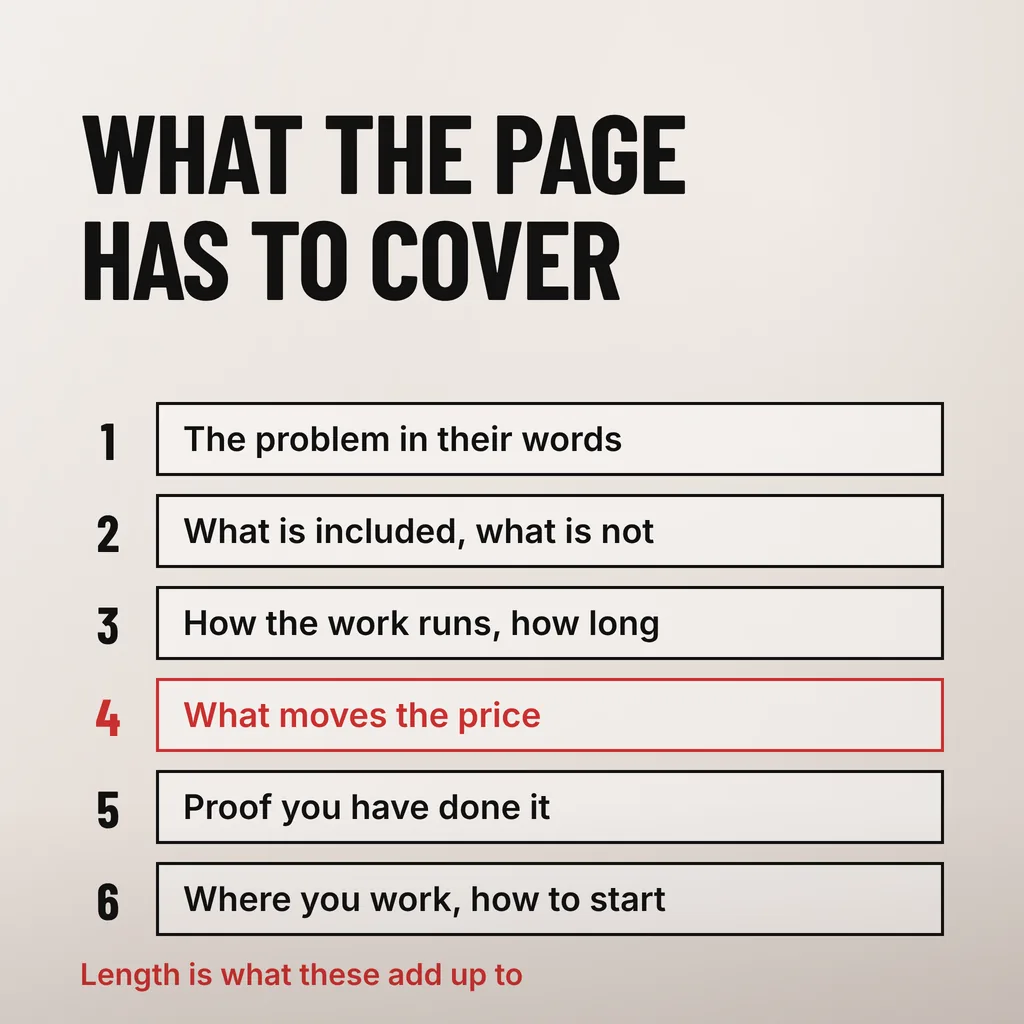
Six things decide whether a reader contacts you: the problem described in their own words, what the service includes and excludes, how the work runs and how long it takes, what moves the price up or down, proof that you have done it before, and where you work plus how to start. Everything else on the page is optional.
Those six are also the page’s budget. A couple of paragraphs each, with lists for the scope and the process, lands the page between roughly 600 and 1,200 words — arithmetic from the list above, not a figure from any study. A page under that band usually has a section missing rather than a section that is too brief. A page well over it usually has one section that turned into an essay.
Order matters as much as coverage. Someone scanning for the price drivers should not have to read your company history first, which is the case for writing each heading as the question underneath it answers; answering the questions customers actually ask works through that structure.
Cut whatever is equally true of every competitor in the country. The opening paragraph about the importance of a strong online presence, the generic why-choose-us block, the potted history of the industry and the boilerplate repeated word for word across all your service pages: none of it answers a buying question, and the last one hands Google several pages that say the same thing.
Two cuts are worth making even when the copy is decent. The first is the introduction that restates the heading before getting to the answer, which pushes the useful sentence below the fold on a phone. The second is the second testimonial block; one piece of proof per section is enough, and the rest belong on a portfolio page.
If a single page is carrying three services because each felt too thin on its own, the problem is page structure rather than page length. How many pages a small business website needs covers that split, including when two near-identical services really do belong together.
Read your last ten enquiries. Every question a prospect had to ask over WhatsApp or email is a section the page failed to cover, and that list is a better brief than any content-length tool. Two further checks confirm it: the queries Search Console already shows for the page, and one read-through by someone outside your industry.
| Signal | What it tells you | What to change |
|---|---|---|
| The same question arrives in most enquiries | A section is missing, not a paragraph | Add it under a heading phrased the way customers ask it |
| Search Console shows queries the page never answers | The page ranks for a question it does not address | Answer it on the page, or build the page that should |
| An outsider cannot say what it costs or what happens next | The decision information is buried or absent | Move the price drivers and the next step up the page |
| Two of your service pages read almost the same | Boilerplate rather than depth | Rewrite each one around its own buyer question |
Notice what is not on that list: nobody ever reports that a page felt too short. They report that they could not find the price, the coverage area or the person responsible. Fix those and the length settles itself.
No. Google’s SEO Starter Guide says the length of content alone does not matter for ranking purposes and that there is no magical word count target, minimum or maximum. The minimums shown by SEO plugins are those plugins’ own editorial defaults; clearing one changes an indicator in your editor and nothing in the search results.
No, because matching a rival’s word count copies their padding along with their coverage. Read the page that outranks you for the questions it answers, list the ones yours leaves open, and answer those. If the result is shorter than theirs, it is still the better page for someone deciding whether to call you.
Visible without scrolling, and again after each section that settles a buying question. Nielsen Norman Group’s reading research found people get through roughly a fifth of the words on an average page, so an enquiry path that appears only at the bottom is one many visitors never reach.
A service page that covers all six areas is usually a rewrite rather than an expansion, and the rewrite is often shorter than what it replaces. Our SEO service covers that work alongside the technical side of getting the page found. One thing to do this week: open your main service page and mark which of the six areas it actually covers — most pages miss two.