
- Resources
Innovative Thinking


Probably not, and the wording is rarely the reason. A visitor discounts a testimonial when nothing in it can be checked: a first name, one warm sentence, no business, no date, no way to find the person who said it. Website testimonials earn their keep through the details that make them checkable, which is why four specific quotes do more than twenty anonymous ones.
The repair is usually a rewrite of what you already hold rather than a hunt for fresh praise. Most of what makes a quote credible — a surname, a company, a month, the number the customer actually cared about — was in the original WhatsApp message or email and got trimmed on the way to the page.
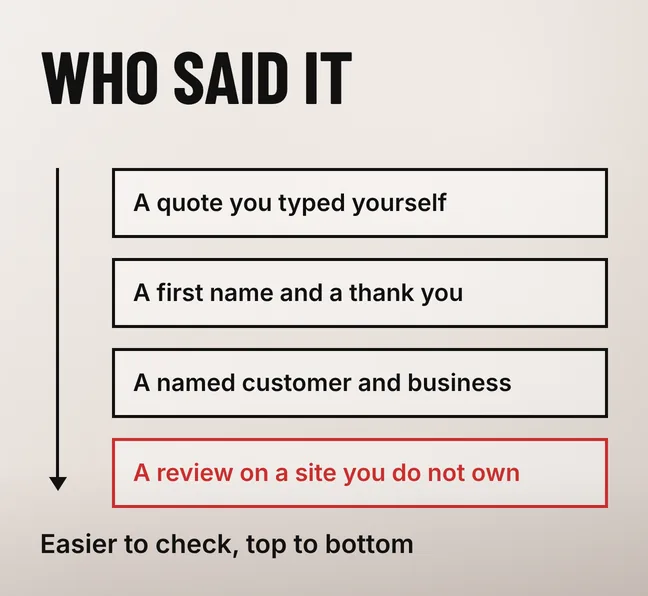
Because you chose them. A business publishes the praise that suits it and buyers know that, so a testimonials page is read as advertising and weighed accordingly. Nielsen Norman Group found the same pattern when it watched people judge service websites, and the reader behaviour it describes has not changed since.
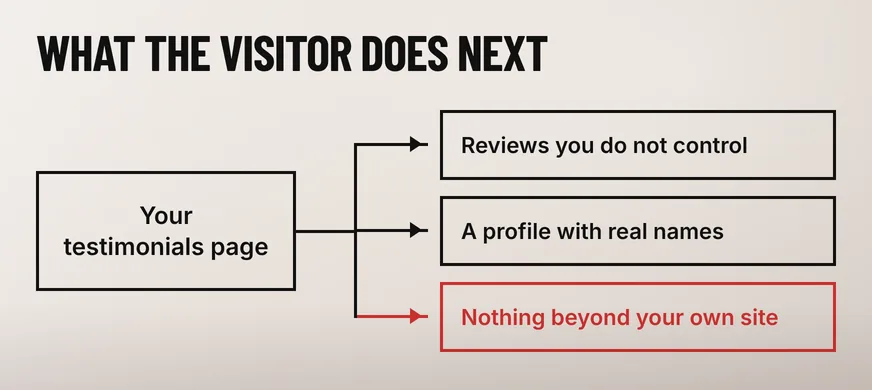
In Nielsen Norman Group’s study of web trustworthiness, published in May 2016, every participant said they would read reviews before deciding which company to hire, and they went past the company’s own words to find them: “people have learned to trust these external sources more than company-sponsored content”, and “when it comes to reviews, people trust testimonials from external sites more than those listed on the website itself”. On-site testimonials were read with “a healthy dose of skepticism”.
One of the four credibility factors the study names is connection to the rest of the web, and it is blunt about a business without one: such a site “appears to either have something to hide”. That is the second tab. Your page is open, your business name is in a search box, and the visitor is looking for the same claim somewhere you cannot edit. A page that leads nowhere outside itself leaves them with your word alone, alongside the other signals a visitor checks in the first ten seconds.
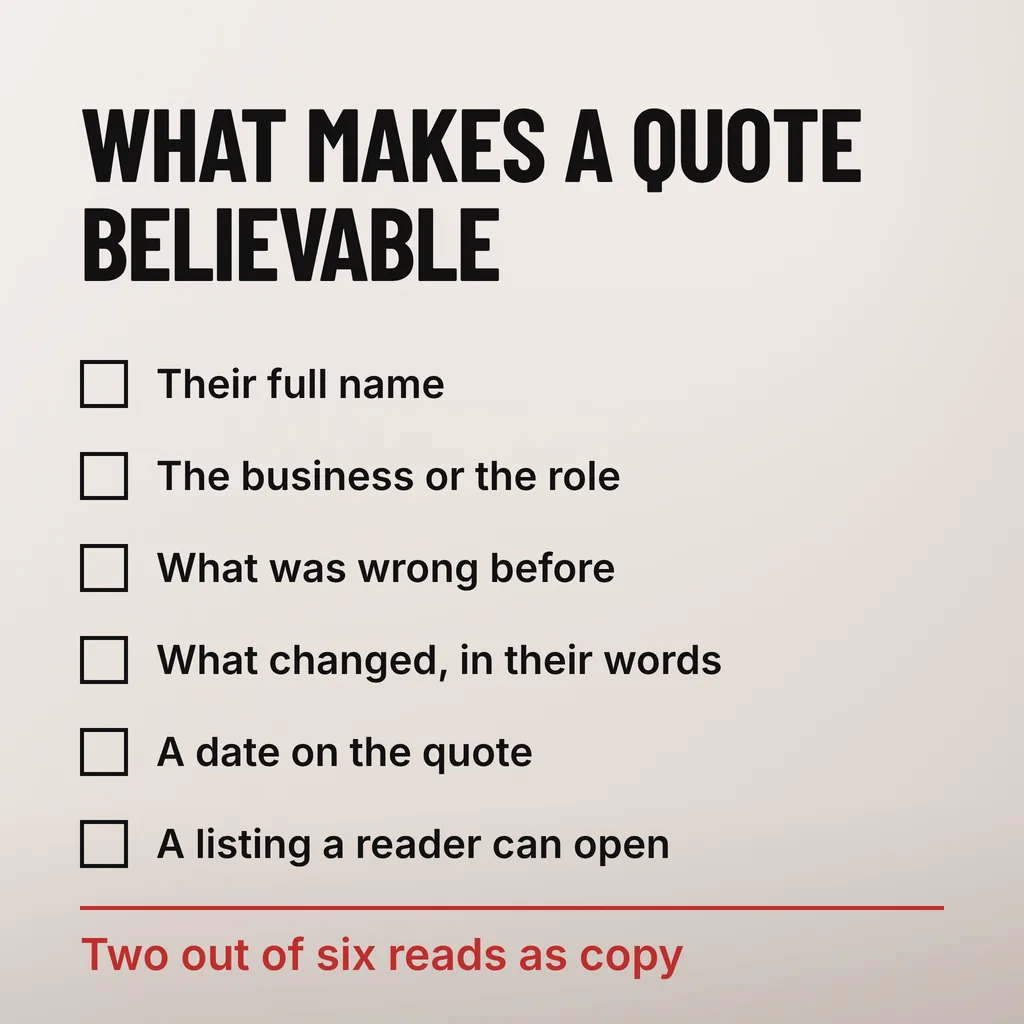
Six details, and a reader runs through them in a couple of seconds: the person’s full name, their business or role, what was wrong before, what changed in their own words, a date, and somewhere outside your site a reader could open. A quote carrying five or six reads as a record. A quote carrying two reads as copy.
| The detail | Why a reader wants it | What the weak version looks like |
|---|---|---|
| Full name | A name can be looked up; initials cannot | “Ahmad K.” or “a happy client” |
| Business or role | Tells the reader whether this customer is like them | No company, no industry, no job title |
| The problem before | Shows what the work was for | Opens on praise with no situation attached |
| What changed, in their words | Specific outcomes are hard to fabricate | “Very professional and responsive” |
| A date | Places the work in time and shows the page is tended | Undated quotes of unknown age |
| Somewhere to check | Lets the sceptic verify without asking you | The quote exists only on your page |
The fourth row is where most testimonials fail. “Great service, highly recommended” describes every supplier in Malaysia; “enquiries now arrive with the budget already filled in, which saves my sales staff a call each time” describes one job. Ask the customer what changed in their week, not what they thought of you, and the quote writes itself in their own register — including the grammar, which you leave alone.
Photographs help only when they are of the person who spoke. A stock portrait turns a true quote into a staged one, and a reader who reverse-searches the face finds the stock library. When the customer declines a photo, no photo is the honest answer.
Three kinds: any you cannot substantiate, any you wrote on the customer’s behalf, and any whose meaning changed in the edit. In Malaysia that is a legal line as well as a credibility one, because the Consumer Protection Act 1999 treats a false claim of endorsement as a false or misleading representation.
Section 10 of the Act, headed “False or misleading representation”, opens “no person shall make a false or misleading representation that” and includes, at paragraph (i), that “the person has any sponsorship, approval, endorsement or affiliation”. A testimonial is an endorsement, and one that cannot be substantiated is what that paragraph describes. Section 25 makes a contravention of that Part an offence.
Section 18 closes the gap a marketing firm might hope to stand in. Where a representation “is made or published in an advertisement”, the Act deems it made by “the person who directly or indirectly claims to supply the goods or services”, “the person on whose behalf the advertisement is made”, or both, “unless the contrary is proved”. If a marketing freelancer invented the quotes on your testimonials page, the business whose services they promote is presumed to have made them.
None of the fixes cost anything. Keep the message each quote came from, in a folder you can find in a year. Get the customer’s agreement to the exact wording you publish, not to the idea of a testimonial. Trim for length and never for meaning — cutting the clause that said “after a slow start” changes what the customer said. Never merge two customers into one composite voice.
No. Google’s own documentation rules out reviews a business controls about itself, so the quotes on your testimonials page cannot earn star ratings in search results however carefully they are marked up. Stars you see against other businesses come from platforms those businesses do not own.
The Search Central review snippet documentation makes pages ineligible where “the entity that’s being reviewed controls the reviews about itself”, and gives as its example “a review about entity A is placed on the website of entity A”. It adds that “ratings must be sourced directly from users” and “don’t aggregate reviews or ratings from other websites”, which closes the other shortcut of pasting platform reviews into your own markup. Its advice to anyone collecting ratings properly is the standard this article argues for anyway: “we recommend only accepting ratings that are accompanied by a review comment and author’s name”.
Marking them up anyway carries its own cost: star markup that appears where it does not belong is a problem in itself, covered in why star ratings turn up on your blog posts. Spend the effort where reviews do earn stars and do get read — a Google Business Profile, where the review sits on a page you cannot edit, which is why a reader believes it.
Open your testimonials page beside the folder of messages those quotes came from and score each one against the six details. The scoring takes about twenty minutes for a dozen quotes, and the outcome is usually a shorter page: fewer quotes, each of them checkable, each sitting next to the service it is about.
If the honest result of that audit is three quotes, publish three. A short page of checkable testimonials outperforms a long one nobody believes, and it is the version you can defend if anyone asks where a claim came from.
Enough that each service you sell carries one relevant quote, which for most small businesses is a handful rather than a wall. Quantity is the easiest thing to fake and readers treat it that way. Four dated quotes naming real businesses, each beside the service it describes, do more than twenty anonymous lines in a slider.
Trim it for length, yes; change what it says, no. Cut a repeated phrase or a long preamble and leave the customer’s own grammar and wording intact, then send the exact published version back for their agreement. Malaysia’s Consumer Protection Act 1999 covers false or misleading representations of endorsement, and an edit that changes the meaning of a quote is one.
For convincing a stranger, usually yes. Nielsen Norman Group found that people trust testimonials from external sites more than those listed on the website itself, because the business cannot edit them. Keep both. The reviews earn the trust; the quotes on your own pages let you place the right one beside the right service, which no review platform does for you.
Testimonials are part of the enquiry path, which is where we spend most of our time on a conversion review: what a visitor reads before they fill in the form, and what quietly stops them. Our digital marketing and ads service covers that path end to end, including the proof a cold visitor needs before a paid click turns into an enquiry. One thing to do this week: score the quotes on your own page out of six, and see how many survive.