
- Resources
Innovative Thinking


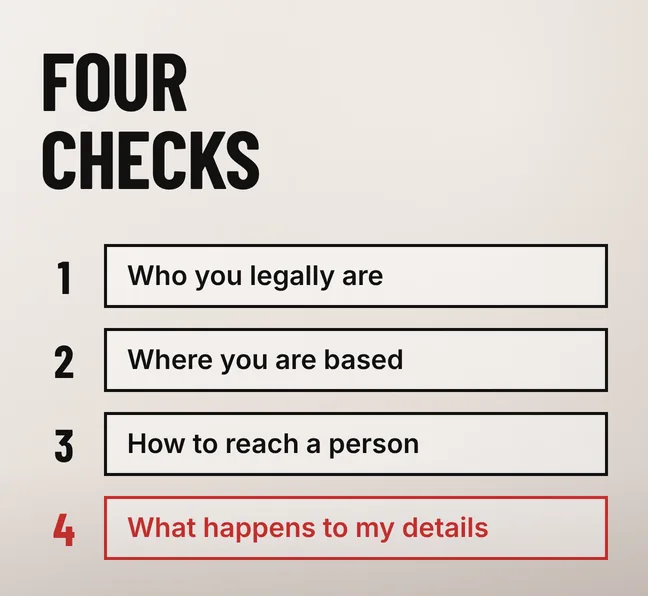
A website footer has four jobs: say who you legally are, say where you are, give a route to a person, and say what happens to the details you ask visitors for. Everything else down there is optional, and most footers carry a good deal of it out of habit.
That matters more in Malaysia than the design blogs suggest, because two of those four lines are asked for by law rather than by a style guide. The footer is also the last block a buyer reads before they transfer a deposit or send the first WhatsApp message, which makes it the cheapest piece of a site to get right.
Visitors reach the footer when the page above it has not answered a practical question: who runs this business, where is it, and how do I reach someone today. Anyone reading the bottom of a page is usually close to acting, so an empty footer costs more than a crowded one, and a wrong phone number down there costs most of all.
Baymard Institute, from its own benchmarking of large e-commerce sites published in October 2019, reported that “13% of the largest e-commerce sites suffer from usability issues with their site-wide footer”. Its testing found shoppers leaving when the footer gave them no way to reach customer service.
The Malaysian version of that moment is specific. Someone has read your service page, likes the price, and before sending a WhatsApp message they scroll down to see whether there is a company name, a registration number and an address attached to the website. If the bottom of the page carries a copyright line and three social icons, they have learned nothing, and a short search for your company name is the next thing they do.
None of this is about decoration. It is the same check we went through for the top of a page in what visitors notice before they contact you, arriving at the other end of the scroll with the decision almost made.
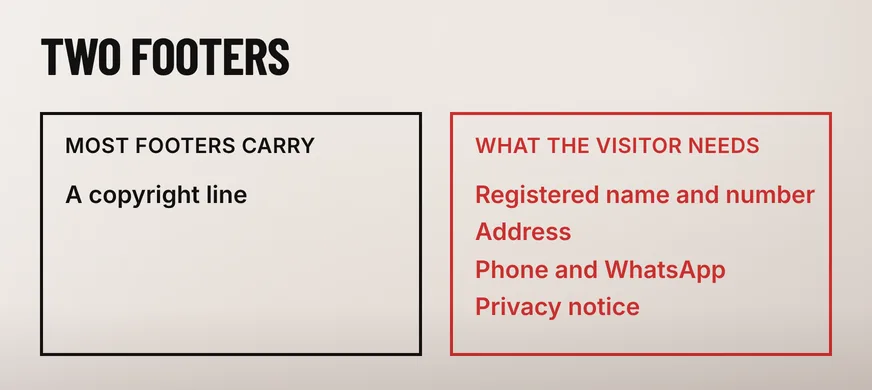
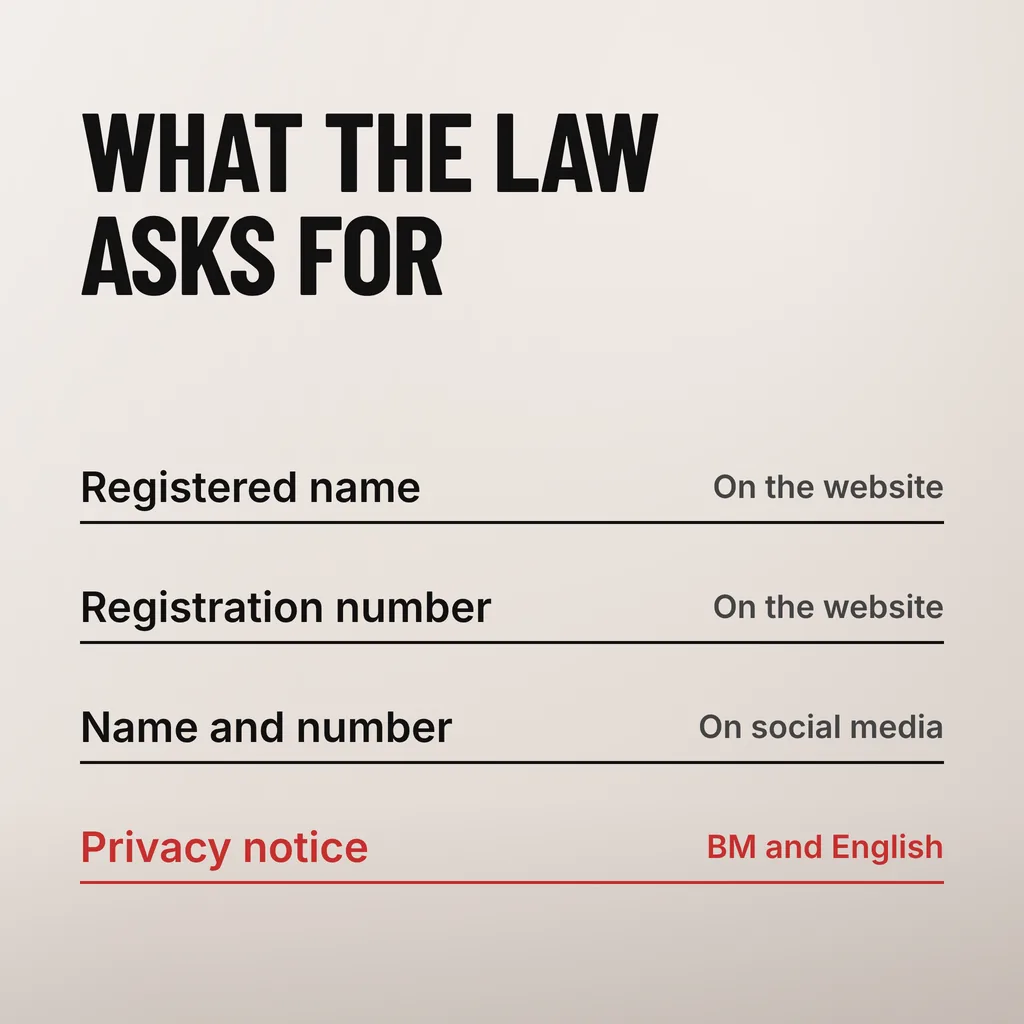
Two requirements reach most Malaysian business websites: the registered name and registration number of the business, and a personal data protection notice wherever the site collects personal details. Both are normally satisfied in the footer, because the footer is the one block that appears on every page of the site.
Section 30(2) of the Companies Act 2016 lists where a company “shall disclose its registered name and company registration number”, and paragraph (b) of that subsection is simply “its websites”. The same section covers business letters and other official publications “including in electronic form”, and section 30(5) adds that “the company and every officer who contravene this section commit an offence”.
Sole proprietorships and partnerships registered with the Companies Commission of Malaysia (SSM) are reached by a separate instrument. SSM’s announcement of the Registration of Businesses (Amendment) (No. 2) 2020 Rules records that the amendment came into force on 7 May 2020 and changed Rules 13 and 13A “to require online businesses to display the name and registration number on the website”, on any social media platform used and on any online marketplace. The same announcement provides that where a business has no permanent or physical place of business, “the residential address of the business owner is deemed to be the business address”.
The privacy notice is the second line. Section 7 of the Personal Data Protection Act 2010 requires a written notice telling people what personal data is being processed, why, and how to contact you with enquiries or complaints about it. Section 7(3) requires that notice to be in the national and English languages, so a Bahasa Malaysia version and an English version both have to exist and both have to be reachable.
An enquiry form, a newsletter box or a WhatsApp click-to-chat button all collect personal data, which is why a brochure site with one contact form is inside this rule rather than outside it. A footer link reading Privacy Notice, pointing at a page that carries both languages, satisfies it on every page at once.
A footer earns its place by holding what a visitor needs after reading a page, not a second copy of the main menu. Contact routes, the legal pages and the two or three pages people genuinely ask for belong there. Links added so that search engines see them do not, and they are the usual reason a footer grows to fifty entries.
| Item | In the footer? | Why |
|---|---|---|
| Registered name and registration number | Yes | Asked for by the instruments above, and the first thing a cautious buyer looks for |
| Full address and a phone number | Yes | Turns an anonymous site into a business with a location someone can picture |
| Privacy notice, in both languages | Yes | Required wherever the site collects personal data, and needed on every page |
| Terms, refund or delivery policy | If you sell | A shopper checks these before paying, not after |
| Three to six key pages | Yes | Services, about, contact: the pages people hunt for when the menu has scrolled away |
| Every page on the site | No | A footer sitemap buries the few links that matter among the ones that do not |
| Social icons | Only if tended | A link to a page last posted on in 2023 is evidence against you |
| A newsletter box | Rarely | Worth the space only when you actually send something |
Order the kept links the way a visitor thinks rather than the way your site map is drawn: contact details first, then the pages, then the legal links last in smaller type. On a phone the footer stacks into a single column, so whatever sits first in the markup is what a thumb reaches first.
One footer line is worth writing out rather than linking: the business name exactly as it is registered, with the registration number after it. That is the string someone copies into an SSM search, and whether a visitor can tell who is behind your website usually comes down to whether that string is anywhere on it.
Footer type is usually the smallest and palest on the page, set in light grey on white or mid grey on black, and that is where contrast requirements are missed most often. WCAG 2.2 Success Criterion 1.4.3 asks for a contrast ratio of at least 4.5:1 for ordinary text against its background, which a lot of footers do not reach.
The standard allows a lower ratio for larger type: “large-scale text and images of large-scale text have a contrast ratio of at least 3:1”, where large scale means at least 18 point, or 14 point bold. Footer text is almost never large by that definition, so 4.5:1 is the number that applies to it.
Size is the other half. Setting the footer two or three steps smaller than the body text is a habit from printed stationery, and it makes the one block holding your phone number the hardest block on the page to read. Keep it within a step of the body size and let the layout carry the hierarchy instead.
On a phone, make the phone number a tel: link and the WhatsApp number a wa.me link, so a tap starts the call or the chat rather than selecting text. A footer that stacks into forty tiny links with no spacing between them is a footer nobody taps accurately.
Take out anything that is there for a search engine, anything you are not maintaining, and anything that duplicates what sits two rows above it. A footer is read in a few seconds by someone who is already looking for one specific thing, and every extra line makes that thing slower to find.
Keep a copyright line with the current year, kept current automatically rather than by hand. A footer still reading 2023 says the site has not been touched in two years, which is the opposite of what the rest of the block is there to say.
Yes, for most registered Malaysian businesses. Section 30(2) of the Companies Act 2016 requires a company to disclose its registered name and company registration number on its websites, and SSM’s 2020 amendment to the Business Registration Rules requires online businesses to display their name and registration number on the website and on any social media or marketplace they use. The footer is the simplest place to satisfy it once for every page.
In the footer, and yes. Section 7(3) of the Personal Data Protection Act 2010 requires the notice to be in the national and English languages, so a Bahasa Malaysia version and an English version both have to exist and both have to be reachable. A single footer link labelled Privacy Notice, pointing at a page carrying both, puts it on every page of the site at once.
No. Three to six links covering the pages people hunt for once the menu has scrolled away is enough, alongside the contact details and the legal pages. A full menu copy, or a sitemap of every page, buries the handful of links a visitor came down there to find and makes the footer taller than the content above it on a phone.
A footer is a half-day of work on an existing site rather than a reason to rebuild one, and it is usually the cheapest improvement available on a business website. Our creative and digital experience service rewrites the block so the registered name, number, address and privacy notice are present, legible and consistent on every page. One thing to do this week: open your own site on a phone, scroll to the bottom, and see how long it takes to find your company registration number.