

- Resources
Innovative Thinking


Check the counting first. A sudden website traffic drop appears as a line falling in a chart, and that line can fall because a tracking tag was removed, a report filter changed or two unequal date ranges are being compared. Confirm the fall in two separate tools, find the day it started, read your own change log against that day, and leave Google’s updates until last.
Every page that answers this question gives you a list of causes, and a list is not a diagnosis. A dozen things could explain a fall; on your site, eleven of them did not happen. What settles it is the order you check in, because each check rules out a whole group of causes and the first three take an afternoon between them.
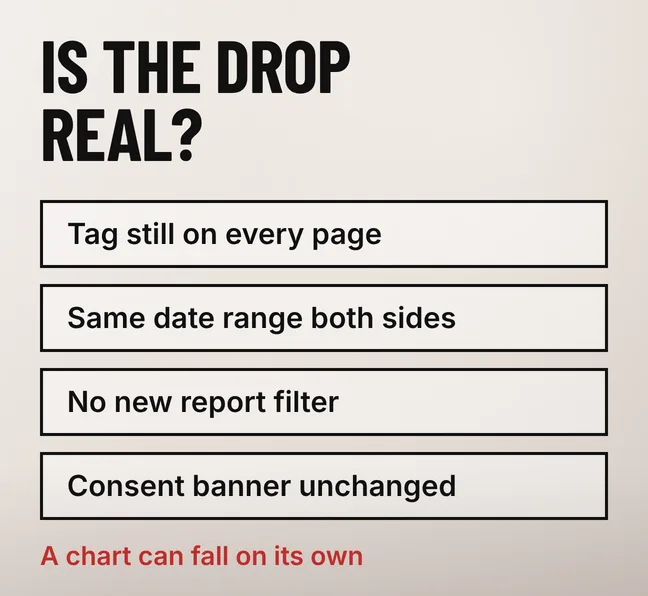
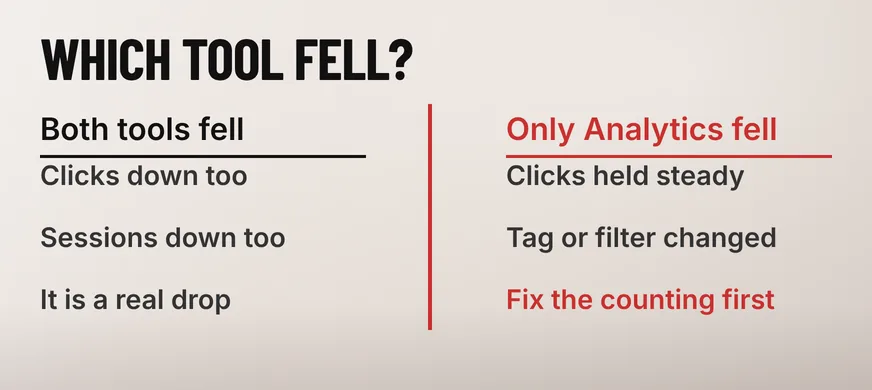
Open Google Search Console and your analytics side by side for the same fortnight. If clicks fell in Search Console and sessions fell in analytics, the fall is real and worth diagnosing. If only analytics fell while clicks held steady, the fall is in the measurement: a missing tag, a new filter, a changed consent banner or a mismatched date range.
Google says the same about its own reporting. Its guide to debugging drops in Google Search traffic lists a reporting fault as a cause in its own right — “The drop might be related to a change in the data processing or a logging error” — and points you at the Search Console Data Anomalies page to check whether one applies to your site. On where to start, it is blunt: “The best way to understand what happened to your traffic is to look at the main chart.”
The two tools disagree by design, which is why reading them together works. One counts what happened before the click and the other counts what happened after it, so a gap between them localises the problem to one side of the click. That difference is worth understanding properly, and we have written about what Search Console shows that analytics cannot.
Three measurement faults come up again and again on Malaysian SME sites, and all three are mundane. A theme or plugin update drops the analytics snippet out of the footer. A consent banner blocks the tag until a visitor accepts, so a share of sessions stops being recorded. And WhatsApp enquiries arrive with no referrer, so a change in how people reach you reads as a loss when the enquiries are unchanged.
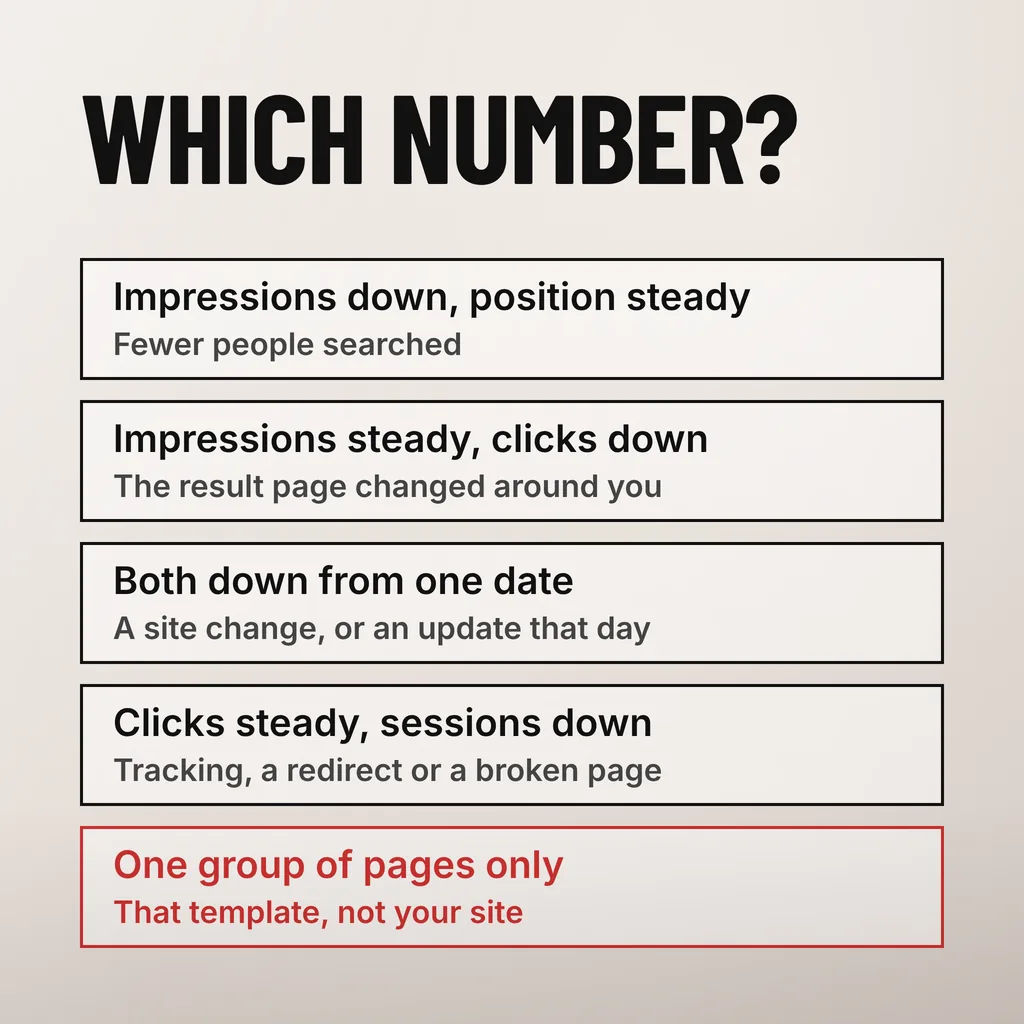
Three numbers move independently, and knowing which one moved narrows the cause before you investigate anything. Impressions falling means fewer searches reached you at all. Clicks falling while impressions hold means the result page changed around you. Sessions falling while clicks hold points at tracking, a redirect or a page that no longer loads for some visitors.
| What fell | What it usually points at | Where to look next |
|---|---|---|
| Impressions down, average position steady | Fewer people searched for your terms | The same weeks last year, and Google Trends |
| Impressions steady, clicks down | The result page changed around you | The Queries tab, compared period on period |
| Impressions and clicks down from one date | A site change, or a ranking update that day | Your own change log, then the status dashboard |
| Clicks steady, sessions down | Tracking, a redirect chain or a broken page | The tag, the redirects, then the page itself |
| Only one group of pages fell | That template or section, not the site | URL Inspection on three of those pages |
Google’s guidance splits the investigation the same way. “If it’s a site-wide issue, check the Page indexing report”, and “If the drop only affects a group of pages, use the URL inspection tool to investigate a few pages.” The Search type filter matters too, because it separates the surfaces: “This will help you understand whether the drop you’ve seen happened in web Search, Google Images, or the Video or News tab.” A product or photography site can lose an image-search audience while web Search never moves.
Put your own change log beside the chart before you look at anything Google did. A theme update, a plugin, a URL change, an edited robots.txt rule, a new security layer or a migration all show as a step down within days of the change. This check costs nothing and is the one most often skipped, because the answer is uncomfortable.
Google treats this group as its own cause: “Technical issues are errors that can prevent Google from crawling, indexing, or serving your pages to users.” On a WordPress site the usual suspects are specific. A staging copy pushed live with its noindex setting still on. A redesign that changed URLs without redirects. A canonical tag pointing every page at the homepage. A firewall plugin blocking Googlebot along with the bad bots. Hosting that was down during a crawl.
Pages that have fallen out of the index take their traffic with them, and that failure is usually configuration rather than content — which is also why it is usually quick to reverse. If the Page indexing report shows pages excluded that used to be included, start with the reasons Google stops indexing pages rather than with rewriting them.
A drop that starts on the day a revamp went live is the most recoverable kind, and the least likely to need another rebuild. Google’s site-move guidance warns that recovery is not instant: “a medium-sized website can take a few weeks for Google to notice the change.” Redirect every old URL to its real replacement, resubmit the sitemap, then wait those weeks out before blaming the new site.
Set the Search Console chart to the last 16 months and look at the same weeks a year ago. Malaysian demand moves hard with the calendar: the fortnight around Hari Raya, Chinese New Year, the long school holidays, the end of a financial year. A fall that happened on the same dates twelve months earlier is a season, and the right response is to do nothing.
Google puts the instruction in those words. Extending the range is there so you can “make sure it’s not a drop that happens every year due to a festivity or a trend”, and on shifting demand it says plainly: “This means your traffic may drop as a result of external influences.” Comparing the drop period against an equivalent earlier period is a separate step in the same guide, which exists “to help you review what exactly changed.”
Google Trends settles the harder version of the question in about five minutes. If the terms your pages rank for are themselves being searched less, your position can be identical while impressions fall, and no work on the pages brings back demand that moved. That is a commercial finding rather than a technical one, and it argues for different pages rather than better versions of these.
Check the date against Google’s own dashboard before deciding it was. The Search Status Dashboard lists confirmed ranking updates with their start dates and durations, so a fall that began on a day with no entry near it probably had another cause. Checked on 7 November 2026, its most recent ranking entry was the September 2026 spam update, which started on 24 September 2026 and ran for thirteen days.
That dashboard is the authoritative list of confirmed ranking updates, and it is short. On the same check, the most recent core update listed had started on 21 May 2026 and run for just under twelve days. Volatility chatter in SEO forums runs continuously and most of it matches no confirmed update, which is worth remembering before accepting an explanation that excuses everyone involved.
If the dates really do line up with a core update, Google’s advice is to resist the obvious reaction: “there might not be anything fundamentally wrong with your content.” Updates reassess which pages best answer a query, so a site can lose positions without having got worse. Rewriting ten pages in the first week destroys your ability to tell what the update did, because you will never know afterwards which change moved the line.
Google publishes no threshold, and we have not measured one that holds across sites, so treat any specific percentage you are quoted as someone’s opinion. What works in practice is a rule about shape rather than size: act when a fall holds for three weeks in clicks and sessions together, or immediately when it starts on the day something changed on your site.
Write the date, the numbers and what you changed into one file as you go. A drop usually goes unexplained because nobody recorded what the site looked like before it, so there is nothing left to compare against three months later.
Days for a tracking fault, a few weeks for an indexing or redirect fix, and no promise at all after a core update. A tag is corrected the moment it is back on the page, though the gap it left in the data stays. Google’s site-move guidance puts recrawling at a few weeks for a medium-sized site. Recovery after an algorithmic update is the slowest and the least predictable of the three.
Not in the first fortnight. Google’s debugging guidance says that after an algorithmic update “there might not be anything fundamentally wrong with your content”, so a rewrite may change nothing except your ability to measure. Identify which queries and pages lost position first, wait for the rollout to finish, then improve the few pages that genuinely answer their query less well than the pages now above them.
Because the result page changed around you rather than beneath you. Holding position two while an AI summary, a larger block of ads or a new result feature sits above you means the same impressions produce fewer clicks. Compare impressions, clicks and average position over the same window in Search Console: steady impressions with falling clicks is the signature, and it calls for a stronger title and description, not technical work.
A sudden drop is worth diagnosing before anything on the pages is touched, because the cause decides whether the work is ten minutes or three months. Our SEO service covers that diagnosis and the fix it points to. One thing to do this week, whether or not your traffic has moved: open Search Console, set the range to 16 months and screenshot the chart, so you have a before.