
- Resources
Innovative Thinking


Your site almost certainly has schema markup already. Rank Math and Yoast both start emitting it the day they are activated, so the useful question is not whether to add structured data but which of it earns anything, and the schema markup small business sites genuinely benefit from is short: Organization, LocalBusiness where customers come to an address, and Breadcrumb.
What none of it will do is move a page up the results. Google’s documentation describes structured data as a way to understand and classify a page, and says in as many words that it does not guarantee any feature will appear. Two of the types most often recommended to small businesses, FAQ and review markup, now earn an ordinary business nothing at all.
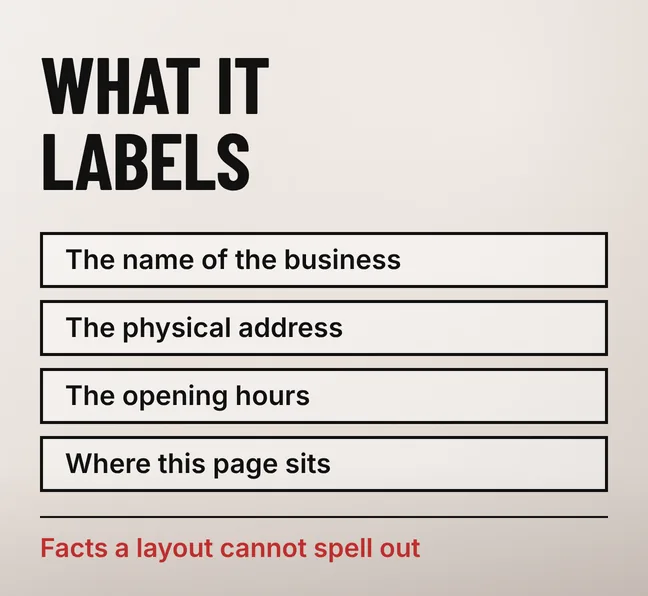
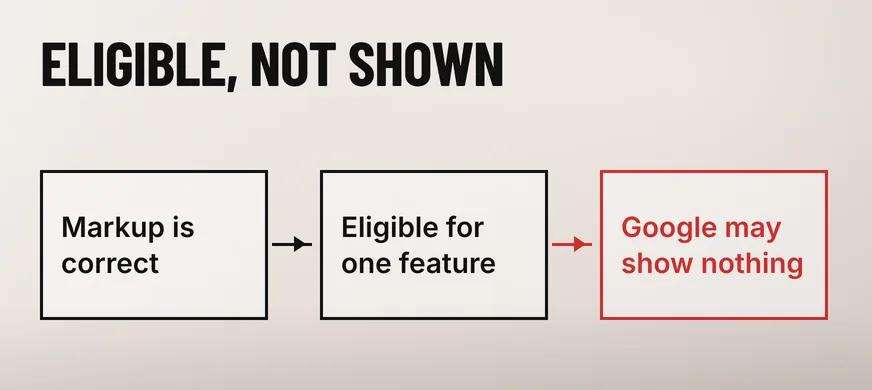
Schema markup puts a machine-readable label on facts that are already on the page, so a crawler does not have to work out from the layout that a string of digits is a phone number or that a line of text is an opening time. Correct markup makes a page eligible for a search feature, and eligibility is as far as it reaches.
Google’s own gallery of structured data features is the list of what those features are, and read on 8 November 2026 it holds twenty-five of them: Article, Breadcrumb, Event, Job posting, Local business, Organization, Product, Recipe, Review snippet, Video and fifteen more. If a type is absent from that gallery, correct markup for it produces nothing, because Google has built nothing to display it.
The documentation is unusually blunt about the ceiling. Google’s structured data guidance states that “items that are missing required properties are not eligible for rich results”, and both its Local Business and Organization pages carry the same warning: “Google does not guarantee that features that consume structured data will show up in search results.” Having every required property makes a page eligible to be chosen, not chosen.
Nothing in that documentation describes markup as raising a page’s position. Google’s introduction to structured data calls it “a standardized format for providing information about a page and classifying the page content”, and says “Google uses structured data that it finds on the web to understand the content of the page”. Comprehension and eligibility are the whole of the claim.
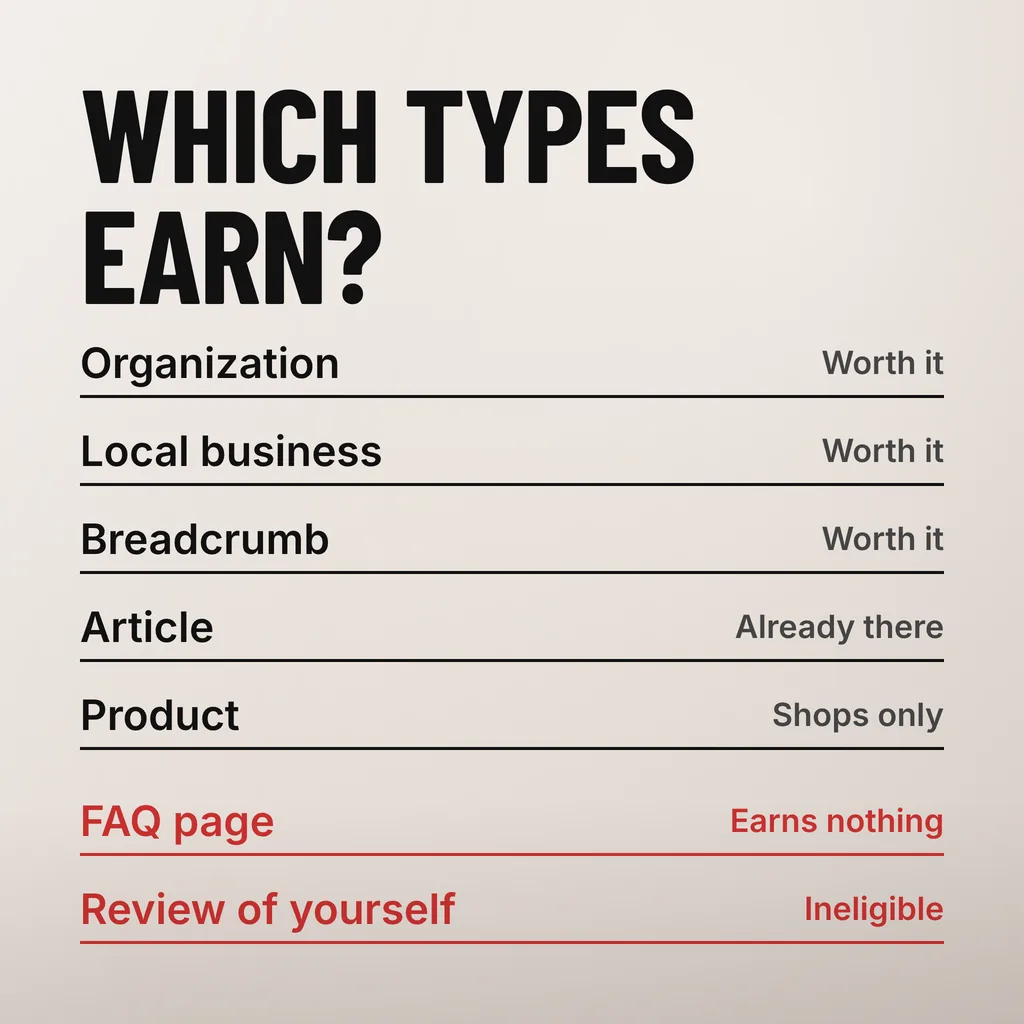
Three types carry almost all of the value for an ordinary small business site: Organization once on the home page, LocalBusiness if customers come to a physical address, and BreadcrumbList on every page below the home page. After that, add only the type that describes what the page actually is, which is Article on a blog post and Product in a shop.
| Type | What Google’s documentation says it is for | Worth it for an SME? |
|---|---|---|
| Organization | Helps Google “better understand your organization’s administrative details” | Yes, once, on the home page |
| LocalBusiness | Business hours and departments; results “may display a prominent Google knowledge panel” | Yes, if customers visit an address |
| BreadcrumbList | A trail that “indicates the page’s position in the site hierarchy” | Yes, on every page below the home page |
| Article | The page is an article rather than a product or a profile | Yes, and your SEO plugin already adds it |
| Product | A product with a price and availability | Only on a shop with real stock |
| FAQPage | FAQ rich results, now shown only for “well-known, authoritative government and health websites” | No |
| Review and AggregateRating | “Only for sites that capture reviews about other local businesses” | No, and it can cost you |
LocalBusiness has the most to gain and the most detail to get wrong. Google’s Local Business structured data documentation requires only two properties, name and address, where address is “the physical location of the business”, and says the markup lets you “tell Google about business hours, different departments within a business”. A knowledge panel is the upside it names, alongside a carousel of businesses related to the query.
Organization needs less work than most plugin screens imply. Google’s Organization documentation says there are “no required properties” and recommends “placing this information on your home page, or a single page that describes your organization”, adding “you don’t need to include it on every page of your site”. A site repeating full organisation markup across sixty pages has not gained sixty times anything.
Breadcrumb is the cheapest of the three because the theme usually draws the trail anyway. Google describes it as a trail that “indicates the page’s position in the site hierarchy”, and a BreadcrumbList needs at least two items, so it does nothing on a home page and something on every service and blog page beneath it.
Almost certainly yes. Rank Math and Yoast both generate Organization and Article markup from the moment they are activated, and most themes add a breadcrumb trail with its markup attached. The work that pays is checking what is being emitted now, which types two plugins are declaring at once, and whether the details inside it are still true.
Check it against a live URL rather than in the plugin settings. Google’s Rich Results Test reads one page at a time and reports which types it found; Search Console’s enhancement reports list each type Google has recognised across the whole site with its valid and invalid item counts. Search Console shows what Google actually read, which is the only version of your markup that matters.
Two faults turn up more than any others on a small business site. The first is duplicate declaration, where an SEO plugin and a theme both describe the business and hand Google two slightly different names for the same company. The second is markup that was accurate at launch: an old address, a ported phone number, hours from before the shop started closing on Mondays.
Stale markup is worse than none, and Google’s structured data guidelines say why. “Your structured data must be a true representation of the page content,” they state, and “don’t mark up content that is not visible to readers of the page.” Markup declaring Monday hours on a page that says the shop is shut on Mondays is wrong in the one format built to be taken at face value.
Google withdrew both features from ordinary websites. Its Search Central blog post of 8 August 2023 reduced FAQ rich results to a small class of official sites and deprecated How-To results outright, while review markup about your own business was never eligible in the first place. Adding either to an SME site produces markup that nothing will ever display.
The FAQ announcement said Google was “reducing the visibility of FAQ rich results, and limiting How-To rich results to desktop devices”, and that FAQ rich results “will only be shown for well-known, authoritative government and health websites”. An update dated 14 September 2023 finished the job: “as of September 13, Google Search no longer shows How-to rich results on desktop, which means this result type is now deprecated.” Neither type appears in the current features gallery.
Review markup fails a different test. Google’s review snippet documentation limits the supported types to “sites that capture reviews about other local businesses”, and states that where the entity being reviewed controls the reviews about itself, its pages using LocalBusiness or Organization markup “are ineligible for star review feature”. Marking up your own testimonials asks for a result the page cannot have, which is a different problem from star ratings appearing on blog posts that never asked for them.
An FAQ section is still worth having where the questions are ones buyers ask, because it answers them on the page. What it will not do any more is widen the result in Google.
Neither, and the ranking claim is the one to be careful with. Structured data helps a parser agree with a page it would otherwise have to interpret, which is a modest and real benefit. No documentation from Google promises a position, and no assistant vendor promises a citation, in exchange for adding markup.
Percentages attached to schema work are worth refusing on sight. The figures circulating on this topic, whether a share of extra clicks or a multiple of visibility, trace back to vendor marketing rather than to a study anyone can open and check, so they are not repeated here. What Google claims for structured data is understanding and eligibility.
For assistants the useful work turns out to be the same work for a different reason: the facts about your business need to be stated plainly in text a reader can see, because markup can only confirm a fact the page already contains. We went through what that takes in whether ChatGPT can understand what your business does.
Start with the business details, because they are what gets quoted back to a customer. One business name spelled one way on every page, an address that matches the one on your Google Business Profile, a phone number in a format someone can tap on a phone, and opening hours that survive a public holiday without going stale.
Two local details catch people out repeatedly:
Then leave it alone. Structured data is not a monthly task for a six-page site: it is worth one careful hour, spent reading what Search Console says the site emits and making the details agree, and worth revisiting when the business moves, renames, opens a second location or starts selling online.
Usually no. On WordPress, Rank Math and Yoast both generate Organization, Article and Breadcrumb markup from their own settings screens, and filling in the business details there covers what most small business sites need. Two cases are worth paying for: a shop that needs product and availability markup, and a business with several locations, where each address needs its own LocalBusiness markup on its own page.
No. A page that is not ranking has a content, link or indexing problem, and markup touches none of the three. Google describes structured data as a way to understand and classify a page rather than to promote one. Check that the page is indexed and that it answers the query better than the pages above it before spending time on markup.
Open the enhancement reports in Google Search Console and read the valid and invalid counts for each type. That is what Google read from your pages, as opposed to what a plugin believes it emitted. The Rich Results Test checks one URL at a time and is the quicker tool while you are fixing something, but Search Console is what tells you the fix took effect.
Structured data is an hour of tidying on most sites and almost never the reason one underperforms, so it belongs near the end of a search visibility list rather than the top. Our SEO service checks what a site already emits, clears the duplicate declarations, and makes the business details agree across the pages, Search Console and the Google Business Profile. One thing to do this week: put your home page through the Rich Results Test and read your own name, address and hours back from the markup.