
- Resources
Innovative Thinking


A new website is usually in Google’s index within days to a few weeks. Showing up for a search that actually brings you work is a separate clock, and it runs in months. When an owner asks how long does SEO take, they are nearly always asking about the second while watching the first, which is why the answer sounds evasive.
Nothing below promises a position or a date, because nobody honestly can. What follows is what Google says about its own timings, what a large study of new pages found, and how to tell an ordinary wait from a fault.
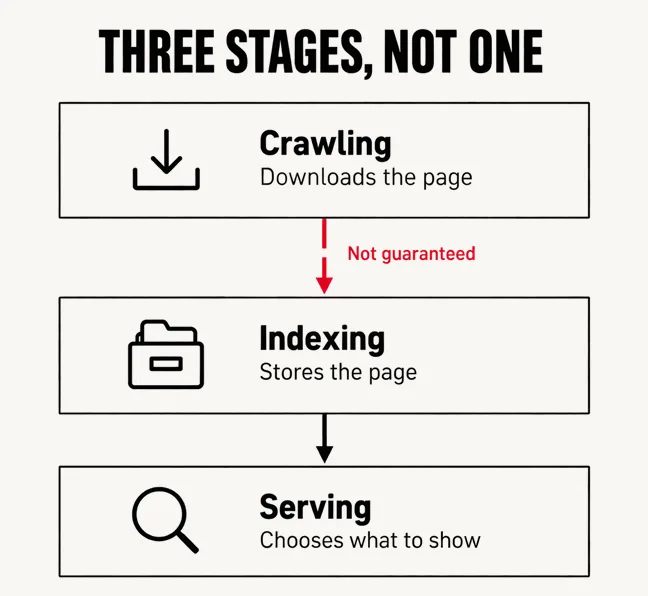
Google describes its own work in three stages: crawling, which downloads what it has found; indexing, which analyses the page and stores it; and serving, which decides what to show somebody who searches. Passing one stage does not carry you into the next, and Google is blunt about the middle one: indexing isn’t guaranteed; not every page that Google processes will be indexed.
On elapsed time, Google’s documentation says that crawling can take anywhere from a few days to a few weeks, and that asking for a crawl “does not guarantee that inclusion in search results will happen instantly or even at all”.
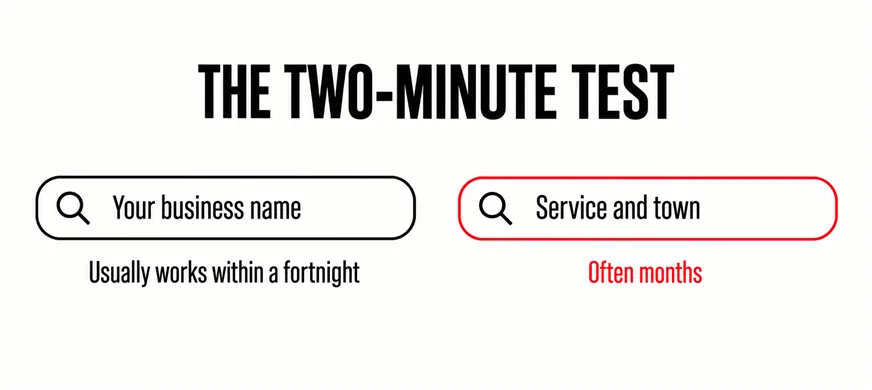
There is a two-minute test that separates the questions. Search your registered business name, then search what you actually sell the way a stranger would phrase it — the service and the town, not your brand. A new site usually passes the first within a fortnight and fails the second for months. Both are normal at once. The second is the one worth measuring.
Being in the index means Google could show your page. It says nothing about whether anyone will ever see it.
Google answers this in its starter guide, under “How long until I see impact in search results?” The answer: some changes might take effect in a few hours, others could take several months, with advice to wait a few weeks before judging whether anything worked. It is deliberately wide, because the honest answer is a range rather than a date.
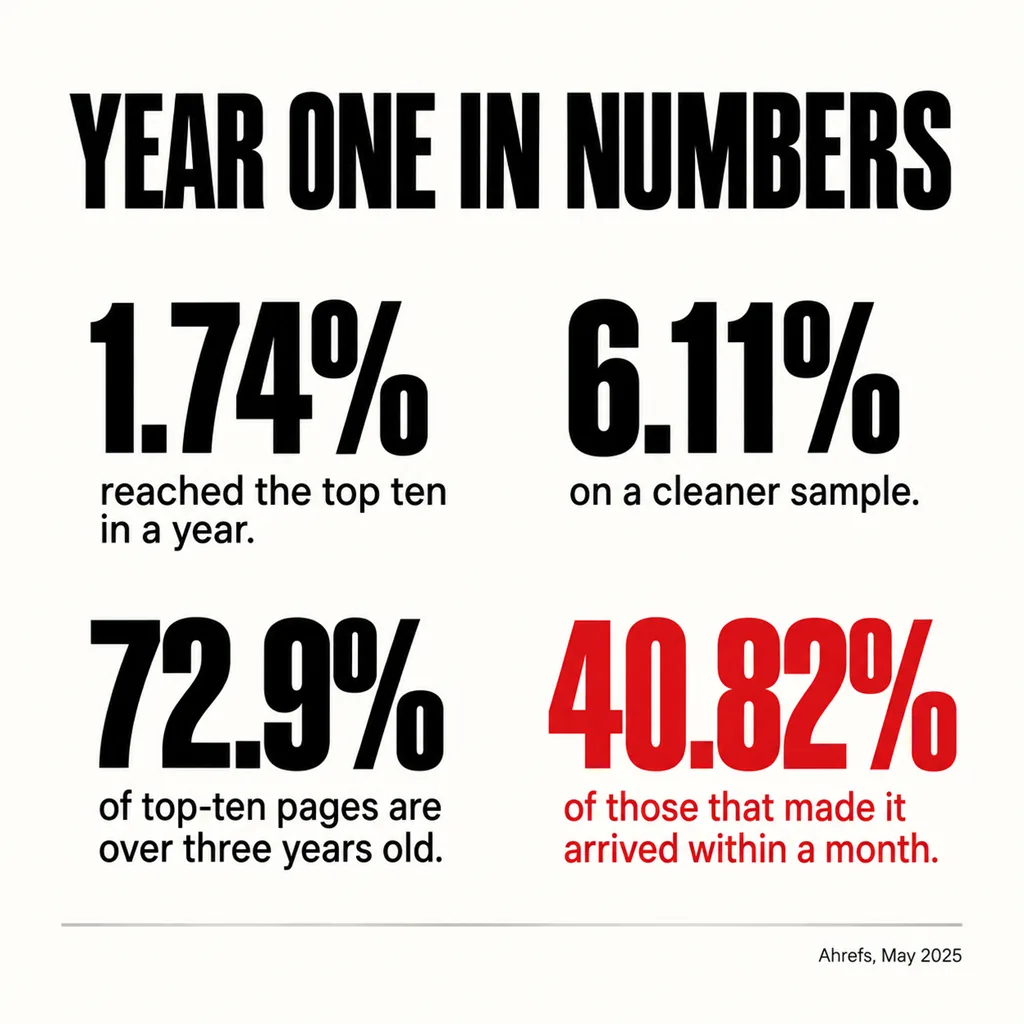
The largest recent measurement is Ahrefs’ May 2025 study of how long pages take to rank, which followed a million randomly sampled URLs first crawled in September 2023 to see how many reached the top ten within a year. Only 1.74% did. On a cleaner sample — two million URLs created in October 2023, restricted to non-empty English pages — the figure rose to 6.11%. Either way, the ordinary outcome for a new page in its first year is that it does not reach the first page.
The same study explains why. Ahrefs found that 72.9% of pages in Google’s top ten are more than three years old, and that the page ranking first is on average five years old. A new site is not judged against nothing. It is judged against pages that have spent years collecting links, mentions and a record of satisfying the same search.
One finding cuts against the usual advice. Of the pages that did reach the top ten, 40.82% got there within a month. Ranking is less a slow grind upward than a page catching hold early or not at all — so a page that has not moved after five or six months is telling you something about the page rather than asking for patience.
Rolled up for an SME launching a new site, the shape looks roughly like this. It is a shape, not a schedule:
Two things owners spend money and worry on are worth ruling out first.
What genuinely shortens the wait is duller.
Search Console tells you whether you are waiting normally or waiting on a fault. A page marked “Discovered – currently not indexed” has been found but not yet crawled: Google says it wanted to crawl the URL but this was expected to overload the site, so the crawl was rescheduled. A page marked “Crawled – currently not indexed” was looked at and not kept; Google says it “may or may not be indexed in the future; no need to resubmit this URL for crawling”.
Neither status asks you to resubmit. A run of the second one across most of the site, months after launch, means the pages are thin or near-identical, not that the wait is ordinary.
The genuine faults, in the order they turn up:
For the first week or two, yes. After a month it is not, and it usually means the site is not indexed at all rather than ranking badly. Check the Page Indexing report in Search Console, and check that the “discourage search engines” setting was switched off at go-live.
No. Google states that it does not accept payment to crawl a site more frequently or rank it higher, and the two systems are separate. Ads are still worth considering on their own terms, because they can bring enquiries during the months when the organic side produces none.
Considerably, and in your favour, provided the addresses were carried across or redirected. A domain with years of history behind it is not a new site to Google. Expect weeks of turbulence while pages are recrawled, rather than the months a genuinely new domain faces.
This is a conversation we would rather have at the start of a project than six weeks after launch, when the site is quiet and everyone wonders whether the money was wasted. Our SEO service is built around what actually moves the date: pages specific enough to rank, an address history worth keeping, and local visibility earned while the slower work runs. A site live for months that still returns nothing but your own company name is a diagnosis, not a waiting game.