
- Resources
Innovative Thinking


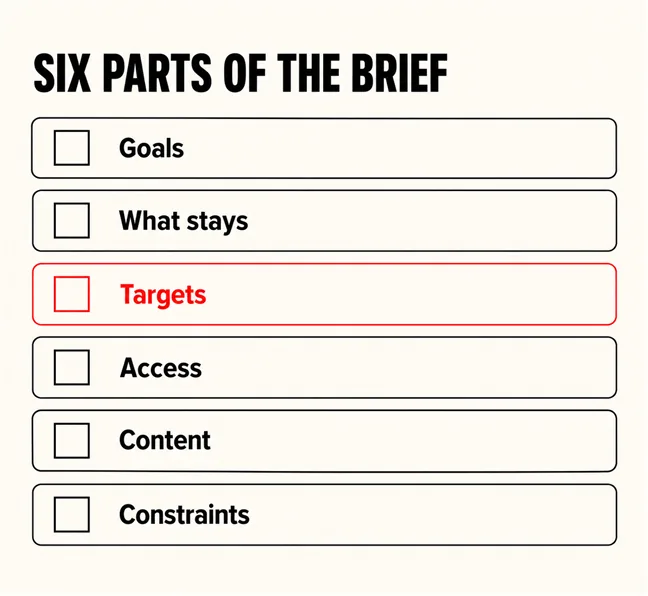
A website revamp brief should let an agency quote without guessing. That takes six things on paper: what the site has to achieve, what must survive the revamp, the targets it will be measured against, who holds the logins, who writes and approves the content, and the constraints — budget band, deadline, languages and the systems it has to keep working with. Two or three pages usually covers it.
Many briefs describe the look and stop there, which is why quotes for the same site come back so far apart: each agency fills the gaps with its own assumptions, and you end up comparing assumptions rather than prices.
An agency quoting a revamp is pricing hours, and the hours depend on facts it cannot see from outside: how many distinct page layouts there are, who is rewriting the content, which integrations must keep working, and how much search traffic needs protecting. When the brief is silent, a careful agency prices the risk in and a hungry one prices it out — and recovers the difference later as change requests.
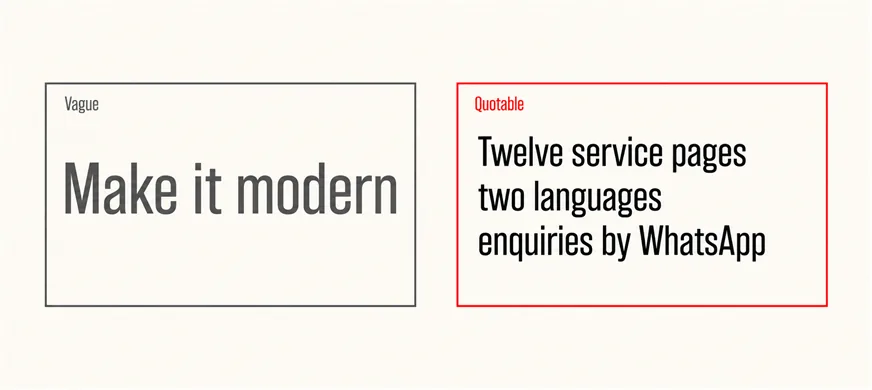
Compare two lines. “Make it modern” gives an agency nothing it can count. “Twelve service pages, two languages, enquiries by WhatsApp” gives it the page count, the translation workload and the one conversion that matters. Every part of a good brief works like the second line:
If you only have time for two, write the goals and what stays; whether to revamp or rebuild turns on exactly those.
Write goals as outcomes a business owner would recognise, not design adjectives. “More enquiries from the Penang branch page”, “fewer phone calls asking for our opening hours”, “a site the office can update without the developer” — each implies different work. Then rank them: three goals in order beat ten in a list, because the order settles arguments halfway through.
Next, list what has to survive: pages that already bring in search traffic, content worth keeping, and the systems the site is wired into — a booking form, a WooCommerce shop with an FPX payment gateway, a CRM that receives the enquiries. Deciding what to keep from the old site covers the audit; the brief only needs its result.
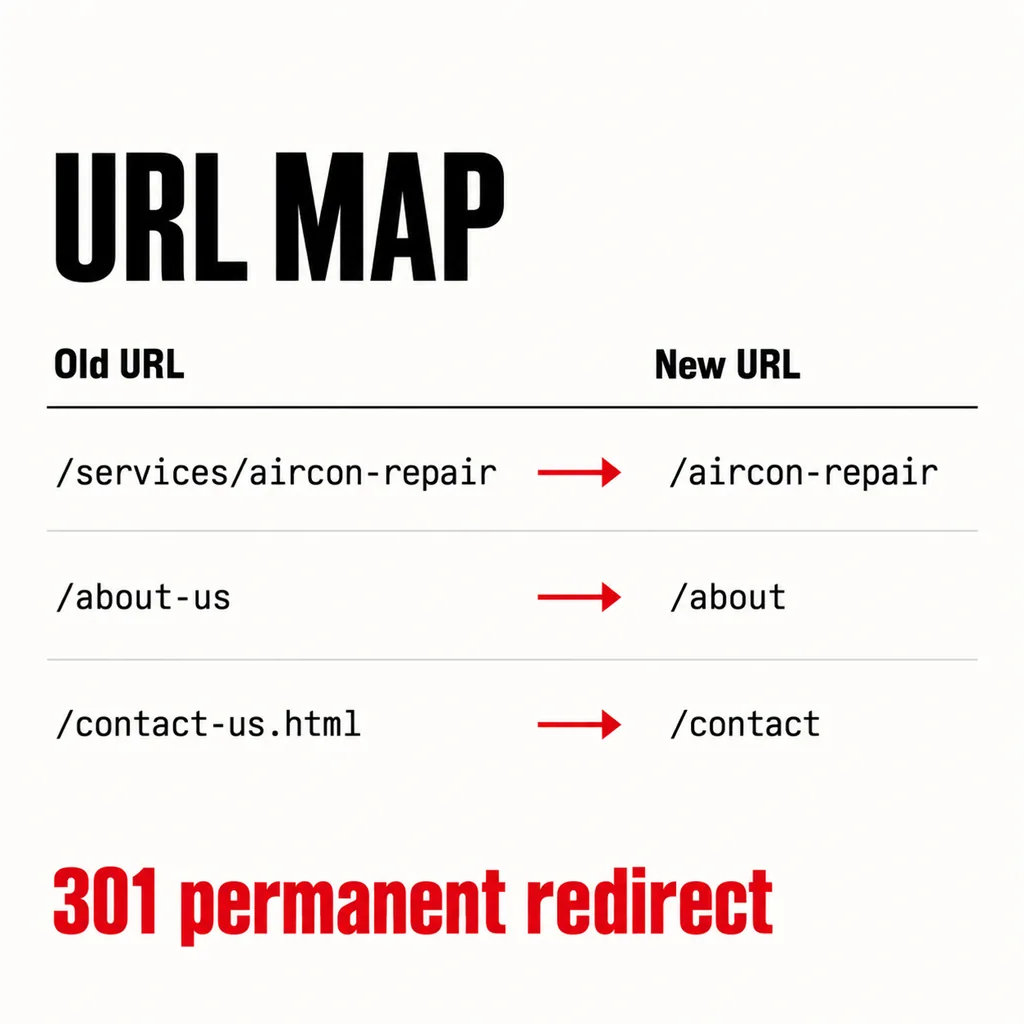
The addresses deserve their own line. Google Search Central’s guidance on site moves with URL changes is direct: “It’s important to map your old site’s URLs to the URLs for the new site.” If /services/aircon-repair is going to become /aircon-repair, /about-us become /about and /contact-us.html become /contact, the brief should say that a URL map and 301 permanent redirects are in scope, so the agency prices them rather than discovering them at launch. Redesigning without losing rankings explains what happens when nobody owns that job.
A target belongs in a brief only if someone can check it after launch without arguing about taste. Three published standards do most of the work.
The web.dev guidance on Core Web Vitals sets the loading line plainly: “To provide a good user experience, LCP should occur within 2.5 seconds of when the page first starts loading.” Responsiveness (INP) should be 200 milliseconds or less and layout shift (CLS) 0.1 or less, judged at “the 75th percentile of page loads, segmented across mobile and desktop devices.” Ask for the mobile figures, the harder of the two; whether three seconds is still fast enough explains why.
Google’s help page about key events defines one as “an event that measures an action that’s particularly important to the success of your business.” Name yours in the brief — a WhatsApp click, a form submission, a tap on the phone number — so the tracking is built into the quote rather than left for later. The minimum analytics setup lists the ones a service business usually needs.
The W3C’s Web Content Accessibility Guidelines 2.2 state that “WCAG 2.2 success criteria are written as testable statements that are not technology-specific.” That is what a brief needs: met or not met. Whether everyone who visits can actually use your site covers what level AA means in practice.
| Target | What to write in the brief | Source |
|---|---|---|
| Loading | LCP 2.5 seconds or less at the 75th percentile, on mobile | web.dev |
| Responsiveness | INP 200 milliseconds or less | web.dev |
| Visual stability | CLS 0.1 or less | web.dev |
| Enquiries | Named key events recording from launch day | Google Analytics Help |
| Accessibility | WCAG 2.2 level AA on the main page templates | W3C |
Record today’s numbers before work starts, since a target with no baseline proves nothing, and carry the targets into the checks before go-live.
List every account the site depends on and who can log in today: domain registrar, DNS, hosting, the WordPress or other CMS admin, Google Analytics, Search Console, Google Business Profile and the email service. Email belongs there because business mail runs off the same domain records, and a careless DNS change during a revamp can stop it.
Then check whose name each one is in. A .my domain registered to a former employee or the original designer is a discovery far better made while writing the brief than on launch day. Say which accounts the business owns outright and which the agency needs its own user access to — not the owner’s password passed around on WhatsApp. If the revamp includes a host move, moving a website without breaking it covers that side.
Content is where revamp timelines slip. Say plainly who writes the copy — you, the agency, or a split page by page — who supplies the photographs, and who translates if the site runs in Bahasa Malaysia and English or adds Chinese. Each is a priced line, and an agency that assumes you are writing everything will quote low and then wait. Handling two languages and photography that lets a site down are both worth deciding before the quote.
Then name one approver. “The directors will review” is a brief with no deadline, because three reviewers with equal say produce three sets of conflicting comments. State how many revision rounds you expect per page, too; it is the cheapest way to make two quotes comparable.
State a budget band. Owners often hold it back to see who quotes lowest, but a band is what lets an agency tell you what fits: a revamp on the current platform, say, or a narrower scope done properly. What actually affects a revamp’s price sets out the drivers — layouts rather than pages, who writes the content, whether the addresses change — and a good brief answers each.
Give the deadline and its reason. “Before the Hari Raya promotion” lets an agency propose a phased launch; a bare date does not. How long a revamp actually takes helps set one that holds.
Then the fixed points: the platform if it must stay, the payment gateway, the hosting if it is already paid for, and who looks after the site once it is live, which changes how it should be built (what a care plan should include explains). Leave the solution itself to the agency: a reference site you admire is useful if you say what you admire, but a proposed solution is part of what the quote is for.
Yes; the same brief is what makes quotes comparable. If one agency asks a question that changes the scope, send the answer to all of them.
It can help, and a discovery session is often how a brief gets finished. But the goals, the budget band and the name of the approver have to come from the business.
When a brief reaches us with gaps, we would rather send the missing questions back than quote around them. Our web development and design service works from the six parts above, and the website revamp checklist picks up where the brief leaves off.